
Trending
As October is National Art and Humanities Month, the Fisher Art Museum thought it a perfect time to launch a monthly series of ARTicles, each featuring one of the seminal works now on view at the museum, located in the Marshalltown Arts & Civic Center (MACC).
The exhibit, Seeing Anew Part II, features roughly half of the works from the Fisher Art Collection, the other half of which was shown in the Seeing Anew exhibit from 2022-2025. An exciting mix of late 19th & early 20th century paintings and sculpture, many of the pieces now on display have not been accessible for nearly 6 years; having, in the interim, undergone restoration at the Chicago Conservation Center, and enjoying a well-deserved rest.
In 1958, Bill and Dorothy Fisher gifted Marshalltown the most extraordinary legacy; a stunning mid-century modern community center, yet after 55 years, the building itself was likewise in need of restoration. And so, in 2017, the process began with the full support of the Fisher Family and the governing body, the Fisher Governor Foundation. Committees wrote grants, digitized records, reached out to organizations and individuals for funding, and hired technical experts and consultants. And in Sept., 2022, the Marshalltown Arts & Civic Center and the Fisher Art Museum opened, ready to serve and inspire well into the future.
Celebrating the intentional, well-informed and prescient collection that the Fisher's amassed primarily during the 1950's and 60's, Seeing Anew Part II includes work by artists from France, Russia, Italy and the Netherlands and showcases multiple art movements such as Impressionism, Nabism, Fauvism, Abstraction and more. Also featured are a nod to Bill Fisher's musical talents and aspirations and 2 works that were donated to, and complement, the collection.
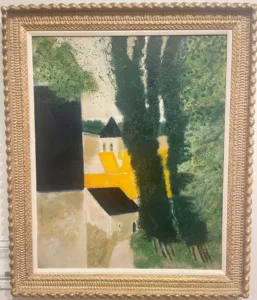
Today's featured artist is André Brailier, whose painting, Village de Bazoches, greets visitors upon entry to the museum.
Brasilier was born in 1929 to a family of artists, in Saumur, France. Saumur was home to a prestigious equestrian school, and as a child, he developed what became a lifelong fascination with horses. To him, their form and energy embodied that of nature itself. Encouraged by his family, he enrolled at the École des Beaux-Arts in Paris at the age of 20 and shortly thereafter began to receive critical acclaim for his work.
He received the Florence Blumenthal Award in 1952 and the Premier Grande Prix de Rome in 1953. He resided at the Villa Medicis in Rome from 1954 to 1957 and traveled a great deal around Europe during those years. He then lived and worked in Paris until his passing just last month.
The first retrospective of Brasilier's work was at the Château de Chenonceau in 1980, with subsequent retrospectives at the Musée Picasso-Château Grimaldi, Russia’s State Hermitage Museum, and the Museum Haus Ludwig in Germany. The most recent retrospective of his life's work was at the Opera Gallery in Paris, France, which ran from March-April, 2025.
As an artist, Brasilier was theoretically and stylistically inspired by Japanese prints and fellow painters Pierre Bonnard, Paul Gaugain and Henri Matisse. It is worth noting that both Bonnard and Matisse, tho not included in the current exhibit, are likewise represented in the overall Fisher Art Collection.
In his more than 7 decades as a practicing artist, Brasilier explored many forms of creative expression beyond painting, including printmaking, theatrical scenery and costumes, mosaics and painted ceramics. And in all of his work, he sought not to replicate what was, but to capture its essence. As he himself stated: "I have a nature that wants to simply. I always try to give the quintessence of a subject with little effect, to say a lot with a little, like Japanese artists..."
The Fisher Art Museum is honored to feature Brasilier's painting, Village de Bazoches, in its current exhibit. An oil on canvas, it is dated 1962. Its flattened planes and daring composition are representative of his abstract, expressionistic style and its color palette reflective of those popular in the early 1960's. But this painting is extra special, because it is unique in subject matter. Known primarily for his pastoral scenes and those of horses and his wife and muse Chantal, there are not many examples of village scenes in his extensive body of work.
Do yourself a favor and visit/revisit the MACC. You'll be glad you did! Marshalltown Arts & Civic Center, 709 S. Center St. #641.758.3005 www.maccia.org
Hours: Wed-Fri (8:30 AM – 4:30 PM) / Second Sat of each month (11:00 AM- 3:00PM)/ Third Thu of each month (4:30 PM – 6:30 PM).
Nancy Jeanne Adams is a local artist and a member of the Fisher Art Museum committee.