
The False Claims Act works
40 years after my False Claims amendments became law, $85 billion and counting have been recovered
Trending
Four decades ago, on Oct. 27, 1986, President Ronald Reagan signed into law my bipartisan updates to the False Claims Act. At the time, I never imagined this sharpened Civil War-era tool would recoup more than $85 billion - and deter untold billions more - from fraudsters seeking to harvest cash from the U.S. Treasury. The law has grown more effective over time. Last fiscal year marked the largest single-year recovery to date, exceeding $6.8 billion and most of that is thanks to patriotic whistleblowers.
President Abraham Lincoln signed the original False Claims Act to combat government contractors bilking the Union Army, fleecing taxpayers and undermining efforts to secure victory in the American Civil War. In just one example, a Union officer purchased 1,000 mules at $119 apiece, but the animals were unfit for service because some were blind and diseased. Lincoln's law incentivized citizens to step up in the fight against fraud by empowering whistleblowers to serve as relators on behalf of the government and file lawsuits, entitling them to receive half of the recovered damages and civil fines. This legal framework originated during the Middle Ages when society relied on ordinary folk to uphold law and order. An abbreviated term for a Latin phrase that means "he who brings an action for the king as well as himself" - qui tam - encourages private citizens with financial incentives to report wrongdoing.
Whistleblowers' valued role in our government dates back well over two centuries. The First Continental Congress passed the first whistleblower law on July 30, 1787. The resolution staked out protections for whistleblowers, underscored Congress' authority over the purse strings and outlined lawmakers' inherent responsibility to guard against wasteful or fraudulent spending.
I hit the ground running during my first term in the U.S. Senate to protect taxpayer dollars. I soon learned one of the best ways to ferret fraud from the bowels of the federal government was to listen to whistleblowers. My door has been open ever since. Thanks to the dogged efforts of Ernie Fitzgerald, a Navy veteran turned Pentagon management analyst, my congressional oversight exposed rampant fiscal mismanagement at the Pentagon. Taxpayers were footing the bill for bloated budgets inflated by defense contractors who charged for $640 toilet seats, $435 hammers and $7,600 coffee pots. Fitzgerald's patriotic quest for the truth fueled my efforts to protect whistleblowers and nip defense contractors' gold rush in the bud.
America needs the eyes and ears of whistleblowers to root out wrongdoing and hold fraudsters accountable for ripping off the taxpayer. My modernized version of the False Claims Act has proven to be the federal government's #1 tool to fight fraud. I've been pleased to see how the Trump administration has made fighting fraud a top priority, including through the launch of the National Fraud Enforcement Division.
Before my 1986 False Claims Act updates, fraudsters faced scant risk to mine federal agencies for cash. The law was gutted during World War II and fraudsters took notice. A 1981 report showed the Justice Department took civil action in only 28 of 393 civil fraud cases referred by other federal agencies. This woefully inadequate response showed fraudsters that crime against the federal government pays.
It was high time to beef up the False Claims Act, empower whistleblowers, hold wrongdoers accountable and protect the taxpayer. My amendments strengthened the law to allow a qui tam plaintiff to receive a portion of the recovery ranging between 15% to 30% of the settlements and judgments.
Over the years, I've urged the federal judiciary and Department of Justice to uphold the law as Congress intended and fought misguided efforts to water down the law that has helped scrape fraud out of defense and healthcare programs, prosecute kickback schemes and flush fraudsters out of the woodwork, including stolen pandemic relief funds.
Every dollar lost to fraud undermines government services for the American people, from housing to medical care, support for veterans, military and first responders, disaster assistance and the farm safety net.
Robust enforcement of anti-fraud tools is more important than ever. Know the numbers:
U.S. national debt exceeds $40 trillion
Federal coffers lose between $233 to $521 billion annually due to fraud
Tax compliance gap exceeds $600 billion and puts law-abiding taxpayers on the hook. I helped launch the private debt collection program in 2004 that's collected more than $3 billion from tax cheats
Since 2006, my updates to the IRS whistleblower program have recovered more than $8 billion
Since 2012, my whistleblower program at the Securities and Exchange Commission has recovered $3.76 billion
Since 2014, my whistleblower program at the Commodities Futures Trading Commission has returned $4 billion
On the 40th anniversary of the updated False Claims Act, I'm proud the law has sharpened the tip of the spear to fight fraud on behalf of American taxpayers. Iowans work hard for their money and I'm working as hard as ever to hold fraudsters who milk the federal treasury like a cash cow accountable.
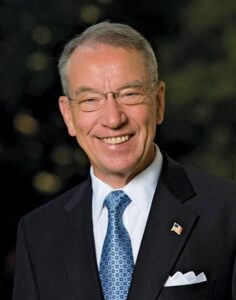
Charles Grassley, a Republican from New Hartford, represents Iowa in the United States Senate.