Sand prairies: Rare landscapes preserved
The MARIETTA SAND PRAIRIE PRESERVE is a unique natural area. It is filled with a wide variety of native plants, some common, some not so common and a few that are so unique that they are classified by botanists as endangered. The story behind the acquisition of this property has a long history, but one that proved to be successful and well worth the effort.
In June of 1983, the first parcel of 17 acres was purchased. The Marshall County Conservation Board had known about the area’s unique plants for well over a decade. Working with the landowner, in due time an agreement was reached. And to secure the money to make the purchase, a special request was made to a longtime Marshall County resident, Janet Paterson. She thought about the project, the land and the goals to conserve this special botanical site. She agreed to fund the entire purchase price for the MCCB. In a special dedication ceremony on Sept. 6, 1984, she was recognized for her generosity in front of a crowd of people, state officials, local officials and many other conservationists.
Several years ago, the property lying north of the preserve tract was purchased by the MCCB using a wildlife habitat grant and several other sources of private funds from foundations and generous individuals. That purchase added 212 acres to the original 17 acres for total of 229. The soils at this site are to say the least very sandy, subject to wind erosion and water erosion if not kept under cover of grass. So the long term plan for these 212 acres has been the steady re-seeding of prairie grasses and forbs to the land. It is working. Additional conversions will take place during the next several years.
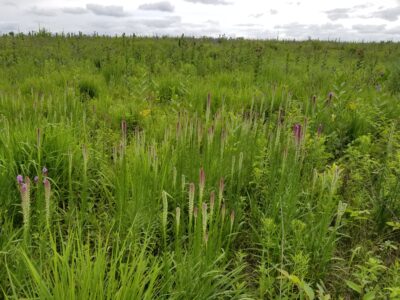
This is public land. It is available for individuals to hike or hunt, study or reflect, photograph or just to watch the wind moving sand lovegrass seed tops each fall as this carpet of fine grasses waves in the wind. School groups come to this area for field trip associated with science classes. University graduate level studies have also used the site for special ecological investigations. The area is open for hunting during seasons as set by the Iowa Department of Natural Resources. Upland game birds are likely to be found here; so are a few wild turkeys and white tail deer.
Iowa has several remnant prairies in several locations statewide. They were set aside long ago, some in the 1930s and 40s, to maintain a bit of the original grassland cover that once was a dominant feature of this land called Iowa. More than 85 percent of Iowa’s vegetative land cover at the time settlement began was tall grass prairie. Thirteen percent of Iowa was forested, and 2 percent was water in rivers, streams, natural lakes and marshes/wetlands.
It was the grasslands, the prairies, that were of intense interest to settlers. The deep dark rich soils were in large part created over many millennia by a climate favorable to native grasses. As they grew and prospered, their deep root system and accumulating organic matter built top soil, lots of it. When it became well known that this land could produce abundant crops, the rush was on. Fast forward to 2015, about 165 years later, and the transformation of Iowa’s native grasslands has been intensive. As the saying goes, “the rest is history.”
Some of Iowa’s native prairies, now in the preserves system, include these names. You may have heard of some of these prairies … such as Kalsow Prairie, Liska-Stanek, Manikowski, Nestor Stiles, Sheeder, Steele, and of course, the Marietta Sand Prairie Preserve. While dark soil loamy prairie remnants are much more common in Iowa, sand prairies tilt to the even rarer side of this equation.
Sand prairies are distinguished by their soil substrate. The sand may have been deposited by either water or wind. The Marietta Sand Prairie’s sand is definitely wind deposited material, the result of intense fall and winter winds blowing off of the Wisconsinan glacier. For thousands of years thereafter as the ice edge slowly melted northward while exposed glacial till mixes of soil patent material was exposed, wind picked up loose material and fine grainy sands. A relentless movement of the sand accumulated in certain regions. One of those regions is the vicinity of the Marietta Sand Prairie Preserve and several sections of land west and north of that location.
Sand prairies are by their very nature dry habitat. Grasses are low growing and scattered in tufts or bunches with perhaps patches of bare sand. While common prairie plants do grow at the Marietta Sand Prairie, other species are not as common. Botanists have surveyed and inventoried this site several times. The list of plant life existing here is extensively documented. Just a sampling of species to be found include big and little bluestem, Indiangrass, sand reedgrass, Junegdrass, tall dropseed, needlegrass, partridge pea, sage, dotted mint, blazing star, birdfoot violet, Missouri goldenrod, savory leaf aster, marsh marigold and many, many others.
This scribe urges and invites you to take a hike … a hike into and through the Marietta Sand Prairie. Take a camera, binoculars, and a field guide or two. Take a friend that finds inspiration in walking on land that has not been transformed by modern day utility. Take time to understand the richness of Iowa’s once extensive native grasslands. And take time to appreciate these remnant jewels of botanical history living and growing right in front of our eyes. It is a history lesson waiting for your to turn its pages of discovery.
q q q
The IOWA STATE PRESERVES ADVISORY BOARD is a seven-member appointed body who know what is important from a history, geological, archaeological, natural, scenic, scientific and educational perspective. Within the broad definition, over many decades of Iowa history, special lands have been dedicated into the preserves system. It is not done lightly. Each site must qualify after close scrutiny by the state ecologist and members of the advisory panel. If an area is deemed worthy of preserve status, the landowner and the preserves board enter into negotiations. Acceptable land uses are defined and management plans developed to maintain the natural character of the site. Once all these hoops are completed, the signature of the governor at a formal dedication is the final step.
By 2007, there were 94 parcels of land in the preserves system. They range is size from less than one acre to 845 acres for a total land area, if combined total about 10,000 acres. Some sites are privately owned, some are owned by private conservation organizations, others are the lands of cities, counties and many are part of or close to state parks or existing wildlife areas.
Marshall County citizens can be proud of the Marietta Sand Prairie Preserve. It is just one jewel of the prairie history waiting for you to learn from and enjoy. To learn more about this special botanical area, contact the MCCB at the Grimes Farm. Pick up an informative brochure to read about sand prairies. Look at the prairie diorama in the nature center and try to find all the various critters that live in the grassland. Then make a special effort to find the Sand Prairie on Knapp Ave. Make it a journey of discovery into native grassland habitat. Enjoy.
q q q
Winged seeds were falling earlier this week, especially during those very windy days. I’m talking about the seeds from maple trees. Botanists call those single “winged” seeds by the name samaras. Samaras are just one kind of seed dispersal technique that mom nature has up her sleeve. For the last several weeks, the flowers of the maple trees have producing a mini-factory of photosynthesis to supply nutrients to the growing seed. The samara shape, that looks a lot like an insect wing with a huge supply of veins all leading toward the hard edge, and that edge terminates at the newly growing seed.
So this past week, the time was right. The maple seeds were ready to fall from the tree. All that was needed was wind to help dislodge the seed pods from all the branch tips. Well, the wind did cooperate. This scribe recalls looking up at the sky only to see the airwaves full of auto-rotating seeds pods circling toward the ground. The appearance was similar to seeing a squadron of helicopters coming in for a landing. With a strong wind, those rotating seeds would disperse far from the parent tree. Rotating seed pods fall slower and give time for the seed to travel farther.
Judging by the total number of brownish seed pods still on the trees, it was apparent that tens of thousands of seeds were produced on just one tree. Multiply that by the vast number of silver maple trees in area forests, home back yards, city streets and area park lands, and there were millions of new maple seeds on the ground.
The next step for a seed is to be lucky enough for it to land in just the right place where it will be undisturbed, able to make soil contact, find moisture and send out a probing tendril to take root. Again if luck is on its side, this little maple seed will become a seedling tree. Perhaps it will even grow to maturity all on its own to repeat the cycle. For trees such as maples, what seems like an overproduction of seeds is the way the game is played … to ensure that just a few will find success.
q q q
Food for thought: There are more stars in the heavens than all the grains of sand on all the beaches of the world and deserts of the world combined.
From that perspective, our earth and its immediate spot in the vast solar system is very, very small.
—
Garry Brandenburg is a graduate of Iowa State University with BS degree in Fish & Wildlife Biology. He is the retired director of the Marshall County Conservation Board. Contact him at P.O. Box 96, Albion, Iowa 50005