
Round River: So smart!
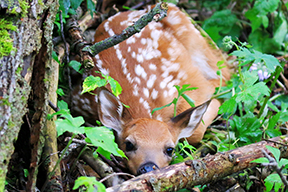
PHOTOS BY LARRY REIS/USED WITH PERMISSION — Spots, scent reduction, and the ability to remain perfectly still help young fawns survive their earliest days in the wild.
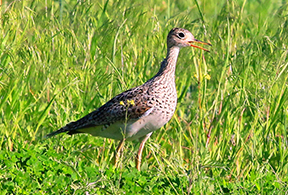
With no map and no compass, the upland sandpiper journeys thousands of miles between continents — one of nature’s quiet masters of migration.
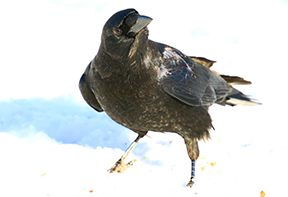
Curious and clever, the American crow can solve problems, use tools, and even recognize human faces.
PHOTOS BY LARRY REIS/USED WITH PERMISSION — Spots, scent reduction, and the ability to remain perfectly still help young fawns survive their earliest days in the wild.
With no map and no compass, the upland sandpiper journeys thousands of miles between continents — one of nature’s quiet masters of migration.
Curious and clever, the American crow can solve problems, use tools, and even recognize human faces.
Trending
The other day, while driving Interstate 35, we noticed a coyote standing in the ditch waiting to cross the road. It looked South, then North, then South again. The road was busy with traffic, and I said, "Turn around, buddy!" I'd like to think I can talk to animals, because he did actually turn around. In all honesty, I know that it was smart enough to recognize the danger and to wait for a better time to cross.
Often, we humans take animals' intelligence for granted. Working in the conservation field for over 20 years, I have witnessed just how smart wild animals truly are. Humans tend to anthropomorphize animals, attributing human characteristics or behaviors to them. But animals are not humans, and animals adapt to their environment, or they do not survive.
A perfect example of this is the annual spring phone calls about baby cottontail bunnies and white-tailed deer fawns. Soon, we will receive phone calls from well-intentioned people who have found what they believe to be abandoned young in need of rehabilitation. Good intentioned as it might be, the young are better off in the hands of nature than in the hands of a human.
Cottontail rabbits will soon begin nesting. Their nests are usually just shallow depressions in the ground, covered with soft grasses and lined with the mother's fur. Often, when we find these nests, no adult rabbit is present. This is completely normal. The doe, or female rabbit, feeds her young only twice a day, at dawn and dusk. She is not lazy; instead, she stays away to protect her young, who cannot move quickly, so as not to attract predators to the nest. If you worry the nest is abandoned, place a small stick over the grass and check the next day if it has moved.
Between 2 and 3 weeks of age, the young leave the nest, and at 3 weeks they are on their own in the wild. So yes, that is one small rabbit, but if its eyes are open and it is bounding around outside its nest, it is good to go!
Deer have similar ways of protecting their wobbly-kneed fawns. Since they are not capable of the same graceful movements as their parents, fawns stay hunkered down for most of the day. The young are checked on and fed only when needed, and then are moved to a new location if the doe doesn't feel the area is safe. In fact, fawns are born without a scent. A doe goes to extreme measures to keep her young from smelling, even consuming the fawn's waste to hide the scent. Their camouflage is also key to helping protect them from predators. Fawns are born with instincts to lie perfectly still until their mama tells them otherwise. Wouldn't it be nice if young humans were the same way? If you don't smell, don't move, and blend into your environment, you've done everything possible to survive. So again, is that fawn abandoned? No, probably not; it is just following its natural instincts to survive.
That intelligence doesn't end with youth; there is a reason why that big buck goes missing during hunting season; he has outwitted his predators for years. He knows how to stay safe and has a place to hide until hunting season ends. He is smart.
When you take time to watch and observe nature, you begin to see the depth of its knowledge and problem-solving. One time, we were paddling the Iowa River and found a pile of freshwater mussels stacked on the shoreline. My first instinct was to think, "Why would a human do this?" But after looking around, it was clear this was the work of an otter. Opening freshwater mussels is not easy, but otters weaken them by removing them from the water. The mussels begin to open as they try to return to the water, making them easier to eat. If the otter puts them far enough away from the water, the mussels won't reach safety before being eaten. This is a perfect example of working smarter, not harder!
It isn't just mammals that show their intellect. Crows have advanced cognitive abilities. They can create tools to get food, understand cause and effect, and learn by watching other crows. Studies also show that crows recognize the faces of humans who have fed or mistreated them, and crows hold grudges. So be nice to that crow in your backyard!
Many know that crows are smart, but did you know that sparrows and barn swallows are also intelligent? Some sparrows have figured out that by flying past sensors that open doors to restaurants, malls, and grocery stores, they can access the food inside. Barn Swallows have learned that they can trigger sensors in enclosed car parking areas, allowing them to enter and build nests protected from the elements and many predators.
If you asked someone on the street, "What is the smartest animal in the world?" most people would probably answer, without hesitation, "Humans." We often see ourselves as the most intelligent species because we define intelligence by the things we do well and then judge animals by those same standards. But what if we turned that idea around? What if we compared our abilities to the things animals excel at instead? And what if we measured intelligence through traits like problem-solving, social intelligence, memory, and self-awareness?
For example, if you asked me to bury 5,000 acorns in the woods this fall, then find 2,500 in the spring, it wouldn't happen. Some days, I forget my kids' ages! I know I wouldn't beat a squirrel at that challenge.
Here's another one. Can you sprint through woods at night without a flashlight? Nope, not possible. Big Brown bats fly at 20 to 40 mph in the woods. The average human sprints at 14 mph; Usain Bolt sprints at 27 mph, but not at night in the woods. Bats' quick sensory processing and spatial memory are challenges we can't match.
How about traveling thousands of miles using only the landmarks you memorized six months ago? No map, no Google, just instincts. I get lost in a large parking lot, so don't ask me to lead! Maybe ask an Upland Sandpiper that leaves Iowa each year to overwinter in Paraguay and returns to the same area each Spring.
We often consider animals that can talk like us, like parrots, act like us, like chimpanzees, or show emotion like us, like elephants, to be the most intelligent species after humans. But maybe that way of thinking simply reflects how we see the world, through our own rose colored lens. Animals may not have written language, schools, or governments, yet they solve problems, protect their young, adapt to change, and survive and thrive in ways we often cannot.
Instead of measuring their intelligence by our standards, maybe we should appreciate it for what it is. When we take the time to observe and respect the natural world, we begin to see that intelligence comes in many forms. Maybe being truly smart isn't about ranking ourselves at the top, but about having the humility to notice and appreciate the brilliance all around us. And perhaps true wisdom lies not in declaring ourselves the smartest species, but in recognizing how much we can still learn.
Upcoming Events
In the Brown Bag Bunch program From Ice Age to Hedgerows: The History of the Osage Orange, Melissa Burdick, Executive Director of the Brenton Arboretum, invites us to discover one of North America's most curious and charismatic trees on Tuesday, March 24, from 11:30 a.m. to 12:30 p.m. at the Grimes Farm Conservation Center.
Through engaging visuals, stories, and science, this presentation explores the Osage orange's unusual fruit, remarkable strength, deep cultural history, and surprising ecological role. Equal parts informative and playful, it reveals how this often-misunderstood tree has shaped landscapes, supported wildlife, and captured human imagination for centuries--proving that even the strangest trees have extraordinary stories to tell.
There is no registration fee, but participants are asked to register by calling the nature center at 641-752-5490.
Come Help Celebrate Iowa's Outdoor Day 2026 at the Iowa State Capitol on March 24, beginning at 10:00 a.m. through 2:00 p.m. Come to the Capitol for interactive displays, speakers, and to connect with legislators for Celebrate Iowa's Outdoors Day!
Iowa's parks, trails, wildlife, soil, and water are all part of our quality of life and cause for celebration! Connect with legislators and meet other Iowans passionate about protecting spaces for outdoor recreation and caring for our natural resources. The day will feature:
• A complimentary lunch
• Interactive displays
• Engaging speakers
• The opportunity to share your own motivations for celebration
Children and families are welcome. There will be activities for all ages to enjoy. This is a free event, but registration is appreciated. Come for any or all of the day. All are welcome! Register on Eventbrite.
-------
Emily Herring is the director of the
Marshall County Conservation Board (MCCB).