
Round River: What good is a bat?
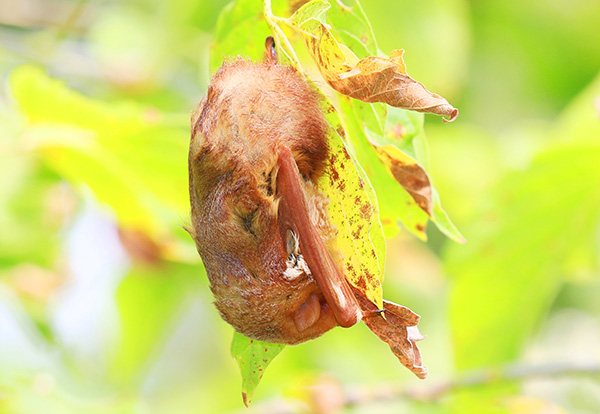
CONTRIBUTED PHOTOS — An Eastern Red Bat rests among tree foliage, its rich reddish fur providing natural camouflage as it roosts during the day. It is the second most common bat species in central Iowa.
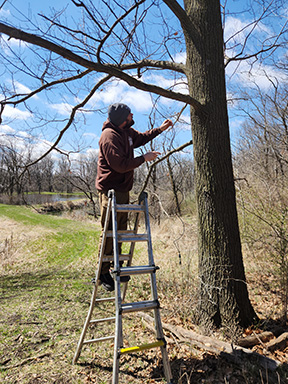
Marshall County Conservation staff install bat monitoring equipment in a local wildlife area, supporting efforts to track and protect native bat populations.
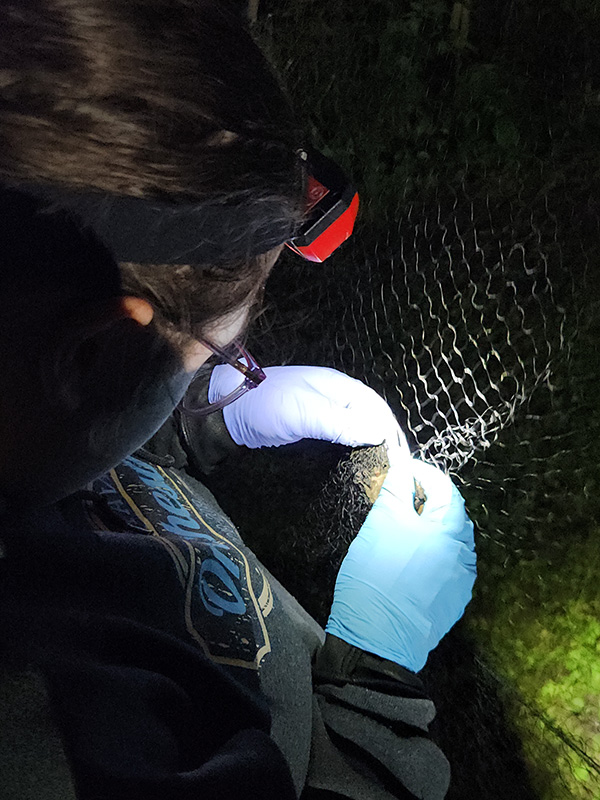
A Central College student carefully removes a Big Brown Bat from a mist net at Timmons Grove, assisting with local bat monitoring and research efforts.
CONTRIBUTED PHOTOS — An Eastern Red Bat rests among tree foliage, its rich reddish fur providing natural camouflage as it roosts during the day. It is the second most common bat species in central Iowa.
Marshall County Conservation staff install bat monitoring equipment in a local wildlife area, supporting efforts to track and protect native bat populations.
A Central College student carefully removes a Big Brown Bat from a mist net at Timmons Grove, assisting with local bat monitoring and research efforts.
Trending
People often ask, "What good are mosquitoes, poison ivy, or any creature humans find pestering, harmful, or unattractive?" My mind immediately recalls Aldo Leopold's quote from Round River: "The last word in ignorance is the man who says of an animal or plant, 'What good is it?'"
The quote, harsh and perhaps never meant for others, was written in his journal. After his passing, his children published his thoughts, and I'm glad they did. They remind us that all living creatures, cute or not, play vital roles in the planet's ecosystem. It also reminds me that in conservation, our job is never done. Ignorance is simply a lack of knowledge; if someone is willing to learn, it is up to conservationists to educate.
Bats often fall into the "unattractive" category, yet they are ecologically essential. Recent discussions about bats emphasize the need for better public understanding. Where better to start than the outdoors section of the local newspaper?
First, let's address concerns about rabies. Around the world, 59,000 people die from rabies every year, with 99% of cases resulting from dog bites, and nearly all occurring outside the United States. In the last seven years, five people in the United States have died from bat-related rabies, less than one per year. By comparison, cows kill an average of 20 to 22 people annually in the United States, yet most don't run screaming from cows. Don't get me started on mosquitoes and how many people they kill. If only there were native animals flying around who could eat all of those mosquitoes. Our irrational fear of bats results from misunderstanding and the misconception that bats will attack. Trust me, the last thing an .8 ounce animal wants is to fight something 4,000 times its weight.
And no, we do not have Vampire Bats in Iowa.
Bats fall into the order Chiroptera, and all the bats in Iowa are in the suborder Microchiroptera or microbats. Microbats are small, less than six inches long, about the size of a goldfinch, feed on insects, and use echolocation. Echolocation is the use of high-frequency, ultrasonic pulses to navigate and hunt by listening to returning echoes. Bats' echolocation is so precise that they can locate something the width of a human's hair.
Bats use their extraordinary echolocation to consume, on average, 6,000 to 8,000 insects each night. This makes them highly effective natural pest controllers, not only reducing mosquito populations but also helping control agricultural pests such as corn earworm moths, cutworms, cucumber beetles, stink bugs, and leafhoppers that damage crops. By eating these insects, bats protect crops and reduce the need for chemical pesticides. It is estimated that bats save $850 million in corn crops in the United States each year. Studies show that preventing bats from hunting in a single corn field leads to a 60% increase in earworms and 50% more crop damage. Furthermore, bats eat insects that often carry fungus that damages crops, so crops protected by bats have fewer corn kernels affected by fungus.
Iowa is home to nine bat species, including the big brown bat (Eptesicus fuscus), which is most common in Marshall County. However, bats are declining rapidly. If trends continue, an estimated 53% of bat species could become extinct in the next 15 years. Two species in Iowa, the Indiana bat (Myotis sodalis) and Northern long-eared bat (Myotis septentrionalis), are federally endangered and have both been found in Marshall County. The little brown bat (Myotis lucifugus), tri-colored bat (Perimyotis subflavus), and Northern long-eared bat have also experienced sharp declines, with some regions reporting a 90% decrease in their populations.
Humans are the main cause of bat decline due to habitat destruction, worsening climate change, and increased wind turbine use. Climate change brings unseasonable heat and drought, causing mass mortality, lower reproduction, and disrupted hibernation. Rising temperatures dehydrate bats, while shifting weather disrupts insect availability and migration.
Habitat loss, driven by deforestation, urbanization, and agriculture, destroys bats' roosts and foraging areas. It disrupts migration, reduces food availability, and pushes bats into less suitable spaces, such as homes, lowering their survival rates.
Wind turbines cause significant bat mortality, with hundreds of thousands dying annually in North America alone due to collisions and barotrauma. Barotrauma is when a bat passes by an industrial windmill and the air pressure changes so rapidly that it causes the bat's lungs to rupture, creating fatal internal injuries. Fatalities peak during autumn migration and on low-wind nights, as bats may be attracted to turbines for roosting or foraging. Tree-roosting bats like the Hoary Bat (Lasiurus cinereus), Silver-haired bats (Lasionycteris noctivagans), and Red Bat (Lasiurus borealis) are at high risk for fatality caused by wind turbines. Experts predict that four bat species will lose more than half of their populations to collisions with wind turbines over the next 15 years if effective conservation measures are not taken.
In 2006, white-nose syndrome appeared in the United States, devastating hibernating bats. A white fungus grows on their nose, ears, and wings, irritating them and waking them through hibernation, which burns critical fat. This repeated waking causes starvation, and in the United States, 6 to 7 million bats have died as a result. Little brown bats, tri-colored bats, and northern long-eared bats are among those most affected.
Unlike many types of small mammals, bats are not quick to replenish their population. Because of this, they are long-lived mammals, living up to 40 years in the wild. However, as threats increase, they cannot replace their population quickly enough. With current losses, scientists believe that it will take centuries for bat populations to recover.
Many of the bat species whose populations are declining are found in Marshall County. Marshall County Conservation wants to ensure we manage our areas to provide suitable habitat for all local bat species. As part of this goal, Marshall County Conservation applied for and received a grant to purchase bat-monitoring equipment. The goal of this grant is to identify bat species in Conservation areas using ultrasonic acoustic recorders. These devices record echolocation. Each bat species has a unique call pattern, frequency, and timing. Using a computer program, we can identify the species by the recorded echolocation call. We are excited about the outcome of this study!
Anyone can help bats! Here are some great ways to help bats even in your own backyard:
• Leave old trees standing, they're nature's bat houses.
• Trim trees from late fall to early spring to avoid harming bat pups.
• Reduce pesticide use, plant native gardens, and provide water if possible.
• Keep cats indoors to protect bats and other wildlife.
• If bats are in your home, call wildlife experts to safely exclude them.
• Try to reduce your energy and carbon footprint, seek sustainable forest products, and buy local.
Bats may never win a popularity contest, but their value isn't measured by appearance or reputation. Each night, unseen and often unappreciated, they protect our crops, balance our ecosystems, and quietly support the world we depend on. Aldo Leopold's words still ring true, asking, "What good is it?" reveals more about our understanding than the species itself. The better question is not what bats are good for, but whether we are willing to recognize their worth and ensure they remain part of our landscape for generations to come.
-------
Emily Herring is the Marshall County
Conservation director.