Where the deer, antelope, prairie dogs and bison roam
WILDLIFE ADVENTURES are cool happenings. Periodically, a foray to familiar places is a good thing to recall past times and see again some iconic wildlife.
With cameras at hand and time on our side, my wife and I took time recently to explore several places while going to and from the Black Hills of South Dakota. It was time well spent for several reasons. It reaffirmed our interest in people, places and nature’s bounty.
Today’s images show just a small portion of things we observed. All along the way to and from the Black Hills, we traversed lots of farmland landscapes in Iowa and Nebraska. Seeing the differences in land uses between eastern Nebraska, it was also interesting to view contrasts
with its central sand hills and prairie grasslands.
More miles to the west were the bluff lands of the Nebraska National Forest. Even more miles northwest of Crawford we explored the Oglala National Grasslands and one of its geological attractions, Toadstool Geologic Park.
Toadstool Geologic Park is an out of the normal pathway of many tourists. However, the park campground had a good representation of campers from many states. And they were interested, as I was, in the one mile loop hiking trail to learn about this unique landscape of ancient rivers.
Now exposed are 24 – 30 million year old deposits of muds and volcanic ash. The land was sculpted by wind, water and lots of time, to create badlands type vistas. Softer claystone layers were interspersed with more resistant sandstones.
Wind and water eroded the claystone and left pedestals of sandstones on top of pillar-like formations. Early settlers and travelers likened these remnants to toadstools, thus its name used today.
This area is full of animal tracks left in volcanic ash layers, now preserved in the rock layers. The rocks do not lie. They tell the truth about ancient times between 38 to 24 million years ago. Roaming this ancient landscape were the ancestors to dogs, cats, horses, camels and deer. Less familiar to us were huge animals called Titanotheres, a distant relative of the rhinoceros.
A predatory large pig type critter named by archeologists as the Entelodont would have caused great fear to any animal not able to escape its jaws. Tracks left in muds and volcanic ash testify to their life along ancient rivers that existed here long ago.
Our next stop was in Custer, South Dakota to settle into our Bed and Breakfast home. Peace and quiet awaited us and afforded a new place to call home while we explored nearby Custer State Park and Wind Cave National Park.
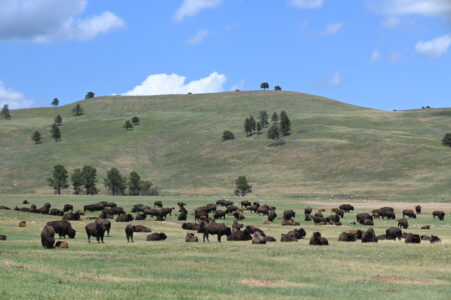
It was in those places that winding roadway through forested land gave away gradually to more open grasslands. It was not long before interesting gravel roads lead us to bison sightings.
We were rewarded with not just a few fluffy buffalo, but hundreds of bison in several herds, many close to the roadway, and in settings filled with great photo making times. I indulged myself with a long lens.
The mere sighting of large bison herds was thrilling. They were content and obviously very much at home on their range.
At a bison barn nature center we stopped for a bit of a walk-about and casual conversation with many other tourists. It was fun to chat with folks from all over the country.
I asked a volunteer host at the greeting desk what was one of her most memorable moments at her job. She thought for a moment and then said, “The busload of inner city folks from New York City. They had boarded a bus in a downtown skyscraper filled with concrete jungles to go on an adventure to the Black Hills. Many had never even heard of that destination. All along the way, their views out the windows of the bus showed them farmlands of Pennsylvania, then Ohio and Indiana. Just as they thought corn fields had to end, they observed more very open farmlands of Illinois, Iowa, Minnesota and eastern South Dakota. These landscapes were amazing and totally reset their thoughts about the Midwest. New Yorker city folks commented on seeing glorious sunrises and sunsets with horizons crisp and clear, something they hardly ever observed back home. They recalled the expanses of the Mississippi River and the Missouri River as the interstate highway bridges crossed these huge rivers.”
“And then came the view of the Black Hills of western South Dakota. The bus stopped in Rapid City for hotel rooms. The next day these New York people re-boarded their tour bus for a drive through Custer State Park. Their goal was to see wildlife and unique landscapes of rolling hills of grass. They were rewarded with a fantastic immersion into parts of the USA they could only have dreamed about, read about, but never thought they would ever see during their lifetime.”
I thanked the host receptionist for her comments. She smiled and said “It is all part of her job, to welcome and educate people to this wonderful country.”
I will add that the old country song lyrics are appropriate. Where the deer and antelope play is a good place to visit.
——-
In the State of Utah, their legislature passed a law requiring non-consumptive users of wildlife management public lands to pony up with money if they are going to recreate at these places. Traditionally, hunters and fishermen/women have gladly paid the price of admission by buying hunting and fishing licenses.
The hunters and fishers understand that the places they cherish the most are not free. The lands need to be managed by skilled folks hired by the natural resource agencies. Buying a hunting or fishing license is okay with them.
Utah, like many states, has state parks. Funding is largely supported by appropriations from the legislature.
Now note the difference of lands called wildlife management areas. These are not funded by tax dollars. Funding comes from hunting and fishing licenses sold and in part by cost share federal funds through the Federal Aid in Wildlife Restoration Act.
Utah leaders wanted to broaden the scope of funding sources because too many non hunters and non fisher folks were using the lands without any financial skin in the game. Utah’s new law took effect in May 2025 — pay to play philosophy at work.
Well, some people objected. It is not that educational public notices went unnoticed. The negative impact to some wildlife management areas located closer to city centers had to be addressed.
Utah chose to require hunting or fishing licenses, even if they did not engage in these activities. It was clearly pointed out that wildlife management areas (WMA) are a different type of public land than state parks.
One is for wildlife first and people second. Parks are built and maintained for people first and wildlife a close second.
Utah’s situation came about due in some cases of unauthorized mountain bike trails established in WMA where this type of use is clearly not what these lands were acquired for. So Utah officials are denying access to users who have non-wildlife recreation as their motive.
Montana residents and non-residents have a slightly different approach. Their mechanism is to have non-consumptive users purchase a special license not tied to hunting or fishing.
In South Dakota, a one day park access permit, or a seven day permit or an annual permit sticker may be purchased that allows access to any South Dakota State Park. This vehicle sticker mechanism has been in force for at least the last 70 years and is well ingrained and accepted as a funding mechanism. It works well for them.
Iowa attempted to sell similar vehicle passes about 40 years ago. It lasted for about two years and was withdrawn due to too many complaints from some members of the public.
Iowa legislators back then should have held fast and allowed that process to become established and accepted. In hindsight, not enough promotion, advertising and explanation of how that new funding stream would have helped Iowa State Parks in the long run would have been a good thing.
A full story about Utah’s experiment in funding scenarios can be found at the website http://thevenatic.beehiv.com/p/new-utah-law-calls-on-non-consumptiveusers.
The newsletter titled The Venatic is a nationwide collection of natural resource stories, good uses and sometimes abuses that draw attention to the good, the bad and ugly. I find their stories fact filled and informative.
——–
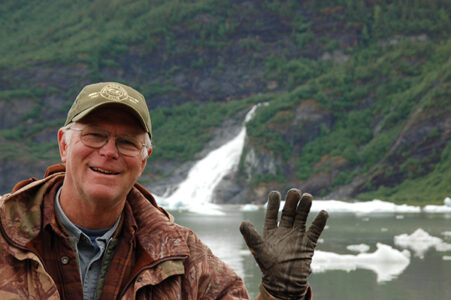
Garry Brandenburg is the retired director of the Marshall County Conservation Board. He is a graduate of Iowa State University with a BS degree in Fish & Wildlife Biology.
Contact him at:
P.O. Box 96
Albion, IA 50005
-
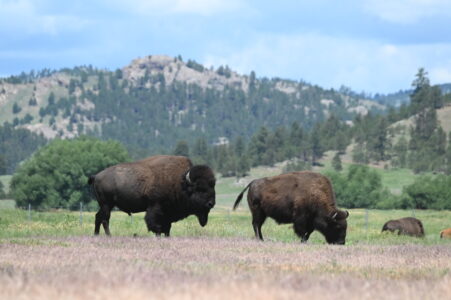
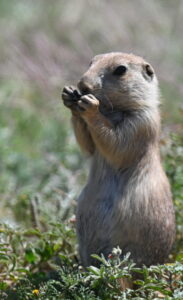
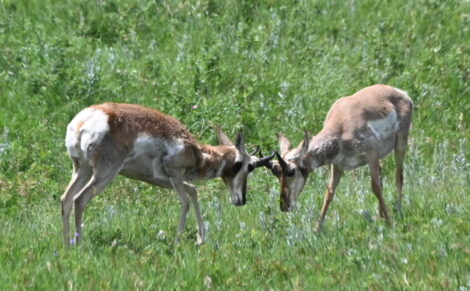
- PHOTOS BY GARRY BRANDENBURG — The old western song titled “Home on the Range” has a line denoting “where the deer and antelope play.” During our recent vacation/business excursion to the Black Hills of South Dakota, we took time to explore a small portion of Custer State Park and Wind Cave National Park. Yes, we did see deer. Yes, we did see antelope. Yes, we did see prairie dogs. And yes, we did see bison, lots of them. In fact, hundreds of bison in several large herds were spotted at grasslands inside Wind Cave and Custer State Park. All these opportunities for a wildlife photographer were put to good use. Bison are large charismatic critters that help us humans recall long ago times when history books tell of 40 to 60 million bison across a wide expanse of the United States prior to settlement. It is hard to imagine a landscape of prairie grasslands across the Midwest and mountain states so filled with this iconic species. It is good to know that the bison as a species is doing well in managed environments.