Round River: Heartbeat
By EMILY HERRING
ne of my favorite times of the year is when winter begins to fade and spring begins to shine. Last weekend was a beautiful preview of spring. Don’t get me wrong, I know it is just a preview, but it sure felt nice to feel the spring sunshine. These warm days and cool nights awaken our desires to venture outside; they also awaken life in the timber. The woods begin to stir, waking from a long sleep, their energy slowly returning with each sun ray. I love this time of year in the woods in part because of the warmer temperatures, but also because it is time for sugaring.
Sugaring is the process of making maple syrup, which occurs only for a very short period during the warming of spring. Yes, the end result is a delicious jar of maple syrup, but for me, the journey there is a delicious sensory experience in itself.
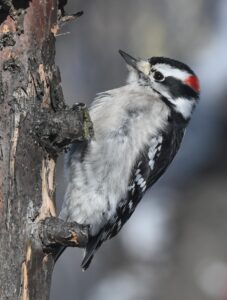
This past weekend, we coaxed, okay, told our children that they needed to go and help collect maple sap with us. (Yes, even our children who are very comfortable in the outdoors often need a nudge to get outside!) It was a beautiful day, and the trees were feeling generous with their sap. After emptying multiple buckets, my daughter and I stopped and listened to the forest. The woods were calm, and we felt the warm sun soaking into our bones. With the exception of an occasional woodpecker or jay heckling our presence, the woods were quiet. As we stilled to take in the peace, we heard an almost nonexistent thumping as drops of sap hit the bottom of the empty buckets. My daughter smiled and said, “It sounds just like a heartbeat.” Ever since that comment, she has got me thinking, as young people often do when we take the time to truly listen to them: Do trees have heartbeats?
If you do a quick search online, you will find that scientific studies show trees actually do have something similar to a heartbeat. A tree expands and contracts, pumping water from its roots up and through its vascular system. Although they do not “beat” as often as humans, tree heartbeats work much like ours. The tree transports much-needed water, sugar, and nutrients to all its parts. Similarly, a human heart pumps oxygenated blood through the circulatory system to every part of the body. Lucky for us humans, the water circulating through the tree picks up sugars, 2 to 4 %, that the tree has been storing all winter. This sugar water serves as a base for one of nature’s sweetest gifts.
For us, the sugaring process began with the tapping of maple trees the first week in February. We chose this time period because the forecast showed daytime temperatures would remain consistently above freezing, while nighttime temperatures would fall below freezing, at least for a while! Although many maple species can be tapped, including sugar maple, black maple, silver maple, red maple, and Manitoba maple (boxelder), sugar maples are preferred because their sap contains higher sugar levels.
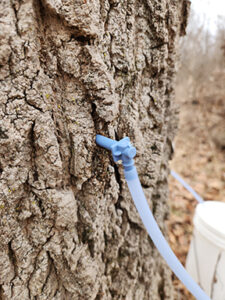
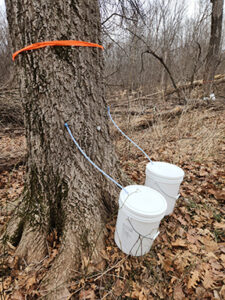
When we tap trees, we use a drill to create a small, upward-slanted hole. Depending on the diameter of a tree, you can drill one to three holes. Next, you gently tap the spile into the hole and attach a tube. The tube runs into a bucket, where the thump, thump, thump of sap drips throughout the day, filling it with the promise of maple syrup.
Carrying five-gallon buckets full of sap from the woods can get your heart racing, but once you get home, the transformation can begin. The process is not quick, but it is amazing to watch. We cook our sap outside over a fire fueled by wood. Neuroscientists believe that scent has the strongest ties to memory because the olfactory bulb connects directly to the hippocampus and amygdala, two regions of the brain that govern memory and emotion. It is no surprise, then, that the warmth and smell of the fire send me back to happy times spent around the campfire with family and friends. Keeping a steady fire rolling all day is the goal, evaporating water from the diluted sugar as quickly as possible. As the day slips into evening, the sap slowly darkens until, at last, it reaches the moment when a beautiful, golden syrup forms.
We quickly filter, reheat, and bottle the sweet, labor-of-love treat. Some bottles are shared with friends and family, while much of the syrup ends up on pancakes, ice cream, or yogurt at our own home. I do not know if our syrup truly tastes better than store-bought real maple syrup, or if the effort behind it simply makes it seem that way, but I swear, it is the best maple syrup.
Soon, the cold weather will fade, temperatures will rise again, and maybe, just maybe, we will get another sap run and our journey will begin anew. Eventually, warm days and nights will coax the trees to swell their buds, the window for collecting sweet sap will close, and sugaring season will end as quickly as it began. Yet the proof of our hard work will be tucked safely away in our pantry, waiting for the next stack of pancakes.
In the end, sugaring is about much more than producing syrup; it is about slowing down long enough to listen to the drip of sap, the crackle of fire, and the quiet heartbeat of the trees awakening from winter. Each jar holds not just sweetness, but the steady pulse of early spring, captured in amber, reminding us that nature works best when we let it keep its rhythm.
If you’re interested in making your own maple syrup, contact Marshall County Conservation. Depending on available supplies, maple sap and instructions for creating maple syrup at home may be provided. To learn more, call 641-752-5490 or email mccb@marshallcountyia.gov.
Join Marshall County Conservation as they celebrate the sweet season of maple sugaring with a Pancake Feed Fundraiser! Come learn about the art of making maple syrup and enjoy a delicious stack of flapjacks topped with real maple syrup, made from trees at Grammer Grove and served fresh at the Grimes Farm Conservation Center.
Your ticket includes: Three fluffy pancakes, two savory sausage links, locally harvested maple syrup, and a refreshing drink. From tree to table, this is one sweet treat you won’t want to miss! Tickets can be purchased at the Grimes Farm Conservation Center and Treasurer’s or Auditor’s Office at the Marshall County Courthouse.
$6.00 in advance, $7.00 at the door. Any questions, please call 641-752-5490.
——-
Emily Herring is the director of the
Marshall County Conservation Board (MCCB).
-
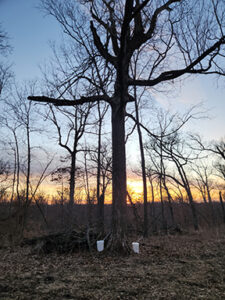
- PHOTOS BY EMILY HERRING — A tapped maple tree fitted with a plastic spile and tubing collects sap into a bucket; the clear liquid will later be boiled down into rich maple syrup, with the sap flow depending on weather and tree conditions.