Round River: Friend or foe?
“The Indians know how to fire the prairie with great skill and how to take advantage of a favorable wind. Despite the fact that all around the village the grass was burned, the cornfields nearby were unharmed.” – Paul Wilhelm, Travels in North America, 1822-1824.
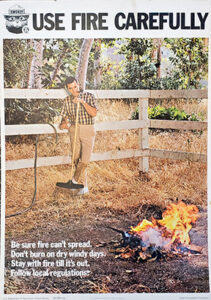
You may have seen the news last weekend about a massive, 3,500-acre wildfire in Woodbury County (southeast of Sioux City). The fire, which was caused by a brush pile burn that re-ignited days later after thought extinguished, jumped Highway 20 and ran for seven miles, burning down two residences and as many as 20 outbuildings. Forty-two fire departments from three different states and over 270 personnel cooperated to get the fire under control.
If it seems like you’ve been hearing about out-of-control field fires and red flag warnings at an increasing rate lately, I agree. In the last two months alone, there have been several news reports of larger-than-usual brush fires across Iowa. In mid-March, the Iowa DNR sent two fire engines and crews to assist with megafires in western Nebraska as a collaborative effort between neighboring states. According to Jim Lee with the DSM National Weather Service, the number of red flag warnings issued in central Iowa so far is already up to six in the first three months of 2026. Comparatively, they issued four red flag warnings in 2025, and three in 2024 during the same time period – a 50-100% increase respectively. And, in case you missed it, in April of 2023 the Loess Hills State Forest experienced a 2,300-acre conflagration which started from a burn barrel that killed swaths of mature bur oak trees leaving a moonscape in its wake. State officials called it a “stand-replacing” fire, a term usually reserved for western pine stands.
The Cedar Rapids Gazette recently updated an article entitled, “Wildfires in Iowa? Experts say it’s an overlooked threat.” Highlighted in that article was an interactive mapping tool developed by the Iowa Environmental Council called the “Interactive Climate Change and Environmental Health Map,” which was first published in February 2025. The tool calculates specific locations in Iowa with elevated wildfire risk, among other things. Alarmingly, an area with one of the highest wildfire risks in Iowa was Woodbury County, coming in at the 92nd percentile of risk (very high). Much closer to home are portions of Tama County and Belle Plaine coming in at the 87th and 89th percentiles.
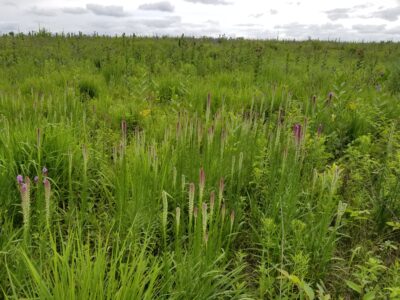
All of this is not to say that fire is universally bad. If you grew up in the Midwest, you probably heard tales of early pioneers braving the wild prairie fires which could move “as fast as a horse could run.” We know that fire was an inevitable fact of life on the prairie. And in the modern era, most folks understand the integral role that fire plays in maintaining the health of grassland habitat.
Fire rejuvenates the prairie ecosystem in a number of ways: it kills woody encroachment (trees & shrubs) which would otherwise succeed in our temperate, humid climate. It’s also successful in knocking back invasive plants that aren’t adapted to frequent fire, such as smooth brome, Canada thistle, sweet clover, Queen Anne’s lace, purple loosestrife, etc. Fire recycles nutrients back into the soil by converting plant litter into nutrient-rich ash. Nitrogen, phosphorus, potassium, calcium, magnesium, and sulfur are all released to the soil, making them available for plant growth. After a burn, the black charred surface attracts sunlight and heats the soil, increasing microbial and plant activity. Experienced practitioners know the feeling of satisfaction they get from watching the explosion of regrowth and increased flowering after a well-timed prairie burn.
The widespread and prevalent use of fire by Native Americans is well-documented, if not well-known among today’s generations. Many falsely believe that most “prehistoric” prairie fires were the result of natural sources such as lightning strikes. And while that may have occurred sporadically, especially in the West, the cause of most historic midwestern prairie fires were the same back then as they are today: humans.
A 2021 study by researchers in Illinois looked at a 232-year record of prairie fires in eight midwestern states (Iowa, Missouri, Minnesota, Illinois, etc.). They analyzed historic records and written accounts of 795 fires that occurred from 1673 to 1905, studying minute details such as the timing, origin of the fire, area burned, attributable deaths to humans & livestock, etc. Their findings shed interesting light and dispel many common false assumptions about fires in North American grasslands. Of the hundreds of first-person accounts analyzed, only five prairie fires were ignited by lightning. Most fires occurred in the fall, during a 2- to 3-week window in the months of October and November, what the settlers called the “Indian summer.” Interestingly, the researchers also determined that most fires occurred when winds were out of the south or southwest.
Early French explorers noted the widespread use of fire by Native Americans. Their journals and written accounts by early settlers, plus experts on the subject cite several reasons that Native Americans deliberately “fired” the prairies. These include improving conditions for hunting, agriculture, for warfare, safety, or harassment of enemies, for signaling, to improve foraging for berries or food, and even things like insect control – think chiggers or ticks. The researchers in the Illinois study also highlighted the fact that as Native American populations plummeted due to disease and displacement, early European settlers took the torch and continued the practice of burning all the way up through about the 1850’s. After that, the landscape became so densely settled and fragmented by railroads and farm fields, that the continental-scale fires that had shaped the plains for millennia ceased to occur almost instantaneously.
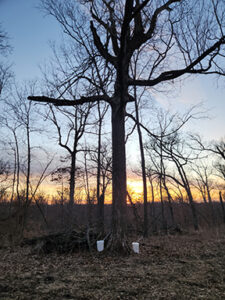
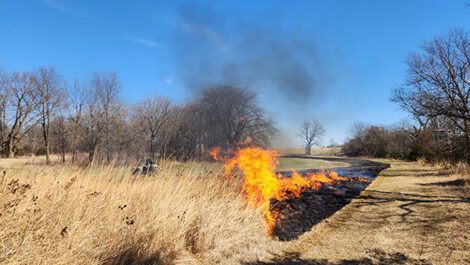
Natural Resource managers have since reintroduced fire to prairie reconstructions and oak savannas in recent decades. Prescribed burning has become a routine tool in the ecological manager’s fight against unwanted vegetation, woody succession, and herbaceous biodiversity. Tyler Renze, Natural Resource Manager for Marshall County Conservation, said county staff burned around 400 acres last year, citing that as typical for them. Burning rotations are usually anywhere from 1-3-year cycles, depending on the habitat type and objectives. So far this year, they’ve knocked out small burns on about four of the conservation areas, with much more in their crosshairs yet to do. Weather is always the biggest challenge, but talk to any burn practitioner and they’ll tell you that increasing urbanization has made burning more of a challenge to avoid conflicts between smoke, people, and livestock.
In visiting with Tyler about the apparent uptick in recent brush fires, he made a comment to me that stood out. It wasn’t about droughty weather or an increase in red flag warning conditions; rather, it was a simple comment about the increase in brush piles. “It just seems like since the derecho, there’s so much more dead wood on the ground and in piles.” This makes a lot of sense to me. Not just the derecho, but the amount of dead ash trees caused by Emerald Ash Borer, and soaring rates of oak mortality documented by the USFS in Iowa. These three factors are nearly a perfect storm of built-up fuels that are almost too tempting to your typical landowner. Clean up the mess, put it in a pile, light a match.
But with respect to your local hard-working Volunteer Fire Departments all across rural Iowa: make sure you do it under the right weather conditions (snow helps), and don’t leave it unattended.
———-
Upcoming events:
— Night Prairie Burn (pop-up event) – approximately April 13, Grimes Farm. The exact date depends on weather conditions and will be determined on short notice. Listen to KDAO, KFJB, and watch Marshall County Conservation Facebook page for updates. Call 641-752-5490 or email mccb@marshallcountyia.gov to be put on the notification list.
— Learn and Burn Prescribed Fire for Woodlands Workshop. April 23, Stephens State Forest. Call 319-759-1108 before April 15th to register and get info.
——-
Joe Herring has worked as a professional
Forester and natural resources manager in central Iowa for 20 years.
-
- CONTRIBUTED PHOTOS