
Local reaction to ‘flat tax’ bill mostly positive so far
Trending
Iowa Gov. Kim Reynolds signed one of the largest tax code overhauls in the state's history earlier this week, and several local leaders in the Marshalltown area are excited about the change, which will gradually transition individual state income tax to a 3.9 percent rate for all earners, eliminate taxes on retirement income and reduce the corporate tax rate.
According to a state website, Iowa currently has nine tax brackets for individuals, and the highest earners -- those making over $78,435 per year -- pay a rate of 8.53 percent. Over a period of four years, all individual rates will move to 3.9 percent, and the corporate tax rate, which is currently 9.8 percent, will be gradually reduced to a 5.5 percent flat rate over time.
Marshalltown Area Chamber of Commerce President/CEO John Hall said Iowa has consistently been ranked as one of the least tax friendly business climates in the country, and he sees the legislation as a great step toward rectifying the problem.
"That created a burdensome tax code for our businesses to have to navigate through and frankly made us a harder marketing sell when it came to business attraction," Hall said. "With this tax rewrite, we are going to see Iowa's tax competitiveness for corporate taxes substantially move up the ranks."
Despite the challenges, Hall said the state has still attracted great businesses due to the work ethic of Iowans, workforce preparedness and the site certification process, but he called the tax reform package "one more tool in the tool belt" to bring in potential developments. Some foreign based companies, he added, have been hesitant to invest in Iowa because of the tax rates.
"Trying to walk through all of the deductions and all of those pieces to help simplify it was just a burden to showcase, so this will make us more competitive from that perspective," he said. "Additionally, the border communities are going to see the highest and first impact of this because they're competing with states adjacent to them. When you can pick between Omaha and Council Bluffs, a tax structure matters."
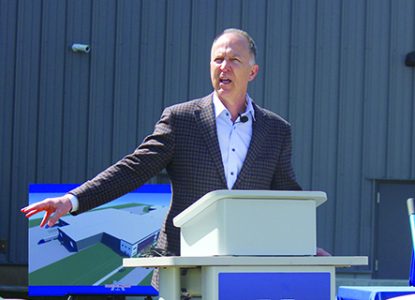
MARSHALLTOWN Company President/CEO Joe Carter counts himself as another enthusiastic supporter of the legislation, calling it a "huge favor" to his 150 employees at the local plant. MARSHALLTOWN, which also operates a facility in Arkansas, recently completed a major addition at the Iowa plant and added 60,000 square feet of manufacturing space as a result.
"It’s absolutely phenomenal because it puts us at a competitive advantage and takes away the competitive disadvantage to building more business here and bringing more business here," Carter said. "We’ve been at a huge competitive disadvantage, and it puts us in the conversation. I love what the governor and the legislators got across here... I just think it’s awesome that we were able to get it done, and I think the state of Iowa should get some fanfare."
Both of Marshall County's Republican state politicians -- Rep. Dean Fisher (R-Montour) and Sen. Jeff Edler (R-State Center) -- were fully onboard with the bill, and Edler said the ultimate goal is to join states like Florida, Tennessee and South Dakota in completely eliminating the state income tax.
"At the end of the day, this is a big win for Iowans. When I went down there, that was one of our key things was trying to get more money returned back to the taxpayers by budgeting and being a fiduciary steward of their money," Edler said. "And we finally got to the point that we could do it."
Both Fisher and Edler cited Iowans leaving the state upon retirement for more favorable tax climates -- not just for warm weather states but also for neighbors like South Dakota -- as a major concern they hoped to address with the overhaul.
"I think this will be a catalyst for keeping people here and getting people to move here," Fisher said. "I know people who have moved to Tennessee and Florida, and those were young folks who were looking for a lower tax environment... I've heard of people moving across the river into Illinois because their income tax treatment was better -- which kind of shocked me -- but for retirees."
Rep. Sue Cahill, a Democrat from Marshalltown who opposed the bill, expressed disappointment that it didn't focus more specifically on lower and middle income Iowans. She called the package "tilted" to benefit the highest earners but also said she supported the elimination of taxes on retirement income.
"I think what we ended up with was more benefits for corporations -- $265 million in tax cuts for the biggest corporations -- and yet we could only do $158 million to support education," Cahill said. "Those who make the most money are going to end up with tax cuts of $67,000 per year... and yet 450,000 Iowa families will never see any benefit from this."
Cahill worried about a reduction in state services as a result of the loss of revenue, which is estimated at about $1.9 billion, and she also expressed concerns about another bill the governor recently signed banning transgender girls and women from competing in female sports as the state seeks to grow its population in the coming years.
"I don't think we can just do one thing and expect people to want to stay in Iowa. We have to have an overall vision that will make Iowa welcoming to all instead of discriminating against some," she said.
----
Contact Robert Maharry at 641-753-6611 ext. 255 or rmaharry@timesrepublican.com.