Sen. Grassley holds community Q&A at MICA
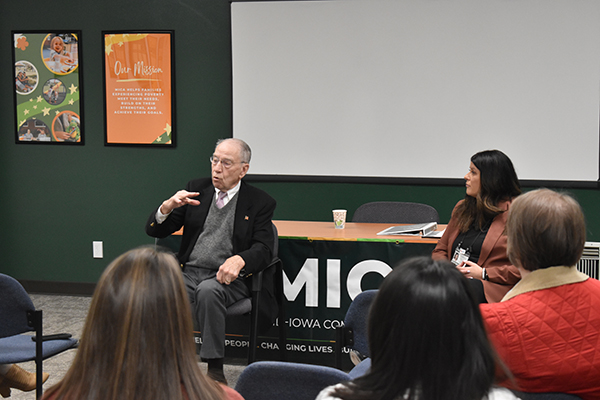
T-R PHOTO BY NICK BAUR U.S. Senator Chuck Grassley held a community Q&A at Mid-Iowa Cooperative Action (MICA) in Marshalltown on Wednesday to field questions from constituents about a wide range of issues and concerns.
In the latest stop on his annual 99-county tour, U.S. Sen. Chuck Grassley (R-Iowa) held a community Q&A at the Mid-Iowa Community Action (MICA) office in Marshalltown.
Though he fielded questions from community members about a wide variety of topics concerning Iowans, much of the focus during the meeting was on the work MICA does in the area and ways to combat poverty.
MICA serves families in Hardin, Marshall, Poweshiek, Story, and Tama counties with outreach programs like Early Head Start, Head Start, and Bobcat University, among others.
Its overall stated goal is to create communities without poverty that are responsive to change and address the causes and conditions of poverty while offering opportunities for all people.
On Wednesday, MICA employees and community members pressed the longtime Senator about greater government involvement in reducing poverty and the circumstances that create it, like food insecurity and affordable housing availability.
Grassley offered a measured response, saying any impact in the fight against poverty would need to be “incremental” over time rather than a one stop shop legislative solution.
“If you want one big major program, you may never get it put together. So you end up doing things incrementally,” Grassley said to the gathered audience. “If people are in poverty, and [their] income is government programs, you’re always going to be in poverty. The way to get out of poverty is to help people, and I mean help people get into the world of work.”
He floated adjusting welfare benefits for working recipients based on their income rather than setting an absolute maximum income and called back to welfare reform legislation in 1996, which changed welfare from a categorical entitlement to a time-limited benefit program tied to a work requirement.
“Why don’t we encourage people to go to work if they make $1,000 more, maybe they lose 10 percent of their benefits. They make $2,000 more. They lose 20 percent,” Grassley said. “Phase out that help. So people are encouraged to go to work.”
In a subsequent interview with the Times-Republican after the Q&A, Grassley talked about his main takeaway from the meeting.
“MICA is very much involved with people that are in poverty,” Grassley said. “So the emphasis I got from several of these questions was, we ought to be doing more to help people get out of poverty.”
However, Wednesday’s meeting at MICA for the Republican Senator was also shadowed by recent developments surrounding the indictment of former Republican President Donald Trump, who on Tuesday surrendered to authorities, appeared in a Manhattan courtroom and pleaded not guilty to 34 felony charges brought by Manhattan District Attorney Alvin Bragg.
Following the announcement of the indictment, Grassley took to his personal Twitter account to call the indictment “an incredibly weak case” which “highlights increasing politicization of the state & federal justice system” among other criticisms.
On Wednesday, he elaborated on these thoughts about the upcoming criminal case and proceedings.
“One of the criticisms I heard is we still don’t really know what he’s been charged with. So mine is kind of a 50,000 foot level view of it,” Grassley said. “There’s statutes of limitations that have run out. Connecting a state violation that’s a misdemeanor with a federal violation seems to be very odd to me, and then the fact that this DA ran on a platform that ‘I’m going to get Trump’ is very troublesome to me.”
Yet, as he added shortly after, he will be awaiting more information as the trial and case progress before coming to any firm assumptions.
“On the other hand, as a person that believes in the Constitution, you’ve got to let the process run out,” Grassley said. “So it’s pretty hard to draw conclusions except for the fact that it seemed to be politically motivated and a historic thing that’s never happened.”
After being re-elected to his eighth Senate term last year, questions and rumors about when he will retire followed Grassley, 89, on the campaign trail, but as he indicated on Wednesday, he has no plans to stop serving in the Senate before the end of his term in 2028.
“The only plan I have is to serve out this term,” Grassley said. “And then, as for the future, ask me in [six] years.”
Todays News

Food Access Committee preparing for Jan. 1 SNAP changes

IVCCD leaders raise concerns about DOGE recommendations on job training programs
City of Toledo reaches final Howe-related settlement
TOLEDO — The city of Toledo has reached a fourth and final settlement with an individual who alleged that former ...

Hoglan students smash food drive goal, collect over 1,700 items

Marshalltown man arrested on charges of possessing child pornography