Proposed modification of Highway 30 intersection in State Center draws strong opposition during community meeting
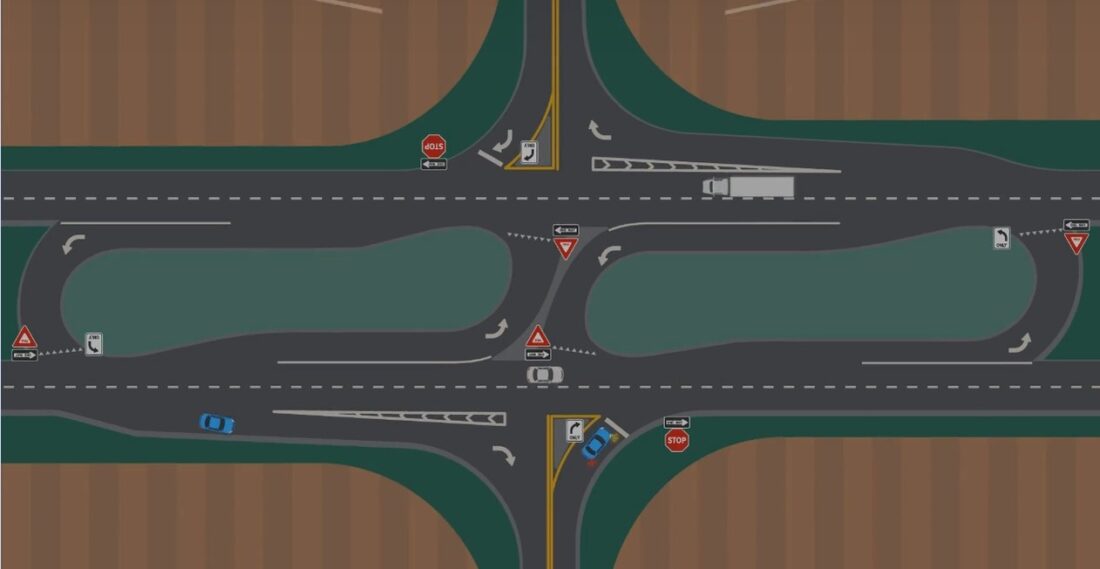
CONTRIBUTED GRAPHIC A rendering shows the design of a Reduced Conflict Intersection, which is set to be constructed at the Durham Avenue turnoff from US 30 in State Center and is estimated to cost approximately $2 million. During a community meeting on Thursday night, area residents expressed strong opposition to the plan.
STATE CENTER — Braving the frigid temperatures Thursday evening, over 30 State Center area residents responded to Police Chief Jon Thomas’s offer to hold a community meeting to gather information and formulate questions for the Department of Transportation (DOT) in regards to the proposed Reduced Conflict Intersection (RCI) to be located at US Highway 30 and Durham Avenue.
The aforementioned intersection has been awarded funding in the amount of $500,000 from the Iowa Traffic Safety Improvement Program for the purpose of constructing the RCI (J-turn) with the total cost of the project estimated to be $1.5 million. Bids and the actual construction is to be done in 2026.
One of the first questions of the evening was “Is this project set in stone?” in which Chief Thomas replied that his understanding is that it is “full steam ahead” from his conversations with personnel at the DOT but Thomas felt it was worth community members meeting with staff from the Department of Transportation to ask that before 1.5 million be spent on the RCI proposed project if other possible solutions could be attempted first.
Discussion of other feasible solutions to reducing the number of crashes at this intersection plus the pros and cons of constructing the RCI led to the following list of questions to be presented to the DOT:
-Unanimous support of those in attendance for lowering the speed limit to 55 miles per hour. Thomas countered that speed has not been a contributing factor to the accidents at this particular intersection.
-What is the data from other states and intersections regarding the semis use of this area?
-Would a deeper offset for turning lanes into State Center help?
-What is the data on the four way stop near Jefferson?
-How will the DOT address the issue of snow removal?
-Concerns were raised regarding semi trucks doing U-turns across multiple east and west lanes, and attendees also noted the complication of the grade for eastbound 30 near Schoppe property.
-How will semis achieve a safe speed without being rear ended?
-What about acceleration lanes and how long would they be?
-Would eliminating the median be possible?
-What does the data in Fort Dodge say?
-What has been the economic impact of this intersection on local businesses such as Sparky’s in Fort Dodge?
-Was traffic count impacted by the implementation of the new intersection in Fort Dodge?
-Are the size of the current signs on Highway 30 impacting visibility for turning traffic?
-What year was the RCUT intersection implemented in Fort Dodge, and how many/type of accidents have occurred since implementation?
-What data contributed to the decision to use this type of intersection in Fort Dodge?
-How would this impact response time for emergency vehicles?
-Based upon the proposed design for the State Center intersection, how many semis with trailers will be able to stage in the turn lanes at the same time?
By April 1, “Intersection Warning Lights” will be installed on Highway 30 to inform drivers if a vehicle is at the Durham Avenue intersection and/or will be entering the thoroughfare. Thomas suggested asking the DOT to “wait and see” if these signs make a difference in reducing the number of accidents at this particular intersection before construction begins on the RCI.
Overall, the group in attendance expressed strong opposition to the idea of bringing an RCI to State Center. Thomas will forward the community questions to DOT officials and will set up a meeting in the next six to eight weeks so community members can hear their responses to these inquiries and engage in further discussion on the proposed project.
Todays News

Grand Opening of the Apgar Family Water Plaza June 6

May is Food Allergy Awareness Month
Three men involved in Nicholson-Ford Park shooting reach plea deals
Three men who were involved in a shooting at Nicholson-Ford Park on the northeast side of Marshalltown have reached ...
Local Dems running for state legislature, county supervisor seats speak at spring picnic
MHS senior Marilyn Mora Montalvo excited to speak at upcoming commencement