Blom, Fisher weigh in on upcoming legislative session
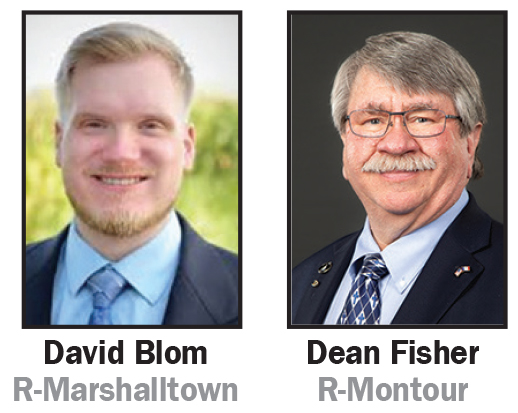
(EDITOR’S NOTE: Today’s Times-Republican features Q&As with two local legislators regarding the upcoming Iowa Legislature session. The remaining two legislators will be in the Sunday paper.)
The Iowa Legislature will begin the second year of the 91st general assembly on Monday. Representing the T-R coverage area are Reps. David Blom of District 52 (R-Marshalltown), Dean Fisher of District 53 (R-Montour), Brett Barker of District 51 (R-Nevada) and Sen. Kara Warme District 26 (R-Ames).
The T-R sent them a list of questions to get their stances on issues which have been focused upon within the state recently, and to find out what their priorities will be. This first part features answers provided by Blom and Fisher.
Blom, first elected in 2024, is the vice-chair of the House Commerce Committee and also serves on the Appropriations, Local Government and Veterans Affairs committees. Former Marshalltown Police Department Chief Mike Tupper (D-Marshalltown) has announced he is seeking Blom’s seat in this year’s election.
Fisher, first elected in 2012, is the chair of the House Environmental Protection Committee and also serves on the Agriculture, Public Safety and Natural Resources committees.
Property tax relief,supporting education focuses for Blom
What will be your primary focus during the upcoming session?
My top priorities for the upcoming legislative session include property tax relief, supporting Iowa education, lowering the cost of living for Iowans, supporting our veterans and keeping high quality jobs right here in Marshall County.
What do you think should be done with property taxes, and how do you propose to do that?
Property tax relief is a top priority for me. I believe Iowa seniors and veterans deserve immediate relief to ensure that they can stay in their homes, though my hope is that we are able to provide property tax solutions to all Iowa families. Additionally, I would support policies that make home ownership more affordable for Iowans of all ages and backgrounds.
Food insecurity is a growing problem. What do you think the state should do to address it?
In my first session in Des Moines, I proudly sponsored the Double Up Food Bucks program, which adds new dollars and allows SNAP customers to double their dollars on fruits and vegetables at farmers markets or grocery stores. Food insecurity affects working families, seniors, and children across Iowa. I support solutions that increase access to nutritious food while also strengthening local food systems. Solutions that connect Iowa farmers with Iowa families are especially effective and help keep food dollars in our communities.
In Marshall County, families can also access resources such as the Marshall County Emergency Food Box, Salvation Army, YSS, SNAP, WIC, school pantries, Meals on Wheels, House of Compassion and neighborhood little pantries that provide free shelf-stable and fresh food. These programs ensure families can get healthy food close to home while also supporting our local economy.
Will the legislature take any action on economic development tools, such as TIF? What do you think will be your vote on such actions?
My top priority is providing stability and certainty to the property taxpayer. Iowa taxpayers need that stability to maintain their household budgets, keep a roof over their head and put food on the table. Taking action on TIF is not a top priority for me, but I will weigh many proposals for property tax relief and ensure that taxpayers receive the transparency and stability they deserve.
How should the state go about bringing factories to the area and rebuilding the workforce?
Keeping and expanding high-paying jobs in Marshall County has always been a top priority for me. As a union sheet metal worker, I bring a unique, hands-on perspective to the Iowa Capitol when it comes to rebuilding and supporting our workforce. My record shows continued support for the Iowa Workforce Grant and Incentive Program, which provides scholarships to students training for high-need jobs. Workforce development must be aligned with real employer needs so that Iowans can gain skills that lead directly to good-paying careers.
I will continue supporting policies that encourage Iowans to stay, raise their families and work in Iowa industries. MARSHALLTOWN Company’s current expansion shows that Iowa’s business climate can attract growth when we invest in people and infrastructure. Efforts like the Elevate Iowa Manufacturing Tour, which brought top state leaders to Marshalltown High School, Marshalltown Community College and Emerson, demonstrate the strength of our local workforce pipeline. We should continue to aggressively pursue new investment in Marshall County while supporting the workers who make that growth possible.
Will you support any legislation that will attract or maintain healthcare providers in the state? Please elaborate.
I have and will continue to support legislation that increases access to healthcare and cuts costs for Iowans. I’ve supported policies to retain healthcare professionals in Iowa and to to remove unnecessary burdens of entry for those entering the healthcare field. I will continue to support policies that attract and maintain healthcare providers in Iowa.
Child care deserts seem to be expanding. What can the legislature do to address this problem, which will help children, families and businesses?
Increasing affordability and access to childcare is another area in which the legislature can increase affordability for Iowa families. I know that there is not one singular solution to this complex issue. So I have supported approaching this issue from many angles – the biggest in my opinion, being the proposal to eliminate the income maximum threshold to qualify for the Iowa child and dependent care tax credit. If this proposal passes, it will allow all families with an income over $25,000 to be eligible to take advantage of this credit, increasing accessibility to childcare for even more Iowa families.
Will you support a higher amount of state supplemental aid for school districts? Please explain.
As the son of an educator, I fully support continued investment in K-12 education and in our teachers. Last year, we provided an increase to school budgets and my intention is to do so again this year. Additionally, I am proud to have fought alongside my colleagues for continued investment in paraeducator salaries to ensure students with learning disabilities and special needs are receiving the assistance that they need.
Libraries have been an off and on focus for the public during the last few years. Do you think libraries should be reined in? What sort of legislation will you support to either limit or expand what libraries do? Please elaborate.
Libraries are an important part of our communities, from providing a community space to assisting people of all ages with resources for research, literacy, technology, entertainment and skill building. I appreciate the services that libraries provide and support much of the work that they do. I believe that libraries, schools and parents should all work together to ensure our youth and students have the resources they need to succeed. I have been a volunteer and donor at our library and I encourage others to serve as well.
Final comments:
It’s my honor to serve House District 52 and I am eager to return to the Statehouse this month to continue delivering results for Marshall County. I’m elected to represent and serve you. So please don’t hesitate to reach out to me at any time via cell phone at 641-758-1334 or via email at David.Blom@legis.iowa.gov for anything you or your family may need.
Rep. Fisher to focus on delivering property tax relief
What will be your primary focus during the upcoming session?
I focus on each and every bill as it comes before us, there are hundreds of bills to deal with in every session and every bill is extremely important to someone. One of the areas of focus this session will likely be delivering property tax relief. Iowans have been very clear that they are desperate for some relief. Retirees are getting priced out of their homes and the costs of homeownership are too much for many young families. I believe we need comprehensive reform that finally puts the taxpayers first. I am also certain that there will be attention given to the issue of eminent domain being used for CO2 pipelines as well. Beyond that I will focus on several bills I’m filing on behalf of constituents I’ve been working with, including bills that deal with “dead-beat dads” and other hot issues.
What do you think should be done with property taxes, and how do you propose to do that?
There are some basic principles that I believe our property tax system must follow. First, it must provide certainty for the taxpayer. Right now, property tax increases are skyrocketing. In many cases it is making it impossible for homeowners to plan for the future. On the other hand, Iowans depend on many of the services that property taxes fund and those services must be maintained. However, all governments need to remain diligent in looking for efficiencies in how to deliver services. Over the years, House Republicans have worked to make state government more efficient by reorganizing and downsizing our state departments. Our property tax plan should incentivize efficiency at the local government levels as well. I have been pressing within my caucus to find ways that we can cut regulations that will make local governments more efficient. One avenue would be to require city and school elections to be on the same cycle as our general elections in November of the even years. This would save millions of dollars across the state as well as increase election participation. I have other ideas I’m working on, and I am open to other ideas as well. Finally, I believe property taxes should be transparent. Iowans should know where their money is going and be able to vote on whether they are willing to see a property tax increase to fund certain special projects.
Food insecurity is a growing problem. What do you think the state should do to address it?
We must make sure that the government programs in place to help families facing food insecurity are sustainable in the long term for those who truly need it. The recent news out of Minnesota, with potentially billions of dollars wasted through fraud in social welfare programs is a clear signal that we must tighten up these systems. We must do regular checks to ensure that those who are getting dollars from the government actually qualify for those funds and help able-bodied Iowans get back to work so they aren’t reliant on the government forever. We have also passed legislation to ensure that those dollars are going to nutritious foods that actually curb hunger rather than sugary, unhealthy drinks and candy.
Will the legislature take any action on economic development tools, such as TIF? What do you think will be your vote on such actions?
I think TIF is an important tool for many entities to utilize, but there are also plenty of examples of it being abused or used for the wrong reasons. I think it may be worth taking a good look at how TIF districts are handled to make sure they are being used for their original purpose.
How should the state go about bringing factories to the area and rebuilding the workforce?
The Iowa Economic Development Authority is always looking for ways they can incentivize businesses to choose Iowa as their home. We have many different programs in place to serve this purpose. I would like to make sure that those incentives are being distributed across the state and not just to the big metros and counties. In 2024 we passed a bill to help with this. Senate File 574 appropriated $300,000 to the Iowa Economic Development Authority for certification costs of certified sites in rural Iowa. This money must be spent in counties with a population of less than 50,000 and would eliminate some of the barriers for businesses to open new facilities or expand their business in rural Iowa.
Bringing manufacturing back to the USA, especially Iowa, is only one of the areas we must focus on. Our current employers have trouble finding the skilled labor they need. Construction workers, plumbers, electricians, welders, nurses, health care workers and so many other job categories are in short supply. Simply filling the openings we have at our current employers would take tens of thousands of workers and significantly improve our state economy. Our community colleges are on the forefront of helping to train these workers, and I’ve been a strong supporter of increasing funding for our community colleges throughout my tenure in the legislature.
Will you support any legislation that will attract or maintain healthcare providers in the state? Please elaborate.
Absolutely. This is something we prioritize every legislative session. It isn’t something that we can pass something to fix immediately, but we can continue to tackle it from many angles. In 2023, Iowa House Republicans created the Iowa Workforce Grant and Incentive program to provide scholarships to students studying to fill high-need jobs like nursing. Each year we have continued to fund that program in the budget and I would be supportive of that again in the fiscal year 2027 budget. We also fund a Health Care Professional Incentive Program that I would like to see continue as well as increased funding to expand health care education capabilities at the University of Iowa. Additionally last year we passed House File 972 that aimed at expanding health care access in rural Iowa by:
Requiring Department of Health and Human Services to request federal approval for a health care hub-and-spoke partnership funding model to establish regional collaboration between health care providers and improve health care delivery in rural areas;
Consolidating all five health care loan repayment programs into one program that will award loan forgiveness or bonuses based on high-need health care professions in shortage areas and doubles the funding it puts into these programs;
Requesting $150 million in federal dollars to create 115 new medical residency spots in Iowa each year for the next four years;
Repealing existing residency and fellowship programs, with transition provisions, and converting those programs to the Medicaid graduate medical education efforts to expand health care for underserved communities;
Streamlining the process for certificate of need decisions.
Child care deserts seem to be expanding. What can the legislature do to address this problem, which will help children, families and businesses?
House Republicans have been aggressive in addressing child care access over the past few sessions. We know there is not one single solution to this complex issue, so we have worked to approach the issue from many angles. We have gotten many of those to the governor’s desk and I do believe they are helping ease this burden for families. But we have also passed a number of bills that have died in the Senate that I think we should revisit this year. These include:
House File 962 eliminates the income maximum threshold to qualify for the Iowa child and dependent care tax credit. With this change, all families with an income over $25,000 will be eligible to take advantage of this credit;
House File 991 would allow child care facilities to be taxed at the residential rollback rate rather than the commercial rate. This would represent a property tax cut for these businesses.
Will you support a higher amount of state supplemental aid for school districts? Please explain.
I am sure you have often heard from the minority party that Republicans are underfunding public education. But Republicans are responsible for record high education investments over the last decade. K-12 education funding has increased by almost a billion new dollars over the last 10 years. The last time education funding was actually cut was when Democrats had the trifecta in 2010. In the fiscal year 2025 budget, state aid to public schools accounts for 43.62 percent of the entire state budget. That’s the biggest piece of the pie by far. And, for all the hoopla the Democrats try and make about state spending on the ESA program, ESAs account for only 2.01 percent of the total state budget. I believe this year we should increase state funding for K-12 just like we have done every year since I’ve been in the Iowa Legislature.
Libraries have been an off and on focus for the public during the last few years. Do you think libraries should be reined in? What sort of legislation will you support to either limit or expand what libraries do? Please elaborate.
I think it is common sense for libraries to have policies in place to safeguard children from explicit, age-inappropriate content. When we send our kids or grandkids to the library, I believe we assume that those safeguards are in place. However, examples have popped up in our state where that has not been the case. The policies promoted by the American Library Association are diametrically opposed to parental control, and sadly, many local libraries blindly adopt these ALA policies. Let’s get back to common sense here. Inappropriate material should be kept where children cannot access them or at the very least, parental controls should be in place to ensure that parents know what their child is reading. If legislation is required to ensure libraries are following common sense protections for our children, then I would support it.
Final comments:
Much has been said about the state’s budget for the upcoming fiscal year. So please let me clear up some misconceptions and outright lies that have been coming from my Democrat colleagues. When we lowered income taxes in 2024, we expected and planned for there to be a drop in state revenues for a few years. This was because we were over-collecting from the taxpayers. Our reserve funds are at their statutory maximums, we have over $6 billion in cash on hand, and more than $4 billion in the Taxpayer Relief Fund. While the Democrats have made it clear they think the government should be spending all of that money, I believe that that money is much better back in the hands of Iowans, rather than sitting in the state’s coffers. So we cut your taxes and now, as expected, we are seeing a temporary loss in state revenue. This was always a part of the plan. As we approach the budget for fiscal year 2027, we must ensure that our state is always running as efficiently and effectively as possible. Bloat and wasteful spending always occur when scrutiny is not taken to government spending. Out of respect for taxpayers, we must stay diligent. As the 2026 session begins, I will continue to work on common sense solutions that will make Iowa a better place to live and raise a family.
Todays News

Marshall County Supervisor Kevin Goodman passes away at 63

Citizen alerts authorities to wanted man at hotel leading to arrest

Coop’s Ride 5.0 set for next weekend in memory of Ryan Cooper
Blom, Fisher weigh in on upcoming legislative session

Marshall County Supervisor Kevin Goodman passes away at 63