City council accepts EMS study, considers next steps
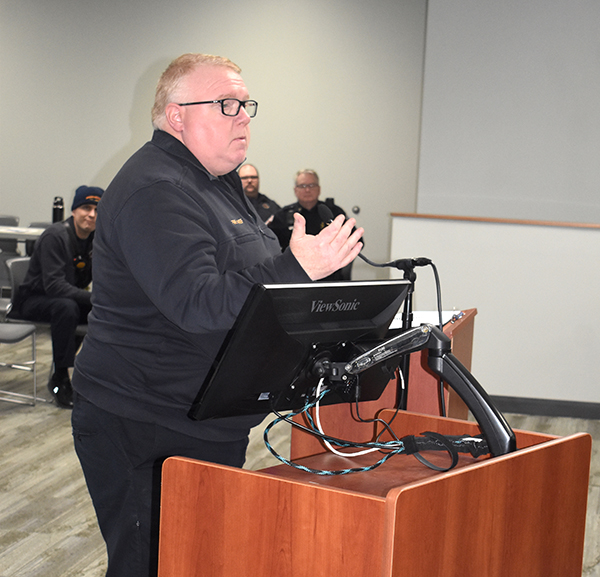
T-R PHOTO BY ROBERT MAHARRY — Marshalltown Fire Chief Christopher Cross addresses the city council about the findings of an EMS study completed by Iowa EMS Consultants during Monday night’s meeting. He also gave a similar presentation during Wednesday morning’s Marshall County Board of Supervisors meeting, and both governing bodies accepted the report’s findings while tentatively agreeing to convene a joint meeting at some point in the near future with hopes of creating a formal recommendation regarding the future of the service locally.
Marshalltown Fire Chief Christopher Cross was a busy man this week as he spoke to the Marshalltown city council on Monday evening and the Marshall County Board of Supervisors on Wednesday morning about the results of the recently completed Emergency Medical Services (EMS) study on options for the future of the service locally, and both governing bodies accepted the results and discussed next steps during their respective meetings.
As the discussion kicked off at the city council meeting Monday, Cross noted that the study arose out of concerns over the fact that UnityPoint Health-Marshalltown (UPH-M) is losing about $1 million a year providing transport services for EMS calls in Marshall County, first sharing some history of the arrangements locally. Currently, the Marshalltown Fire Department (MFD) and UPH-M have a “loose” transport agreement that says UPH-M will provide transport services, and the MFD and other fire departments in surrounding smaller communities will provide first responders, and it is severable with 30 days notice. There are no performance benchmarks stipulated, no minimum staffing and no time standards to respond.
In Iowa, EMS is not considered an essential service like police and fire, but individual counties can now approve levies to fund EMS as voters in neighboring Tama County did in 2024. About two years ago, UPH-M hosted stakeholder meetings to discuss the future of EMS in the county and the state of volunteerism as those numbers have generally declined in recent years.
“UnityPoint has indicated that they would like to not do EMS transport because of a loss in revenue, according to their statistics, to the tune of about $1 million a year. That’s the UnityPoint rationalization on why we are here trying to figure out a resolution to EMS,” Cross said.
Later that year, a new task force was formed that included several city and county elected officials and fire department leaders as well as a UPH-M representative to address a contingency plan if UPH-M does opt to stop providing the service. It was decided to commission a study from an outside third party — Iowa EMS Consultants of Sac County — with the city and county sharing the total cost of just under $60,000.
The report is now complete and available for viewing in full at https://www.marshallcountyia.gov/AgendaCenter/ViewFile/Item/5936?fileID=3541 or https://marshalltownia.portal.civicclerk.com/event/2098/files/attachment/5375.
One section of the report indicates that Iowa EMS Consultants found the relationship between Marshall County first responders — over 30 of whom were interviewed and allowed to maintain anonymity — and UPH is “strained.”
“First responders informed Iowa EMS Consultants that their relationship with UnityPoint Marshalltown was ‘a wreck’ and that UnityPoint Marshalltown treats first responders ‘like garbage,'” it reads.
Cross said the findings showcased “strong opinions” from stakeholders who were interviewed by the consultants, but he didn’t feel that it was reflective of the relationship between the city and county and how services should be provided in the future.
“We’re interested in solving problems and being proactive and exuding professionalism whenever we can. The EMS report, I think, helps us to move the conversation from reactive problem solving to intentional long-term planning,” he said.
The report, he added, highlights the high EMS call volume especially within the city of Marshalltown and a large geographic area of approximately 573 square miles that needs to be covered in the county with a heavy reliance on volunteer first responders outside of the city.
“We have to have them. They’re very important,” Cross said. “These realities that the status quo arrangements are inadequate, and we need some proactive planning to forge the path forward into the future for EMS.”
The report ultimately outlines three prospective courses of action: a unified intergovernmental city/county EMS system implemented by the city with costs primarily covered by the county through an essential services levy, a county-operated standalone system without the assistance of city personnel or continuing to rely on UPH-M and subsidizing the private organization through the essential services levy. According to Cross, the report outlines costs and staffing needs for each scenario, but it does not force the council or the supervisors to make an impromptu decision without further consideration from all of the stakeholders involved.
Before hearing from the council, he asked the council to accept the report and schedule a joint meeting with the county supervisors to formulate a recommendation and implementation plan for the task force. In response to a question from Councilor Greg Nichols, Cross noted that city and county officials who have served on the task force are currently leaning toward the intergovernmental arrangement as the most cost effective and efficient strategy.
Councilor Mark Mitchell asked about the increased number of staff and ambulance vehicles that would be needed, and Cross responded that it would require an additional 28 staff members funded through the countywide levy with the city handling personnel management. If the ballot measure, which would require a 60 percent supermajority to pass, is unsuccessful, he did not believe there would be any contingency for an alternate level of service than is currently provided.
Nichols followed up by asking about reimbursement for the calls and whether the current MFD facility would have enough space for the increased number of employees, and Cross replied that he believed they could accommodate the new staff within its confines. There is also a provision in the plan, he added, to house a satellite ambulance out of the State Center Fire Station.
Mayor Mike Ladehoff, who has served on the task force, said there were still many unanswered questions, and he called the situation with UPH “disheartening,” noting that there are times when they aren’t fully reimbursed for a call.
“It’s a losing proposition, and you cannot say ‘Well, we’re just gonna charge for it’ because it’s not allowed. And then on top of that, then you have people that don’t have insurance, and now you’re chasing people while you’re trying to keep your EMS up and going,” he said.
After explaining the standards for EMS billing, Cross fielded a question from Councilor Sue Cahill on how much the city is currently paying into the system beyond sending firefighters out as first responders on EMS calls. He responded that no money changes hands between the city and UPH-M as it stands now.
When Cross first arrived in 2016, he said UPH-M kicked money back to the city for the services of sending firefighters out on EMS runs, but they have since stopped doing that. The change led to questions — including “loud conversations at a volume that everyone could hear” between Cross and Councilor Gary Thompson — about whether city personnel should continue to respond to such calls.
“The expectation of service that the public has of us is tremendous, and if we were to stop responding to those runs — even though it’s not mandated, we’re not recouping any money from it, we’re paying the salaries and supplies anyway — I think it’s right for us to do that, and that’s why I argued so much for that viewpoint. And thank you for sparring with me on that, that was fantastic,” Cross said. “But that doesn’t exist anymore, so we have community buy-in and a community investment where we feel, as a department, that it’s the right thing for us to do to respond to the citizen when they’re in trouble. We only exist to answer the bell. The only reason why we exist is to help people, and so we thought it would be a disservice if we didn’t do that.”
Cross then broke down funding mechanisms and 28E agreements in response to another question from Cahill, and she then asked if UPH-M has provided a timeframe on when they will stop providing transport services. Cross described the working relationship with UPH-M as “wonderful” and said they have been involved in all of the conversations and decisions being made thus far.
UPH-M, he said, has no intention of abruptly pulling the plug, but there have been “loose discussions” on what will happen if they do make such a decision.
“Unitypoint’s doing the best that they can. We’re doing the best that we can, and we’re still communicating quite frequently. And everything is fine with the relationship. It was never bad as far as at the administrative level,” he said.
Finally, Nichols asked if the suggested arrangement would lessen the burden on the MFD, and Cross responded that technically, it wouldn’t because the new employees would all work for the fire department. In response to a question from Councilor Melisa Fonseca, Cross reiterated what he was asking for from the council that night, and Nichols made a motion to accept the report and schedule the joint meeting as suggested.
During the public comment period, Marshall County Emergency Management Coordinator Kim Elder recounted the history of the working relationship between various local agencies dating back to her own childhood and noted that overall, EMS is not a moneymaker anywhere in the world, which has prompted the conversations about the future of the service.
“The volunteers are still gonna do their same hard work that they always did, no matter what this decision comes out to be… so I just want to give them credit too. The responders will still remain. We’ll need them. They’re out there in those areas and making that response. We just have to find a better way to get our patients to the hospitals or the help that they need and a better response time,” she said. “We all know that volunteerism is down and EMS is suffering just like the rest of them, so it’s just important to figure out what that is, if it’s a decision of choosing one of these choices or a combination of these choices. It’s just a matter of trying to find out what is gonna work.”
Before the vote, Thompson clarified that he and Cross do “love each other,” which the chief classified as a “bromance,” and Councilor Marco Yepez-Gomez thanked the task force for its work on the issue and commissioning the report. Councilor Jeff Schneider also expressed his support for the plan despite the “unfortunate” situation.
As he concluded his remarks, Cross opined that if the new arrangement is structured, funded and staffed correctly, it could go down as one of the greatest accomplishments for any two elected bodies of officials that has happened in the community in “a very, very long time.” The motion passed by a unanimous 7-0 vote.
MARSHALL COUNTY EMS TASK FORCE
City of Marshalltown
Fire Chief Christopher Cross, Mayor Mike Ladehoff, City Administrator Carol Webb
Marshall County
Supervisor Carol Webb, Sheriff Joel Phillips, Emergency Management Coordinator Kim Elder
Volunteer fire chiefs
Jacob Patterson (Gilman), Brad Pfantz (State Center)
UnityPoint Health-Marshalltown
Shari King, Executive Director of Operations
——
Contact Robert Maharry
at 641-753-6611 ext. 255 or
rmaharry@timesrepublican.com.
Todays News
Coughenour, Heil honored for years of service to Marshall County

Missoula Children’s Theater brings ‘Cinderella’ to Marshalltown
After similar discussion, Supervisors also accept EMS study
Less than two days after he stood before the Marshalltown City Council to present the results of the EMS study and ...

Alta Vista Real Estate celebrates new downtown location with ribbon cutting, open house
City council accepts EMS study, considers next steps