Council moves forward with request for four-way stop at S. 6th St., Merle Hibbs intersection
After much consideration and deliberation, the Marshalltown city council voted to move forward with a proposal for a four-way stop at the intersection of West Merle Hibbs Boulevard and South 6th Street during Monday night’s meeting that was spurred by a petition from residents with over 325 signatures.
Mary Mauk, who lives on West Merle Hibbs Boulevard, started the petition drive to convert the current two-way stop with signs on each side of Merle Hibbs — to a four-way, and she spoke to the council about the rationale behind the proposal.
“This intersection has become increasingly hazardous due to the growing use of 6th Street as a main thoroughfare and the rising population west of 6th Street. Many residents, including children, pedestrians enjoying the ponds and daily commuters, depend on this crossing. Without proper traffic control measures, the risk of serious accidents will continue to increase,” she said.
She cited accidents, near misses and unsafe driving practices at the intersection and said residents on Southwest 6th Street near Merle Hibbs currently lack regulated traffic access during peak periods. When she was collecting signatures, Mauk added, one woman quickly signed the petition and said her mother had recently been in an accident at the intersection.
“Thankfully, she survived,” she said.
In response to a question from Councilor Gary Thompson about the number of signatures, Mauk said she had mostly collected them from residents in the affected area but also some from other parts of Marshalltown. Mark Mauk, Mary’s husband, spoke next and noted a long wait to cross Merle Hibbs Boulevard after moving there in 2024, prompting them to pay more attention to the intersection and learn that many of their neighbors shared similar sentiments.
As for pushback, Mauk was told that such an arrangement had been proposed before and rejected due to the lack of traffic and crashes needed to justify two more stop signs, but he clarified that crashes weren’t the main reason for the request.
“It’s just difficult to make a turn there. You end up waiting a lot of time, and you become impatient in waiting, which leads you to do things you maybe wouldn’t normally do — take more risk to get across or make a left turn,” he said.
Specific times of day when people are driving to and returning from work are typically the busiest, he added, and Carol Hauser then expressed her support for the petition for one reason: safety.
“Have you ever tried to cross 6th Street any time of the day? Walking is putting your life in your own hands as cars speed down 6th Street going either north or south. Sometimes, when I’m crossing the street to walk that really nice pond, cars don’t slow down. They act like I’m in the way,” she said. “Is this safe for the pedestrians of Marshalltown? I think not. What is it going to take to have this resolved? A bad accident where someone gets killed or maimed for life? Safety for everyone, let’s keep Marshalltown safe for our families.”
Kevin Holubar, who also lives on West Merle Hibbs, registered in support of the proposal and felt it would slow traffic down coming off of Iowa Avenue. While acknowledging the increased traffic on 6th Street, Doris Kinnick, however, worried about putting a four-way stop at the bottom of a hill.
Mayor Mike Ladehoff then welcomed Public Works Director Heather Thomas to the podium to share the metrics staff usually consider for converting a two-way stop to a four-way stop.
“When I say there’s guidelines, there is not a hard, fast matrix… It’s a little bit more fluid than that, and every intersection should be treated on a case-by-case basis,” she said.
When she receives such requests, Thomas typically reaches out to public safety officials for their input, and she said the police department did not offer a recommendation to make a change. A similar conversation unfolded back in 2013, she noted, which ultimately led to a speed limit reduction from 45 to 35 miles per hour in that area.
In this case, she said, site distance is not an issue, and pedestrian counts are not high enough to consider the area something like a school zone that would warrant a higher level of stop control. As for crashes, there have been 11 reported at the intersection in the last five years, and all were property damage only — none were reported as minor, major or fatality injuries.
City staff also performed a video review of the intersection on a day with the highest eight-hour traffic volume, and for the warrant to be met, Thomas said it would require 300 cars per hour on 6th Street and 200 on Merle Hibbs, and the counts were 571 on 6th Street and 153 on Merle Hibbs, the latter not meeting the minimum threshold.
Thomas expressed concern that stopping vehicles at the bottom of a hill could increase the number of rear-end crashes before opening up the floor for questions. Councilor Sue Cahill asked about the potential for more housing being built in Knollway development and a subsequent effect on traffic, and Thomas responded that there are secondary access points for those homes.
“Even if we added 40 houses, that’s not going to contribute more than the 47 cars per hour that it’s currently short of that traffic count measure that we look at,” she said. “Now, with that said, as Merle Hibbs develops further to the west over to 12th Street, these are all things that are fluid as this area develops, and that’s obviously something that we’re going to be looking at further as that street continues and connectivity increases in that area.”
Councilor Greg Nichols noted that anyone in the new subdivision has no controlled access point to get out with nothing but two-way stops in the area, and Councilor Mark Mitchell asked about the cost of the signs and manpower to install them — to which she replied that it would be “miniscule,” around $500.
Fellow Councilor Gary Thompson felt it would be better to be proactive than reactive as the area continues to grow, and he shared his support for the proposal, citing drivers traveling faster than 40 miles per hour especially coming north off of Iowa Avenue. Nichols, who represents the ward where the intersection is located, echoed that support based on the number of signatures gathered and the need to represent his constituents.
At-Large Councilor Jeff Schneider, who lives in the same neighborhood, had a different perspective and felt the stop signs would cause more problems than it would solve.
“A four-way stop there is gonna cause problems. It’s gonna slow down a lot more people. I don’t have any problems with the intersection myself,” he said.
During the public comment period, a resident named Lane urged support for the proposal based on the number of signatures, and Councilor Melisa Fonseca wondered whether it would cause more harm than good. She added, however, that she lives on a busy street where there have been serious accidents, including the recent destruction of a home on South 3rd Avenue, and she would like to know more about the risks associated with adding the four-way stop.
“I think that there would be potential for an increase, especially probably in rear-end collisions on 6th Street. I think there’s gonna be people continuing to take the major street and potentially have some accidents,” Thomas said. “If that’s council’s wishes to put a stop sign in, hopefully those will be along the same lines that are currently there today looking at property damage only and not looking at the major fatality injuries. Ultimately, the city council is the one who passes and approves the ordinances that set the locations of stop signs within city limits.”
Fonseca also asked about testing out temporary stop signs there, but Thomas didn’t recommend putting a movable sign in the middle of the road. Thompson cited the history of putting retention ponds in and turning them into parks along with developing additional housing as reasons the proposal should be supported.
“We want you to live there. We want you to walk. We want you to enjoy the parks, but you know what? Good luck crossing that street to the two ponds,” he said. “I just don’t understand the hesitation to be proactive to continue to develop that area of town. I struggle with this because to me, it’s a no brainer. It’s just like, put the stop signs up, start slowing the traffic now so when more houses get built, it’s an easier mountain to move today than it will be in six months, a year or five years. So that’s where I’m at with this.”
He then motioned to bring it back as a formal ordinance at a future meeting, and it passed by a 5-2 tally with Schneider and Councilor Marco Yepez-Gomez opposed.
——
Contact Robert Maharry at 641-753-6611 ext. 255 or
rmaharry@timesrepublican.com.
-
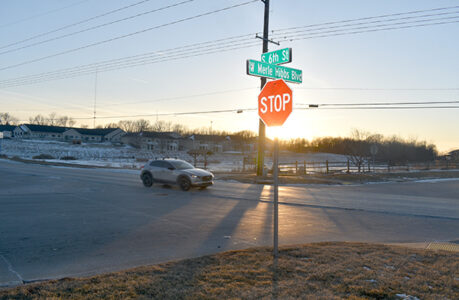
- T-R PHOTOS BY ROBERT MAHARRY — The intersection of South 6th Street and West Merle Hibbs Boulevard is pictured on Thursday afternoon. During Monday night’s meeting, the Marshalltown city council voted 5-2 to move forward with a proposal to convert it from a two-way to four-way stop after a petition with over 325 signatures was presented.
-
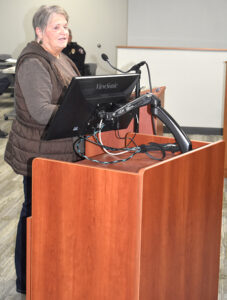
- Mary Mauk, a resident of West Merle Hibbs Boulevard who led the petition drive, spoke before the city council on Monday night.
Todays News
Happy 100th birthday, Vaughn Hauser!
Marshalltown man sentenced to over 12 years in federal prison for possession with intent to distribute meth
CEDAR RAPIDS — A Marshalltown man who illegally possessed nearly three kilograms of methamphetamine was sentenced ...
Peoples Community Health Clinic to open new satellite clinic in Traer
Council moves forward with request for four-way stop at S. 6th St., Merle Hibbs intersection
Coughenour, Heil honored for years of service to Marshall County