Council tentatively agrees on over $500,000 in budget cuts, revenue increases during special meeting
City staff instructed to look further into utility franchise fee
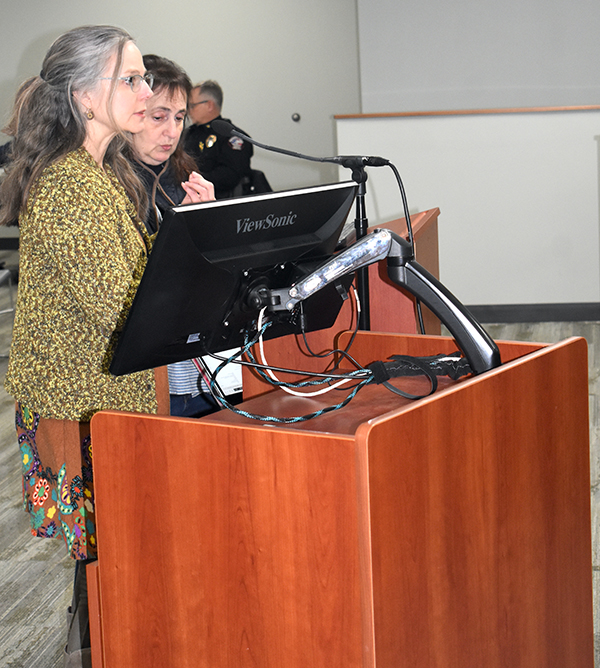
T-R PHOTO BY ROBERT MAHARRY Marshalltown Public Library Youth Services Manager Joa LaVille and Director Sarah Rosenblum address the city council during Monday night’s meeting. The council voted 4-2 to proceed with a 50 percent reduction in the general fund transfer to the library, from $250,000 to $125,000, as a result of the library losing its special levy after the passage of House File 718 in 2023.
The Marshalltown city council met for nearly two hours in a special session on Monday night to discuss a series of proposed budget reductions and revenue increases aimed at partially closing a general fund shortfall of approximately $1.573 million before any Local Option Sales Tax (LOST) revenue is transferred in to close the gap.
With six of the seven councilors present — Gary Thompson was absent — the council had tentatively reduced the shortfall to $1,033,223 by the time the meeting concluded after talking through a number of adjustments, some relatively small and some major. In Fiscal Year 2026 (the current year), the council budgeted $1,076,145 of LOST revenue to balance the budget.
The largest item on the list of City Administrator Carol Webb’s suggestions was potentially eliminating the $250,000 transfer from the general fund to the Marshalltown Public Library (MPL) to replace the special library levy that was eliminated due to the passage of House File 718 by the Iowa Legislature in 2023.
Webb said MPL Director Sarah Rosenblum told her a reduction of $250,000 would primarily be managed through vacancy management, reducing operational and material expenses and making operational adjustments such as closures or other adjustments determined by the board of trustees. Webb’s memo indicated that it would have a major impact on library services.
Stepping forward to the speaking podium, MPL Youth Services Manager Joa LaVille told the council the library had already made difficult cuts including selling off the bookmobile a year ago, and Rosenblum made similar points during her remarks.
“We saw this coming, and I’ve been here 15 years almost. And I’ve been through this show before, so it’s just really hard. Every department has taken cuts in my 15 years, but it’s just really hard. It’s gonna have a huge impact on library service to our community,” Rosenblum said.
Councilor Sue Cahill said she opposed the loss of the special levy when she was a state legislator, and she also wondered if the loss of funding would result in the library being closed another day or reducing staff. Rosenblum noted that she plans to retire in November and suggested the possibility of promoting an internal candidate and combining her current position with the director job but felt it would be a lot of work.
In response to another question from Cahill, Rosenblum said the renovation project that started Monday is entirely paid for by the Friends of the Marshalltown Public Library and would not be affected by these cuts.
Ultimately, Councilor Jeff Schneider proposed exploring three different scenarios — 15 percent, 25 percent and 50 percent reductions out of the $250,000 — with Councilor Marco Yepez-Gomez making it clear that he did not support any reduction at all. Later in the meeting, the council voted 4-2 to proceed with the 50 percent cut ($125,000), with Councilors Schneider, Melisa Fonseca, Greg Nichols and Mark Mitchell in favor and Cahill and Yepez-Gomez opposed.
From there, the council moved more quickly through several subsequent items — eliminating $2,000 for mosquito spraying (with the caveat that it could be paid out of LOST later on if deemed necessary), leaving vacant positions open for a savings of $160,775 and continuing volunteer furlough days ($2,000).
Another item that garnered more discussion was the possibility of closing the Aquatic Center on Wednesdays and July 4, opening later (June 8) and closing it sooner (Aug. 15). With Thompson not on hand to vote, the council was split 3-3 on whether to close Wednesdays, and Webb vowed to consider both options budget wise.
A proposal to suspend operations and programming at the Veterans Memorial Coliseum was quickly shot down by the council.
“This affects so many youth programs, so many community programs, so many activities plus the fact that so many donations went into refurbishing that when the disaster hit, I think we’d be doing a disservice to our community by closing the coliseum,” Nichols said.
The council quickly agreed to charge more of Housing and Community Development Director Deb Millizer’s salary to the Housing Choice Voucher program ($8,367) and eliminate mowing contracts for the public safety buildings and the library ($8,480) and hire seasonal staff to do it. They did, however, opt to leave in the $2,500 recruiting bonuses for police department hires at this time.
The council decided to retain the Veenstra & Kimm contract for building inspections as opposed to hiring two full-time equivalent (FTE) employees ($19,584) but hiring a rental inspector as well as eliminating the downtown banners ($20,000), which, to be clear, are separate from the MCBD’s veterans banners.
The council will not proceed with hiring a communication director ($27,000), which was previously identified as a priority during a strategic planning session, and instead utilize 25 percent of an FTE to focus on communications. They discussed eliminating the two electric vehicle charging stations downtown and ultimately decided against doing so to allow for more research.
The council agreed to eliminate the use of Plan-It Software for the Capital Improvement Plan (CIP) program ($6,825) and reduce budget line items including travel, training, consultant fees, equipment, operating supplies, and contract maintenanceIt software ($82,000). Finally, the council was asked to consider reducing or eliminating its contract with the Arts + Culture Alliance (ACA), which is currently funded out of LOST, to free up more money for other programs or transferring to the general fund. Currently, they have a five-year agreement for $130,000 annually to support creative placemaking efforts and the Arts and Culture Master Plan.
ACA Executive Director Amber Danielson spoke to the council and, while highlighting the benefits of the agreement from her perspective, suggested a 20 percent reduction in the interest of budget relief.
“In closing, I want to acknowledge how difficult it is to see so many important services and initiatives under consideration tonight. None of this is easy, and we realize every line item impacts real people,” she said. “Our hope is simply that the value of this partnership is seen as part of the city’s overall efforts, one that works best when we continue moving forward together rather than taking a step back at a time when progress is clearly underway.”
The 20 percent cut would amount to a payment of $104,000 annually to the ACA, which the council agreed on before moving on to revenue generation proposals. The council was OK with moving forward on a pet licensing program with the potential to generate up to $20,000 in annual revenue and adding the cable franchise fee for Heart of Iowa to the proposed budget ($5,000.)
Proposals to increase the rental fee for the 911 Commission and charge E911 an HR administrative fee did not move forward as it would require a one-year notice to modify the current agreement, and 911 Director Rhonda Braudis noted that her budget for the upcoming fiscal year is already finalized.
Finally, the council agreed to proceed with raising recreation program fees, including Blast, by $84,645, before further discussing the proposed library cut and ultimately voting 4-2 to proceed with the 50 percent reduction ($125,000). Cahill suggested eliminating councilor pay for one year ($5,000 each) as a means of avoiding cuts that would have a bigger impact on the community.
Franchise fee discussion
The final 10 minutes of the meeting focused on the potential implementation of a utility franchise fee after a five-percent proposal in 2023 garnered a petition for a special election and was overwhelmingly defeated by a 3-to-1 margin at the polls that September. This time around, Webb recommended a three-percent franchise fee tailored toward essential services such as public safety and crafting a clearer revenue purpose statement.
She then provided the potential timeline for enacting the fee and when a special election would be held if a petition is generated. A special election is budgeted for, according to Webb, and Fonseca felt the franchise fee was worth seriously looking at because LOST couldn’t be relied on to fill every budget gap.
Yepez-Gomez expressed his preference for the vote to be on a general election ballot, which the council could choose itself, but Webb clarified that a petition from the public would require a special election.
“Unfortunately, I think we’re gonna have to pursue this for the long-term sustainability of our general fund, even with decreased services, even if this passes. I don’t think we should take all year to do this. I think we should look at an expedited timeline,” Schneider said.
The council reached a general agreement on proceeding with further exploration of the franchise fee proposal. ——
Contact Robert Maharry at 641-753-6611 ext. 255 or rmaharry@timesrepublican.com.
Todays News
Area deputies respond to several weather-related crashes over weekend
Marshalltown man sues city over public records access ‘inconsistencies’
A Marshalltown man with a lengthy history of filing extensive public records requests from government entities ...
Council tentatively agrees on over $500,000 in budget cuts, revenue increases during special meeting

A Q&A with the commander of the Kosovo Security Force, Lt. Gen. Bashkim Jashari

County public health director weighs in on updated vaccine schedule