Congressional hopeful Dave Dawson holds town hall at Marshalltown Public Library Saturday
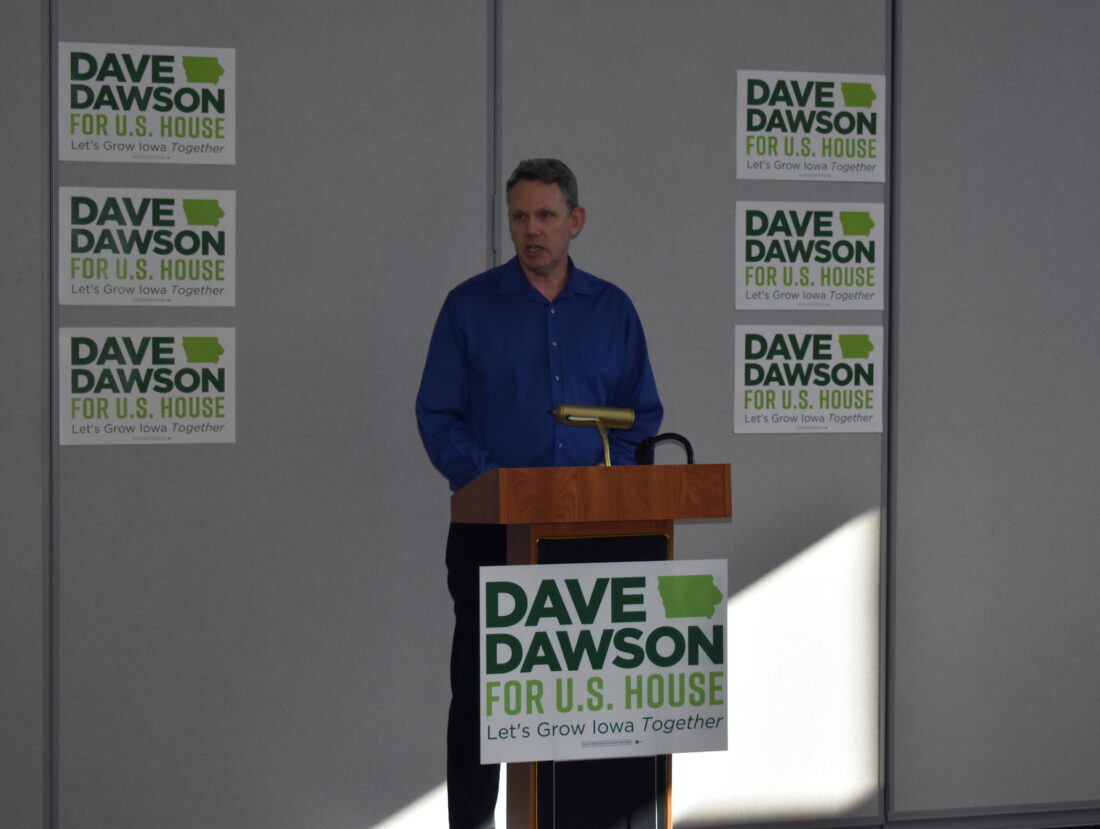
T-R PHOTO BY ROBERT MAHARRY Former State Rep. and current District 4 U.S. House candidate Dave Dawson, a Democrat from Lawton, held a town hall meeting at the Marshalltown Public Library on Saturday afternoon.
Former State Rep. Dave Dawson stepped away from politics a decade ago to return to his career as a prosecutor. Now, the Democrat is getting back in the mix by running for the U.S. House in Iowa’s Fourth District, and he stopped by the Marshalltown Public Library on Saturday to share his own story and explain why he’s running for Congress.
Before a small crowd of about 10, Dawson, who now resides in Lawton with his wife Liza and their three children, recounted his roots being born in Cherokee and raised in nearby Washta in northwest Iowa, and after his introductory speech, he spent about 40 minutes taking questions and comments from the audience. The historically conservative Fourth District seat is currently held by Republican Randy Feenstra, who is seeking the governor’s office in 2026, so a new representative will be headed to Washington next January. Currently, three Democrats — Dawson, Stephanie Steiner and Ashley WolfTornabane — are seeking the seat along with four Republicans — Chris McGowan, Ryan Rhodes, Christian Schlaefer and Matt Windschitl.
Opting against entering the family business of farming, Dawson went to Iowa State University and then the University of California Los Angeles (UCLA) for his law degree, first moving to Chicago and working in corporate litigation for a large firm there for three years. He quickly discovered, however, that it wasn’t his calling and returned to Iowa to work as a prosecutor in the Woodbury County Attorney’s Office, where he has spent most of the last 24 years.
Dawson said he chose that job because it afforded him the opportunity to protect the public and children and cited his record of community involvement as a coach, church elder and nonprofit board member. When he served in the Iowa Legislature, Dawson ran his own private law firm focused on family law and court-appointed attorney work.
In 2015, he returned to the Woodbury County Attorney’s Office, and he left his legislative seat in 2017. Some of the achievements Dawson highlighted included a bill reducing property taxes on businesses in Iowa, which, at the time, included a stipulation for a general fund backfill to assist cities, school districts and counties that has since been eliminated.
“Now, local government has had struggles to meet the needs of the services that they provide in their communities, and (it) could lead to higher property taxes because of that change. I probably wouldn’t have supported that bill back in 2013 if it hadn’t provided that funding for local governments,” he said.
Dawson also touted efforts to expand Medicaid access and open a mental health crisis stabilization unit in Sioux City that has since closed in 2023, leading him to lament the lack of mental health resources for children and adults in the state.
“While I was in the legislature, I worked hard to earn a reputation as somebody who would work across the aisle, somebody who was trusted, who would follow through with their word and make sure I could work hard to get things done for my constituents,” he said. “I wasn’t there to make headlines, just to play party politics. I was there to get things done.”
He worked across the aisle to enact a mandatory minimum prison sentence for caretakers whose actions cause death, but Dawson said he also worked to reduce mandatory minimums for nonviolent drug offenders and nonviolent robbery cases not involving a weapon. Dawson received the Gold Star Award from the Iowa State Sheriff’s and Deputies Association for leadership in public safety and law enforcement issues.
“If you can work together to find common ground, you can actually accomplish things for your constituents, and that’s what I think is most important when you go to become a public servant and represent people from your district,” he said.
Through his career as a prosecutor, Dawson commented that he has seen many situations where social service agencies and courts in Iowa can’t meet the needs of the state’s most vulnerable restaurants, and he felt that recent Congressional actions to cut Medicaid would compound those problems.
“We need to learn to do better,” he said. “If we can’t do the better for the least among us, why are we in public service to make improvements to people’s lives and to help? That’s why I’ve decided to run for Congress. I want to make sure that people receive a quality education and have real economic opportunities because if they don’t have that education or economic opportunities and they don’t feel treated fairly by those in authority, including those in government, they don’t have hope for their future. We need to do better.”
Restoring “decency, ethics and the rule of law” would be a major goal for Dawson if he is elected, and he told the audience he would not be accepting any corporate Political Action Committee (PAC) money to fund his campaign.
“We’re living in times that are not normal. We have a president who is ignoring the Constitution and going around Congress to claw back money that has been appropriated to invade countries, to deploy national troops throughout our country. This is not the America I grew up in, and it’s not the America I want to see for our next generation including my own children. We need to do better,” he said. “My campaign slogan is ‘Let’s Grow Iowa Together.’ I truly believe we can have stronger communities if we all work together to improve the lives of our fellow citizens. I promise to work hard for all of my constituents regardless of your party background, and I hope to earn your support in the upcoming election.”
From there, he opened the floor up to a range of questions kicked off by Sue Blaisdell, who asked if he would advocate for more diversity in Iowa agriculture beyond the traditional staples of planting corn and soybeans, touting water quality, conservation and Iowa’s cancer rates as her biggest issues. Dawson advocated for more investments in science to get to the bottom of the cancer situation, the passage of a long-term Farm Bill, which prompted an interruption from Blaisdell that it wouldn’t do any good if it continued to subsidize the same commodities, pushed for rescinding President Trump’s tariffs and focusing on small, local farmers over large agricultural corporations.
Mark Smith, a Democrat who represented the Marshalltown area for 20 years in the Iowa House and now serves as the mayor of West Liberty, urged those in the room to support Dawson and District 52 Iowa House candidate Mike Tupper (D-Marshalltown) to “restore some sanity to government here in Marshall County.” Smith described Dawson as a truly genuine person and an excellent father and stepfather who was known for his ability to work with anyone and remain fair in his dealings.
In explaining his decision to run, Dawson reiterated his position that a Democrat such as himself could win the seat despite the district’s composition, noting that there are a large number of independents, and J.D. Scholten nearly defeated Republican incumbent Steve King in 2018.
“Maybe it’s time to vote for something different than what you’ve been voting for the last several cycles. Maybe it’s time to do something different, for somebody like me to come forward who has experience,” Dawson said. “It’s a tough seat to win. A lot of people with experience write it off and say it can’t be won. I said this time, it could be done, or I wouldn’t be running.”
He added that King and Feenstra were both state representatives prior to serving in Congress.
Former Marshalltown Mayor Joel Greer spoke about his mostly unsuccessful experiences attempting to connect with King in Washington, D.C. to advocate for cancer research, which led Dawson to question whether any of the current or former Congressmen serving the area had held town hall meetings open to the public.
The candidate said he called all local, state and federal elected officials serving Marshall County ahead of his event to invite them to the event, but he didn’t see any of them on hand. He urged those with more local questions and concerns to reach out to him as he couldn’t possibly know everything going on in all 36 counties of the sprawling Fourth District.
Another question pertained to the judicial nominating committee, which was stacked with Democrats under former Gov. Tom Vilsack, and the practice has continued — but with Republicans — under GOP Governors Terry Branstad and Kim Reynolds. Dawson felt it needed to go back to the previous, more nonpartisan arrangement.
Marshalltown Public Library Director Sarah Rosenblum commented on funding cuts to Housing and Urban Development (HUD) and federal funding for libraries, which is only a small amount in Marshalltown. Nonetheless, she worried it could affect libraries in much smaller towns where such facilities are a lifeline to the population, which prompted Wally Paige to remark that Republicans “don’t give a damn” about small towns as medical clinics and nursing homes continue to close, instead favoring wealthy donors and corporations.
Dawson told Paige he supports term limits and overturning the Citizens United Supreme Court decision in hopes of moving to a system of federally financed elections, and he won’t be accepting any corporate PAC money.
As he began to wound down the event, Blaisdell asked Dawson if he had been following Iowa Secretary of Agriculture candidate and former University of Iowa researcher Chris Jones — not to be confused with the Marshalltown police chief or the Kansas City Chiefs defensive lineman of the same name — and his campaign. Thus far, Jones and Albion farmer Wade Dooley are the two declared Democrats in the race to take on Republican incumbent Mike Naig.
In response to a comment from Greer that Jones is considered a little “out there,” Blaisdell opined that “out there” is needed given the current water quality situation, and Dawson did not feel the nutrient reduction strategy passed in 2011 has been improved or funded adequately.
Tupper spoke of the need to support public education, citing his own personal journey and his daughter’s service as a teacher, and he asked Dawson about the Trump administration’s “dismantling” of the federal Department of Education and how it might impact Iowa.
He said he was glad to see Iowa receive $9 million from the federal government in flexible grant funding, but that’s a small piece of the pie when the state spends billions on education each year. Dawson advocated for more community college funding and vocational programs to solve workforce shortages, and he also felt that schools weren’t being funded adequately, causing continued consolidations at places like his alma mater, which is now known as River Valley.
“We need to do a lot better at the state, local and national level for our kids,” he said.
In response to another question about the Education Savings Account (ESA) or voucher program for private schools, Dawson said he would not have voted for it if he was still in the state legislature due to the lack of accountability, but as a federal Congressman, he wouldn’t have any say on it. At the bare minimum, however, he did feel the program should be means tested and limited to those who need it based on their income level.
Another attendee thanked Dawson for showing up and answering questions instead of talking around people, and she felt his authenticity was on full display. Conversely, Blaisdell told Dawson that he should be focusing more on the agricultural issues she had previously raised.
Tupper commended him for running, noting that, as a new candidate himself, he’s learned politics is “a bloodsport” with people taking shots whether they’re informed or not.
“Maybe I’m preaching to the choir here, but I believe that our country and our state needs new leadership and we need people like Dave with new voices,” Tupper said. “And there’s no perfect candidate out there. They’re not gonna be able to speak to every issue, and you may not agree with them on issues. But Randy Feenstra has pretended to be all for farming, and it’s not really going too well for us in the state. I appreciate you stepping up and taking a shot at this, and I wish you the best.”
Rosenblum, who serves on the Holden Cancer Advisory Board, commented on the high Radon levels in Iowa, calling it “a death sentence” seeping it out of the ground and stressing the need to test and mitigate within the state. Another attendee said the state has funding available for free testing and radon mitigation through the county public health department, and Blaisdell said it has been a long-lingering issue brought about partly by the struggle for realtors to sell homes in the early 2000s.
——
Contact Robert Maharry at 641-753-6611 ext. 255 or rmaharry@timesrepublican.com.
Todays News

St. Francis celebrates Catholic Schools Week
Congressional hopeful Dave Dawson holds town hall at Marshalltown Public Library Saturday

East Marshall grad named new director of Des Moines Metropolitan Wastewater Reclamation Authority
Council considers LOST spending reductions amid budget discussions
The Marshalltown city council spent the final 45 minutes of last Monday night’s regular meeting discussing Local ...

Midnight Garden launches pop-up kitchen with unique twist