
GOP Congressional candidate Christian Schlaefer visits Pachyderm Herd Friday
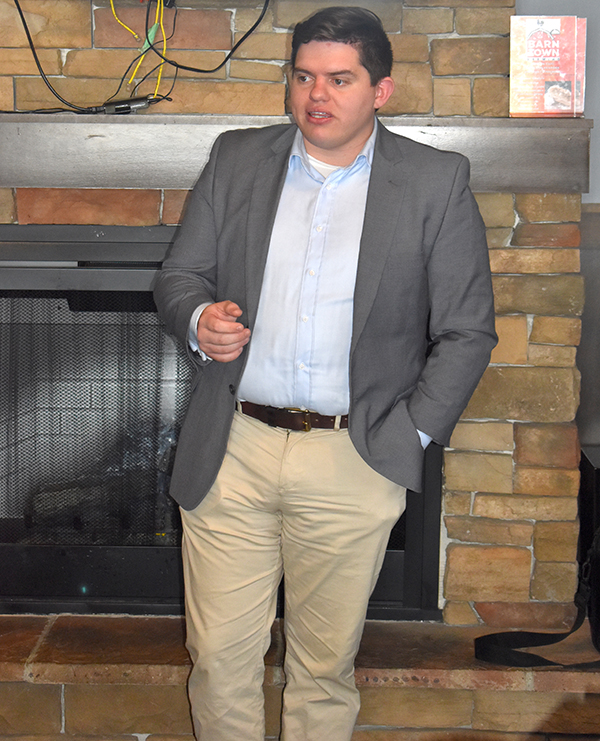
T-R PHOTO BY ROBERT MAHARRY Republican Congressional candidate Christian Schlaefer, a farmer and software consultant from rural Lakota, speaks to the Pachyderm Herd at Legends American Grill in Marshalltown on Friday. Schlaefer, Chris McGowan and Ryan Rhodes are vying for the GOP nomination in Iowa’s Fourth District.
Introducing himself as a political outsider and a grassroots candidate, Republican Congressional hopeful Christian Schlaefer braved the elements and stopped by the Pachyderm Herd at Legends American Grill in Marshalltown on Friday, the second time the Marshall County Republican club has hosted a District 4 candidate in as many weeks.
Schlaefer, 30, resides outside of the Kossuth County community of Lakota and works as a software consultant while also farming and serving as a volunteer firefighter and a laypreacher for two area churches. He and his wife have spent the last few years building a homestead on the farm, and they are expecting their first child this summer. He, Siouxland Chamber of Commerce President Chris McGowan and Iowa Tea Party Founder Ryan Rhodes are vying for the GOP nomination in the race to replace Rep. Randy Feenstra (R-Iowa), who is now running for governor.
As he shifted into explaining why he decided to run for office, Schlaefer highlighted his Christian faith and the nation’s Christian roots, a desire to give back to his community despite his firm belief in rugged individualism and a sense of industriousness. An erosion of core American values, he added, is why he jumped into the race.
“That is what’s at stake here in these elections. As Donald Trump leaves office in a few years, we’re gonna decide what the future of American politics is, and that is not a decision over economic policy. Economic policy is important and I’m going to talk about that here tonight, but it is fundamentally a decision over what American values are, what do we want this country to be and how do we want this country to operate?” he asked. “And when you look at cities around this country today, you’ll see that those American values are under attack.”
He cited New York City, which he described as “the greatest city in the world,” as a prime example of that erosion due to the election of Mayor Zohran Mamdani, a Democratic Socialist, along with recent “lawlessness” in nearby Minneapolis amid protests against Immigration and Customs Enforcement (ICE) operations there.
“When you’re up there, you realize that they’re not saying anything about immigration. It’s not about ICE policy being too aggressive. The values that they’re promoting are neo-Marxist values. They’re values about changing what America is, about condemning the types of people who built America and instead advancing a different type of people for the future,” Schlaefer said.
Implementing the values that he believes in, Schlaefer told the audience, comes down to three main areas. The first is immigration, both illegal and legal, as he noted that the Somali population in Minneapolis came to the U.S. legally as refugees and “fundamentally changed the landscape of the United States.” The second is economic and rooting out government overspending and waste.
“I always say that America was built on Main Street and the church, and it is that Main Street we need to fight for. In Lakota, we can’t just have a bar and a post office. You have to have businesses there, businesses ran by common Americans employing common Americans paying them a real living wage,” he said.
The third and final imperative, according to Schlaefer, are moral issues like abortion — on which he supports a complete federal ban and the position that life begins at conception — and transgenderism. He called abortion a core moral issue and took issue with conservatives celebrating the overturning of Roe v. Wade when it still permits states to allow abortions as their governments see fit.
After he completed his introduction, Schlaefer took questions for about 35 minutes on topics ranging from abortion to tariffs to agriculture to immigration. Because Iowa’s Fourth District, which covers 36 counties from Marshall all the way to the northwest corner of the state, is as conservative as it is historically, he felt it was important for candidates like himself to take principled stands and fight for them in Washington, D.C. instead of compromising. He called Feenstra, who was first elected to the House in 2020, a “conservative in broad strokes” who doesn’t have the voting record to back it up.
Answering a question on gender identity and preferred pronouns, Schlaefer said it wasn’t his responsibility to validate a “concocted lifestyle” and described transgenderism as “a sickness of the mind,” citing high suicide rates and condemning the institutions and medical professionals who advance transitioning procedures.
“Really, I think these type of procedures should be banned in the same way that you can’t go to your doctor and ask them to cut off your arm for no reason — that would be a violation of their medical duties — but certainly for children. It shouldn’t even be an argument that this stuff absolutely should not be allowed to happen,” he said.
On agriculture, he called for reform to move away from subsidy-based industries, diversifying the crops grown in Iowa, relying less on foreign markets like China, an emphasis on supporting small farmers, avoiding consolidation and making the transfer of land between generations less burdensome from a tax standpoint. That led into a conversation on tariffs in light of a Supreme Court ruling striking down President Trump’s ability to impose them under a 1977 law known as the International Emergency Economic Powers Act (IEEPA).
Schlaefer compared the trade war to an actual war, contending that the current administration is using tariffs to gain long-term leverage to level the playing field and establish a truly free market.
“So I think they have to happen, and I think we will pay an economic cost for them. I’m thankful that we have Donald Trump, an administration that truly cares about the people and makes sure that the cost is a financial one in the short term,” he said. “The administration needs to be able to do this, and they’re legally allowed to do it. They have been given these powers. They were handed over to them to execute them, and just from a practical standpoint, I don’t think anybody can honestly believe that our Congress would be able to pass reactive, effective tariffs against other countries.”
Returning to the abortion topic, Schlaefer told an audience member that Iowa’s current law, which bans most procedures once a fetal heartbeat detected at around six weeks of pregnancy, is a step in the right direction, but he will continue to push for a ban on all abortions and reiterated his criticism of conservatives celebrating the overturning of Roe v. Wade. He also said he supports banning foreign purchases of American land unless a company is specifically pursuing an industrial project that will create jobs, but he doesn’t believe it should be allowed on farmland.
On immigration, an attendee asked about situations for people who have come to the U.S. on work visas and are now running into trouble under the recent crackdowns, and Schlaefer, despite his compassion for those individuals, advocated for a hardline approach after decades of failed attempts at reform — calling for a complete moratorium for at least the coming years, the return of anyone here without authorization to their home country and a limited system based on merit and values once it is reopened.
“That has to be the future of American immigration because if it isn’t, we will simply lose this country,” he said.
He argued that immigration has actually driven down wages in places like Miami and also led to major instances of fraud such as the cases that recently made headlines in Minnesota. Finally, he told the crowd he would support term limits to stop a system that enables career politicians but felt representatives should have a chance to serve eight years to truly understand and master their positions. To drive home the point, he shared a personal anecdote about his father’s employment.
“My father worked for the State Department. Every couple years growing up, I would get bounced around, get posted, like the military, to a new country. The reason they cycle them around to all the countries, every two years, every four years, is because they learn that if you keep somebody there for too long, what happens is they become too cozy with the host government. They become corrupt. They start to advance policies that aren’t actually pro-American policies,” he said. “They cycle them to prevent that exact same abuse.”
As he wrapped up his remarks, Schlaefer made reference to one of his opponents, McGowan, who he said is backed by party establishment figures like former Gov. Terry Branstad and received Trump’s endorsement not long after the Caucus straw poll showed Schlaefer in the lead.
“My campaign is solely by talking to the people. If I’m in Congress, my obligation is solely to the people of Iowa and representing what they tell me because they’re the only ones who put me there and will continue to put me there,” he said. “Be very careful that we do not enter another situation where you elect an individual who is not beholden to the people but is beholden to other political actors or the major donors that back them because if that happens, what you do is you lose your voice in Congress. I think we have seen that happen over the last few years in this district, and we’re not at a time period where we should allow that to happen again.”
——
Contact Robert Maharry at 641-753-6611 ext. 255 or
rmaharry@timesrepublican.com.
Todays News

Lisa Naig rejoins HSMC Board of Directors

Former Tama County Engineer Ben Daleske joins city of Marshalltown staff

Seeing Anew Part II debuts at Fisher Art Museum Feb. 27
Farmers speaking at IDP press conference view Supreme Court tariff ruling as ‘welcome’
Two days after expressing frustrations over tariffs during a virtual roundtable event, a group of Iowa farmers ...
GOP Congressional candidate Christian Schlaefer visits Pachyderm Herd Friday
Iowa House passes ‘compromise’ 2% per-pupil education funding rate
Iowa House lawmakers passed the state’s per-pupil funding package Thursday for K-12 schools, amending the measure ...