MCSD using Google Gemini as vetted AI program
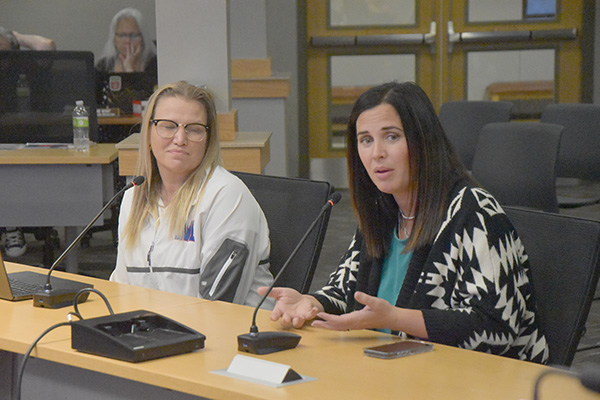
T-R PHOTO BY LANA BRADSTREAM Director of Technology Amy Harmsen explains how the Marshalltown Community School District (MCSD) should move forward with artificial intelligence (AI) during the regular Monday board meeting. She gave a presentation with Executive Director of Education Services Shauna Smith.
Artificial intelligence is frequently discussed in the country nowadays. At the regular Marshalltown Community School District Board of Education meeting Monday night, a presentation was made on the technology, also known as AI, by Executive Director of Education Services Shauna Smith and Director of Technology Amy Harmsen.
“At some point, you’ve probably wondered where we are as a school district, not only for our teachers, but also for our students,” Smith said. “I’m very thankful to have some very cutting-edge educators, including Amy, to be able to work through what some districts are doing with AI and would that work locally for us.”
The district hosted a professional development day in January and dedicated 90 minutes of that time to AI. The women wanted to present to the board what they learned during that time and share what the next steps will be. Harmsen said the day was used to present district AI policy to the teachers and provide guidelines on how to utilize the technology for themselves and with the students.
She said they have been working on how to drive AI in the Marshalltown Community School District (MCSD).
“I really got involved to make sure that what we chose as far as AI goes was compliant with things we have to have to think about when it comes to student privacy and rights, and really doing that diligently,” she said. “Some of the things we have done at the district level will talk about vetting high-quality AI that we feel good about telling teachers and students that they are safe using and that it can come alongside and work as a partner with them.”
Smith said the district is using Google Gemini, which has been vetted. Board policy states that AI should maintain safety and privacy of students, be accessible to students of all abilities, be accurate and must be monitored to ensure accuracy and appropriateness.
“I believe firmly that our students will be expected when they leave MCSD to use AI, to be really efficient users of AI,” she said. “It’s not realistic that we would ever think AI would ever go anywhere. We do have a wide spectrum of opinions of AI, and I’m sure you have experienced those too in your working environments.”
Harmsen said when it comes to accuracy, it is known online information can not only be biased, but also just flat out incorrect.
“How do we make sure students are evaluating what it is they see?” she asked. “The staff are evaluating what it is it comes up with and then truly fact checking.”
Harmsen said Google Gemini is also transparent and interruptible, which means the process can be stopped.
“What we really like is because we are already a Google district,” she said. “Google has allowed public districts like us to use their education tools for free, since 2010. They have really worked with school districts to make sure they understand how servers can protect and hold onto student data without the crossover of private to education. They also make tools specifically to be safe for students.”
Harmsen said they can see the “back end” of Gemini and see how it operates, ensure there are bumpers to prevent people from accessing everything. They can access a lot of it, she added, but not all of it. Making sure AI is being used ethically is also a huge consideration.
Smith told the board members many of them have probably already been using predictive AI for a long time.
“In some cases we think AI is brand new in the last three years, but generative AI is the new [AI],” she said.
Predictive AI makes predictions on content users might want to see based on historical data, such as Google Doc word prediction and YouTube suggested videos. Generative AI, such as ChatGPT, creates new content using data on which it has been trained.
Smith said responsible usage of generative AI includes not using it to create academic assignments. It can be used to clarify, assist, plan and revise or edit. Students must acknowledge their usage of generative AI, such as citing instances in their work.
She added teachers may not use AI to create materials for classrooms as the district has high quality curriculums which educators are to utilize. They also cannot use the technology to supplant their role as instructors, to compromise student safety or any unvetted AI.
Smith said they are already using Gemini for students in grades seven through 12, and would like to extend it to kindergarten.
“We’ve already communicated and had training with staff,” she said. “We have communication for parents, but haven’t sent that out yet.”
According to Harmsen, a lot of AI is already blocked on the MCSD firewall and with filters.
Superintendent Theron Schutte said he attended a couple AI sessions at a conference, and a couple things stuck with him.
“To claim to get kids career ready without AI being part of it would be negligence,” he said. “. . . Kids are going to use it whether we allow it or not, so what do we do to build digital citizenship as it relates to AI and the curriculum? . . . Then the key to successful use of AI is the ability to write effective questions. So, how do we build that into our literacy efforts, and how do we teach kids to scrutinize what AI generates, because it’s no different than reading the news or social media. Those were key points I took away . . . It’s exciting but scary, a new world as it relates to technology.”
Contact Lana Bradstream at 641-753-6611 ext. 210 or lbradstream@timesrepublican.com.
Todays News

GOP gubernatorial candidate Adam Steen highlights state administrative experience

Half Price Appliance officially opens downtown Marshalltown location

Marshall County Supervisor Heil announces run for re-election
MCSD using Google Gemini as vetted AI program

Former MHS business instructor pleads guilty to embezzlement from teachers union