
2026 Shear Colbert Symposium at MCC focuses on homelessness
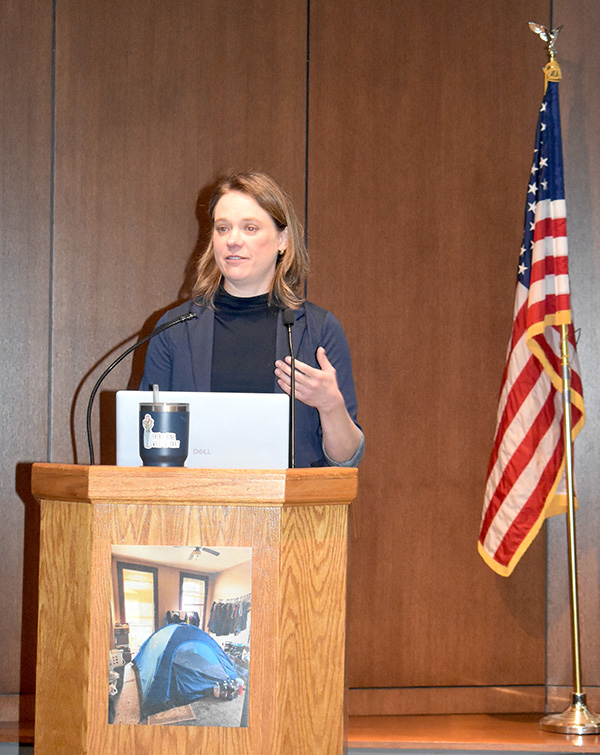
T-R PHOTOS BY ROBERT MAHARRY — Drake University Professor Elizabeth Talbert delivered the keynote address titled “A Door That Locks: Housing, Homelessness, and Stability in Iowa” during the Shear Colbert Symposium at Dejardin Hall on the Marshalltown Community College (MCC) campus Wednesday morning.
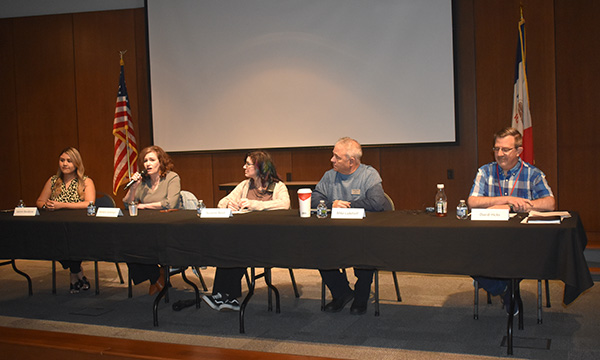
From left to right, Jasmin Banderas of Child, Adolescent and Parent Support (CAPS), Former Marshalltown Area United Way (MAUW) Executive Director Kendra Sorensen, Marshalltown Police and Community Team (MPACT) Advocate Suzy Reed, Marshalltown Mayor Mike Ladehoff and YSS of Marshall County Senior Director of Community Engagement David Hicks participate in a panel discussion during the Shear Colbert Symposium on the Marshalltown Community College (MCC) campus Wednesday morning.
T-R PHOTOS BY ROBERT MAHARRY — Drake University Professor Elizabeth Talbert delivered the keynote address titled “A Door That Locks: Housing, Homelessness, and Stability in Iowa” during the Shear Colbert Symposium at Dejardin Hall on the Marshalltown Community College (MCC) campus Wednesday morning.
From left to right, Jasmin Banderas of Child, Adolescent and Parent Support (CAPS), Former Marshalltown Area United Way (MAUW) Executive Director Kendra Sorensen, Marshalltown Police and Community Team (MPACT) Advocate Suzy Reed, Marshalltown Mayor Mike Ladehoff and YSS of Marshall County Senior Director of Community Engagement David Hicks participate in a panel discussion during the Shear Colbert Symposium on the Marshalltown Community College (MCC) campus Wednesday morning.
Trending
As the issue continues to garner attention and discussion in Marshalltown three years after a task force was originally established to address it, homelessness took center stage during Wednesday morning's Shear Colbert Symposium at Dejardin Hall on the Marshalltown Community College (MCC) campus that featured a keynote address from Drake University Professor Elizabeth Talbert titled "A Door That Locks: Housing, Homelessness, and Stability in Iowa" followed by a panel discussion moderated by MCC Professor Nancy Adams featuring members of the aforementioned task force.
It was the first symposium at MCC since 2023. The longstanding lecture series is named in honor of the late professor Tom Colbert, and his wife PJ provided introductory remarks before welcoming Talbert.
She kicked off her speech by describing conversations with individuals who have struggled with homelessness about the things they want in a living space: answers were as simple as a small garden, a door that locks, a place to keep their belongings and, most of all, a place they feel safe and stable.
"It's a place of belonging and a place of stability. It's a place where you feel comfortable and you feel warm. It's where you come back to when the trials of life get you down, where you recharge, where you start out," Talbert said.
She pushed back against the idea that individuals must complete treatment before they can obtain stable housing and said the biggest current problem is the fact that there are only enough available units for 16 percent of people in crisis.
Talbert also cited a statistic that it would cost approximately $72.5 million to fully address the issue of homelessness in Iowa, and the most recent state budget appropriated about $1.5 million -- less than five percent of that total. She broke down numbers and findings from the Unsheltered Des Moines study before wrapping up and passing the microphone to the panel -- Jasmin Banderas of Child, Adolescent and Parent Support (CAPS), Former Marshalltown Area United Way (MAUW) Executive Director Kendra Sorensen, Marshalltown Police and Community Team (MPACT) Advocate Suzy Reed, Marshalltown Mayor Mike Ladehoff and YSS of Marshall County Senior Director of Community Engagement David Hicks.
With Adams steering the conversation, each member of the panel introduced themselves, spoke of their connection to the issue of homelessness and discussed the steps the task force is taking to address it. Banderas said CAPS has seen "a big increase" in homelessness cases in the last few years, working primarily with families, and she joked that 4 p.m. calls on a Friday afternoon just before the staff heads home for the weekend are exceedingly common.
The group recapped the various resources available to the public for those struggling with homelessness or housing instability in Marshalltown, and Hicks recounted the origins of the MPACT program, which launched in 2021 thanks to funding from the city council under the leadership of Hicks and former Police Chief Mike Tupper. Ladehoff also highlighted the key role that local churches and organizations like 100 Women Who Care have played in fundraising efforts for the task force. The most recent Point in Time (PIT) count showed 23 people experiencing homelessness in town, though Hicks guessed that the actual number was likely higher.
At the end of the approximately 30-minute discussion, members of the panel took questions from those in the audience, and Talbert reflected on the experience during a brief interview with the T-R.
"The more we can get the stories of homelessness out there and kind of the need and bring coalitions like this together, the better politicians will be informed, but I think another thing we need to do more is kind of a cost-benefit analysis," she said. "It's expensive for cities to support homelessness. It's much less expensive for them to have people who are housed and contributing to the economy in very productive ways. So the more we can have information on that, the better."
She also recounted a quote she heard at another event that if every church in America adopted a homeless person, there would be no homeless people. PJ Colbert Joslin cited Talbert's extensive research on the issue as the primary reason she was chosen for the symposium and called her "a perfect fit."
In conclusion, Talbert was asked what she hoped the biggest takeaway from the morning would be.
"That homelessness is a structural problem, not an individual failing despite the stories we like to tell ourselves and that it's gonna take kind of a collective will to make it better. And we can start that by convening things like this," she said.