
Council hears update from Marshalltown Water Works GM
Trending
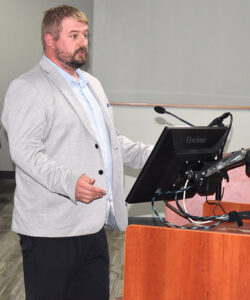
Marshalltown Water Works (MWW) General Manager Zach Maxfield shared an update on his department with the city council during Monday night's meeting and touched on several recent topics of conversation before opening up the floor to questions.
MWW is an enterprise fund governed by a three-member board of trustees appointed by the mayor without council approval, and they oversee about 160 miles of water mains under the ground, some of them well over a century old, along with 1,000 fire hydrants they are tasked with maintaining and flushing and 1,000 valves used to fix main breaks -- on average, there are about 20 breaks a year.
The staff performs fire hydrant flushing annually, but Maxfield said it didn't happen last year due to staff turnover and a project to replace nearly 10,000 meters.
"Our guys had to go walk 14 miles a day every day... to read everybody's meter," he said.
Since they've been replaced, staff has been able to collect readings by driving and significantly cut down the amount of time it takes. He also said the new meters make it easier to detect anomalies like leaks that result in an abnormally high bill and work with the customer to address those situations.
This year, the plan to start with hydrant flushing on the west side of town and then move to the east, and at City Administrator Carol Webb's request, Maxfield dove deeper into the decision making process on which ones are replaced first.
"Typically, we don't know that a fire hydrant's out. We don't have an alarm that goes off when one gets hit or something isn't working," he said.
When they go out to flush them, they take chlorine levels, how long they flushed it and whether it's operable or not, and they decide which areas have the highest levels of immediate need. They also try to keep the Marshalltown Fire Department (MFD) in the loop to avoid sending them to a broken hydrant on a service call.
Residents typically expect fire hydrants to be fixed quickly, and the goal is to avoid tearing up a busy road and disrupt traffic. A hydrant can cost upwards of $10,000 to replace. As he took his first break for questions, Councilor Jeff Schneider asked Maxfield if customers receive a courtesy call when leaks are suspected.
He replied that if they notice a sudden surge, a billing clerk will reach out to the customer, or a staff member will be sent out to determine if it's something out of the ordinary or just filling up a pool. Maxfield said they also work with people and make arrangements to lessen the burden of a large water bill if a leak is found.
Maxfield then shifted the discussion to the city's aging water infrastructure with some pipes over 120 years old, and he noted that multiple projects are currently in progress with most of the work done in house as a cost-saving measure.
"We can lay more pipe for cheaper. It might take a little bit longer, but we recognize that and we try to work with homeowners and business owners in those areas to say 'Hey, we're gonna be going through your yard. It might not get done as quick as another contractor, but we'll be back.' We're gonna repair it to the best of our abilities and try to be transparent about what we're doing," he said.
The current projects include West High Street and on Main Street as part of the larger street replacement.
"That is a huge project, and I'm so happy that you guys are doing that because I've worked here for about 10 years and that's a scary area for us because of the impact they can have to downtown and the hard capabilities it would take to fix a problem down there," Maxfield said. "So I'm happy that the project's getting done and it's getting done fast. So I thank you guys for that."
Another major project is the construction of a 6 million gallon Reverse Osmosis (RO) treatment plant north of town to go with the 12 million gallon a day lyme softening treatment plant.
"It'll free up some water so any future infrastructure or somebody new coming to town, we'll be able to provide water for them," he said.
The plant is slated to be finished in the spring of 2028, and Maxfield offered tours for anyone interested in learning more. From there, he opened the floor back up for questions, and Schneider asked if the waters were blended to ensure quality taste with the new treatment process. Maxfield replied that MWW has a strong water source with no nitrates or PFAS chemicals and said it contributes to the consistently well-regarded taste of the water coming out of the taps.
"We are well aware that Marshalltown has really good drinking water, and we don't want to change that at all," he said.
He concluded by thanking MWW staff for all of their efforts and public service in ensuring a quality product. During the public comment period, Tim Bradbury asked about how MWW accommodates large water using customers like Alliant Energy and JBS and whether any of the costs are passed on to residential customers.
Maxfield said rate increases are flat across the board, and the large businesses are required to pay the costs they incur. On average, about 6.5 to 7 million gallons of water are used in the city, and the peak days are closer to 12 million.
"With Marshalltown growing, we have to grow," he said. "With those places having big large industrial consumers, we're still able to pump them and get the revenue back without having to put that burden on the residents."
There have been large rate increases in recent years, he added, but that was the result of Marshalltown previously having "the cheapest water in the state" and stressed the need to invest in infrastructure. The current plant is around 50 years old, and while Maxfield hopes to get another 20 to 30 years out of it, he conceded that it is coming to the end of its life.
Bradbury also asked if MWW ever runs out of water, and Maxfield said they are in the process of looking for more wellfields to ensure a consistent long-term supply.
"Marshalltown is a very fortunate place when it comes to water, water quality and the amount of water that we have," he said.
------
Contact Robert Maharry at 641-753-6611 ext. 255 or
rmaharry@timesrepublican.com.