
Council proceeds with placing franchise fee on November 2027 ballot
Trending
Marshalltown voters will have the chance to decide the fate of a three percent franchise fee on gas and electric bills during the November 2027 city/school election after the city council voted unanimously to proceed with that course of action during Tuesday night's meeting.
During the previous meeting, the council voted 4-3 against taking the next steps in implementing the fees through a public hearing and ordinance readings -- which likely would have triggered a special election by petition -- and City Administrator Carol Webb explained that the council had received feedback suggesting a narrower revenue purpose statement more specifically detailing how the money would be spent on public safety and placing the item on the 2027 general election ballot rather than paying for a special election.
According to Webb, the Marshalltown Police Department's (MPD's) Fiscal Year 2027 budget is approximately $6.6 million, while $4.2 million is allocated for the Marshalltown Fire Department (MFD), and cost pressures include wage increases, overtime, fuel and vehicle costs, the Marshalltown Police and Community Team (MPACT) -- which is currently only funded until the end of 2026 -- and ongoing building costs. A three percent franchise fee would generate an estimated $1.5 million annually with $500,000 of that replacing Local Option Sales Tax (LOST) revenue.
Councilors Greg Nichols and Sue Cahill quickly endorsed the revised plan, which Cahill felt would give them ample time to educate the public and make the case for how the franchise fee revenues would be spent after a five percent fee failed by a 3-to-1 margin at the polls in a 2023 special election. Fellow Councilor Jeff Schneider commented that the fee is a necessity.
"Our general fund revenue is going to be gutted going forward. I think waiting until November of '27 is waiting too long. I think we need to act sooner," he said.
If the ballot measure passes next year with the required 60 percent supermajority, Webb projected that the first revenues would be collected approximately three to four months after the election. Councilor Gary Thompson also asked whether the issue would be "dead in the water" if the council decided against placing it on the general election ballot.
"I don't know of another option, so I would say yes," Webb said.
Nichols then made a motion to proceed as outlined, which garnered a quick second from Cahill, but Webb's request for clarification on whether MPACT should be included as part of the public safety portion of the fee prompted a more in-depth discussion. Nichols and Councilor Melisa Fonseca felt that MPACT should be included, but Councilor Marco Yepez-Gomez thought it would be "easier to digest" if people knew all of the money was going to police and fire salaries.
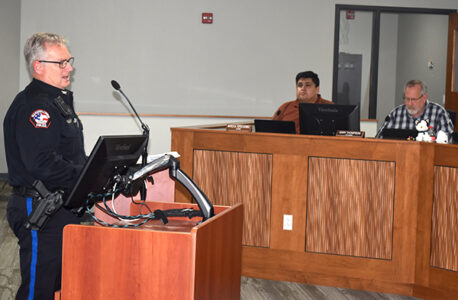
Police Chief Chris Jones then came forward to discuss the MPACT funding situation, noting that Marshall County has received opioid settlement dollars to make the program countywide, and he also said he has been in conversation with Judge Sharon Greer about finding ways to supplement the program with state dollars through the court system. The current annual cost to the city with two MPACT advocates is estimated at $180,000.
Nichols then said he would support the current proposal with or without MPACT while mentioning that he would like to see the program funded one way or another.
"We need to pass this franchise fee, so if there's concerns about MPACT, we can withdraw it. But I like it in there personally," he said. "But I would take it out if people felt that would improve the chances of it passing."
Cahill opined that MPACT would give the ballot measure a better chance of passing given the positive feedback it has received in the community since its inception in 2021. It was clarified that the motion the council was voting on would include MPACT before the floor was opened up for public comments.
Layne Pieri asked about the process of amending the revenue purpose statement and, while expressing support for the fee, suggested putting the money toward "basics" like roads and sidewalks instead of public safety.
"When those improve, people notice, and when people notice, confidence starts to come back," Pieri said. "Let people see the progress. Let them feel like they're a part of it. I don't think this has to be a tense or divisive issue. I think this is actually a great opportunity to work together and rebuild that shared sense of purpose because at the end of the day we're all on the same side here."
Doris Kinnick shared her support for putting the item on the November 2027 ballot and educating the public in the meantime, and Cahill then clarified that the money going into the general fund would still free up dollars for other expenditures such as sidewalks and roads.
Thompson then asked if bringing the MPACT advocates in as city employees would save money on administrative costs as opposed to the current arrangement with YSS of Marshall County, and Jones replied that making the advocates government employees could actually restrict their abilities to interact with clients, take them to appointments and build cases.
"That makes sense. I just don't want to be overpaying for that freedom," Thompson said.
If the measure fails at the polls next November, the council would be free to pursue another election at any time in the future. Schneider reiterated his argument that the council was acting too late by waiting until next year, and Yepez-Gomez responded to Pieri's comment by noting the recent general fund shortfalls the council has faced and changes in state law limiting property tax increases.
The council ultimately voted 7-0 to proceed with the 2027 general election route. According to Webb, ⅓ of the generated revenues would still go toward property tax relief with the other ⅔ going to public safety.
------
Contact Robert Maharry
at 641-753-6611 ext. 255 or
rmaharry@timesrepublican.com.