
Supervisors, county engineer discuss plans for 260th/Ridge Rd. area during special meeting
Trending
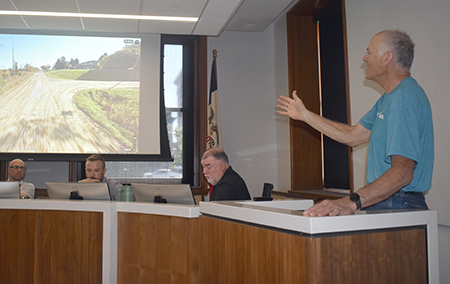
Over 2 ½ years after nearby residents Mark Wyant and Harlan Helgren first approached the Marshall County Board of Supervisors to request improvements to the 260th Street/Ridge Road area just south of Marshalltown, the board and County Engineer Paul Geilenfeldt discussed their plans for the project during a well-attended special meeting at the courthouse on Wednesday morning.
Geilenfeldt explained that he has sent a letter to adjacent residents laying out the work of cleaning and regrading ditches, reshaping driveways and improving the intersection of Ridge Road and 260th Street. Most driveway culverts will be replaced to align with the new ditch grades, and he asked for patience and understanding while the work is being done.
He vowed to avoid making promises he couldn't keep.
"I can promise you this. Wet weather will make our project. I will also promise that we will work hard to control erosion and restore ground cover," Geilenfeldt said.
He also offered his direct contact information for everyone in attendance to ensure that lines of communication stay open. Safety, sight distance and drainage have been the biggest ongoing concerns along the gravel roads, and the engineer then provided a more technical breakdown of the issues, including a comment that postal carriers sometimes haven't even been able to deliver mail.
Geilenfeldt opened the floor up to discussion, and Helgren came forward first, noting that he and his neighbors have all pulled people out of the ditch.
"It's a visual accident. Every time I go to my mailbox, you've gotta drive over the hill to see who's coming, and I just think the big problem with this road, even the intersection, it's a safety problem," he said. "And someday, somebody's gonna get hurt, and there'll probably be some kind of action with the county paying."
In response, Geilenfeldt said he was at "a fork in the road" between the options of purchasing a limited amount of right of way to pursue the project and purchasing a temporary easement on every affected property, which could quickly get out of county staff's "weight class," in his words.
"We've got the talent. We just don't have all the tools to do it," Geilenfeldt said.
The other major issue, he said, is that the project will have to be funded entirely by local county dollars as opposed to any state or federal sources. Steve Seberger, who lives on Ridge Road, told Geilenfeldt he has put his car in the ditch twice in the time since he moved there, and he suggested that the crown should be reduced or modified in some way -- the target, according to Geilenfeldt, is four percent to keep water off the road.
After Supervisor Jarret Heil asked, Geilenfeldt estimated that the crown is currently at four to six percent. Dave Hala commented that while drainage was a concern, he was more worried about drivability and the road becoming too narrow after it was re-engineered.
"Straddling the crown is super dangerous because you can't see. You're in the middle of the road, and a lot of the time, somebody else is always coming," he said.
Geilenfeldt spoke further on the budget implications and predicted that a grade and pave project there could cost as much as $1.5 million, which would take time and good weather to build up a fund balance unless the supervisors opted to borrow the money instead. Supervisor Carol Hibbs asked him for a timeline on the work, and he said the majority of it would take place after July 1 with the idea that "someday," the road will be paved. While he wouldn't assume they'll get good weather, he projected that rebuilding the intersection would likely take nearly a month. The intersection would also need to be completely closed to traffic during that time.
Seberger also wondered if a guardrail was possible for the north side of the 260th/Ridge intersection, and Geilenfeldt said a cable guardrail could be feasible.
Mel Osgood shared similar experiences to the other residents, which prompted Geilenfeldt to recall the "tow truck that had to call a tow truck" story.
"Hopefully, when we get done with this, people won't have to ask 'Why do I live here?' Even though I ask that, a lot of times for the whole state," Geilenfeldt said.
The engineer told the crowd that with its traffic count of 270 vehicles per day, it would be easier to maintain 260th Street as a paved road than rock. Wyant told the engineer he and his team could do whatever they wanted on his property to make the intersection safer, and Danny Nelson asked about the timeline for survey work and the project budget.
At this point, Geilenfeldt didn't have an overall budget finalized, but he vowed to send it out as part of a letter to affected landowners. As the conversation wrapped up, he commented that the work was "overdue."
"I've kind of violated my own rule here of if you've got to eat a frog, it's best not to look at it for too long, and I've looked at this one for too long," Geilenfeldt said.
Heil thanked Geilenfeldt for his work and all of the attendees for their participation in the conversation, adding that he hoped they would continue working together going forward.
------
Contact Robert Maharry at 641-753-6611 ext. 255 or rmaharry@timesrepublican.com.