
Council presses pause on approving chain link fencing for Center Street viaduct
Trending
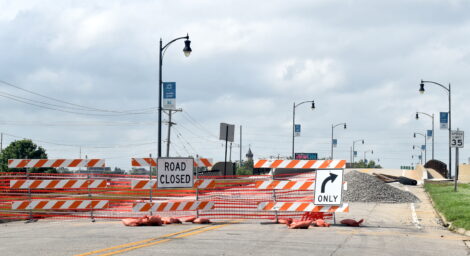
After the Marshalltown city council voted to move forward with a proposal to install chain link fencing along the currently closed Center Street Viaduct during a meeting last month, the topic came up yet again during last Monday night's meeting -- this time as a change order that would have formally approved the chain link fencing was pulled from the consent agenda -- as the discussion carried on for nearly a half hour.
Councilor Melisa Fonseca explained that she requested to pull the item after hearing some "community ideas" on other potential options besides the chain link fence, and she asked City Engineer Ben Daleske to share his thoughts. Daleske provided a brief history of the bridge and noted the painting effort in 1997. The most recent major repair, he said, was in 2005.
The current cost estimate to put the chain link fencing in is $109,000, and Daleske said the city would either have to do "one or the other" before reiterating his previous recommendation to perform the deck repair instead of replacing the fencing. He also warned that holding off on a decision, as some members of the public have suggested, will delay the completion of the project.
According to Union Pacific standards, the fencing needs to be 10 feet tall or eight feet with an overlink and two-inch mesh chain link. The Iowa DOT standard is a four-foot tall vertical fence, and currently, it's 3 ½ feet tall. If the council opts to repaint the current railing, it would be grandfathered in and not subject to those design standards.
Councilor Greg Nichols asked Daleske about the original cost of sandblasting and repainting the fence in the contract, which was about $290,000, and he brought up images of the posts in their current condition to highlight how degraded they had become.
"The idea of painting over this and thinking we have a solution would be, in my mind, doing nothing other than making ourselves feel a little better because based on the shape of this metal, if we sandblasted that, all we would be finding is more problems," he said. "So this hasn't been tested, not even a tap test to go see how many places are about ready to give up."
Nichols called painting over the current railing a waste of money and time and recommended either moving forward with a chain link fence or replacing the railing up to current standards. In response to another question from Councilor Gary Thompson, Daleske said the $290,000 for painting and sandblasting did not include any repairs, and he clarified that the $109,000 for fence replacement would be added on to the original $290,000, thus not resulting in an initial cost reduction.
Boulder Contracting has already requested 15 extra days to complete the chain link fencing, according to Daleske. Councilor Sue Cahill recalled her late husband and their children all working to paint the railings back in 1997 and noted the sentimental value it holds, but, like Nichols, she worried about the potential futility of trying to choose a more aesthetically pleasing option given the condition of the railings.
Daleske did tell Mayor Pro Tem Jeff Schneider that he had consulted with a contractor about "better looking" options and gotten a quote for $148,000, and Fonseca asked about the life expectancy of a black chain link fence. He replied that the warranty was for 15 years, and it was later clarified that the chain link fence on the 3rd Avenue viaduct is 42 years old.
During the public comment period, Heidi Dalal thanked the council for being willing to discuss the matter further and hoped to pause on moving ahead with chain link, offering to help city staff with looking into other opportunities and partnering with local organizations to help make it happen. Tim Bradbury wondered about the number of change orders and whether the other bidders who came in higher than Boulder had actually provided more thorough estimates.
John Hermanson highlighted the importance of the bridge as a gateway to downtown, comparing the current discussion to a proposal to tear down the old ticket booths at Franklin Field to put up chain link fencing. Ultimately, however, after a "pause," the booths stayed.
"That refurbished gateway really has served not just as a gateway to the 13th Street District and the Iowa Veterans Home but really a gateway to progress down there," he said. "And I feel like this bridge is really similar. It's the gateway to our downtown, which is really the heart of our community. The gateway is an experience that you counter as you're approaching this place, and what kind of feeling that you're afforded during that experience is significant."
Chain link fencing, he added, could make a bad impression on young professionals considering a move to Marshalltown, and like Dalal, he advocated for more of a pause to evaluate other options. Conversely, April Long commented that she drives the other viaducts in town frequently and never notices the chain link fencing as it blends into the landscape.
"Safety should be the number one priority. Save that additional funding and make our streets better so that when people drive into town, they're driving over streets that aren't filled with potholes," she said.
If the city had unlimited funds, Long noted, a more aesthetically pleasing project would make perfect sense, but she urged the council to take a more "sensible" path and go with the galvanized fencing. As Schneider asked for a council action, Thompson worried about delays in the project and resulting public frustration, and he hadn't heard of anyone offering up private funds to contribute.
"I'm telling you right now, my vote is to go to chain link because I don't think we can leave that viaduct closed past Oct. 15," he said.
Schneider wondered about a two-week hiatus and how that might affect the completion window, and Daleske said he could consult with Boulder to see what they say. Carol Webb added that the next council meeting isn't for three weeks, and she could do the best she can to explore more options and their costs.
"I would imagine that it'll delay the project somewhat. I don't know by how much," she said.
Ultimately, a motion to postpone the decision to the next meeting on July 13 passed by a unanimous 7-0 vote.
Contact Robert Maharry at (641) 753-6611 ext. 255 or rmaharry@timesrepublican.com.