
‘Don’t believe all the misinformation’
Flanked by farmers and pork industry leaders, Rep. Hinson touts Save Our Bacon Act in Marshall County
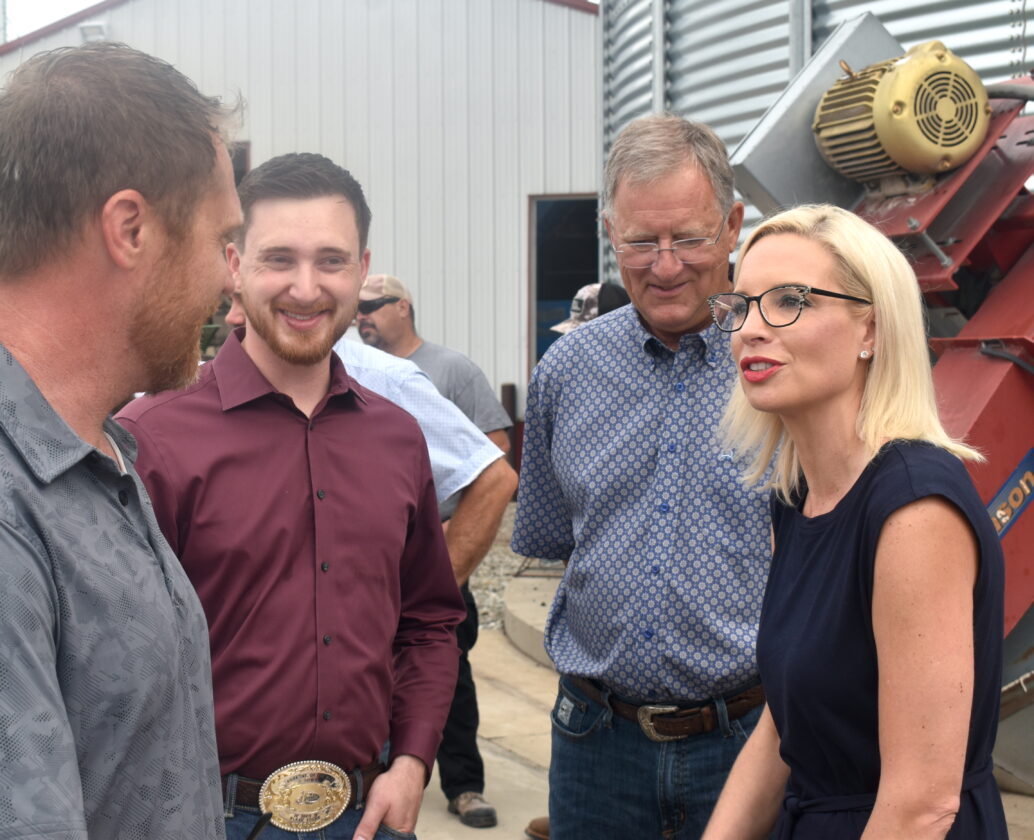
Once the formal press conference had concluded, Hinson, who is seeking a seat in the U.S. Senate in the November election, stuck around to interact with attendees including State Center area farmer Blake Edler, second from left, who spoke during the event.
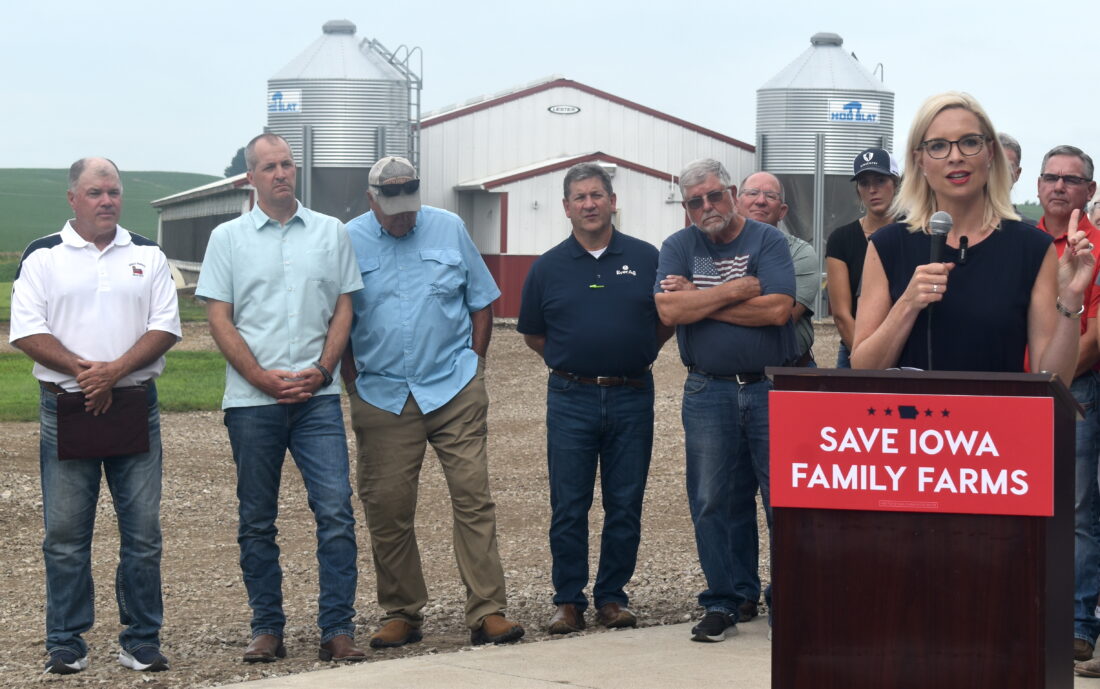
T-R PHOTOS BY ROBERT MAHARRY U.S. Rep. Ashley Hinson (R-Iowa) addresses an audience gathered at the farm of Tom and Suzanne Mead northwest of Marshalltown on Friday morning for a press conference about the Save Our Bacon Act, which she has introduced in response to state animal welfare laws like California's Proposition 12.
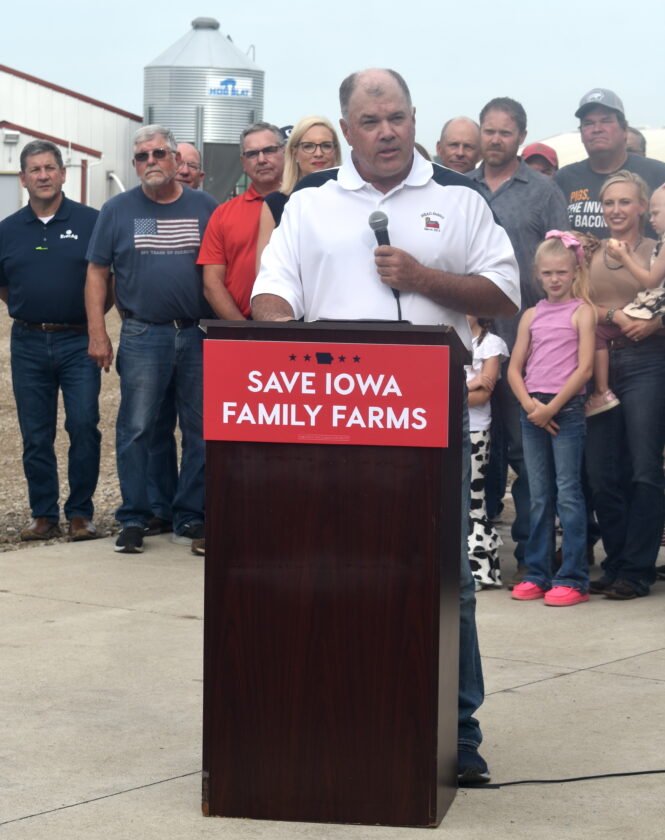
Tom Mead, the owner of the Century Farm between Marshalltown and Albion, was the first speaker of the morning.
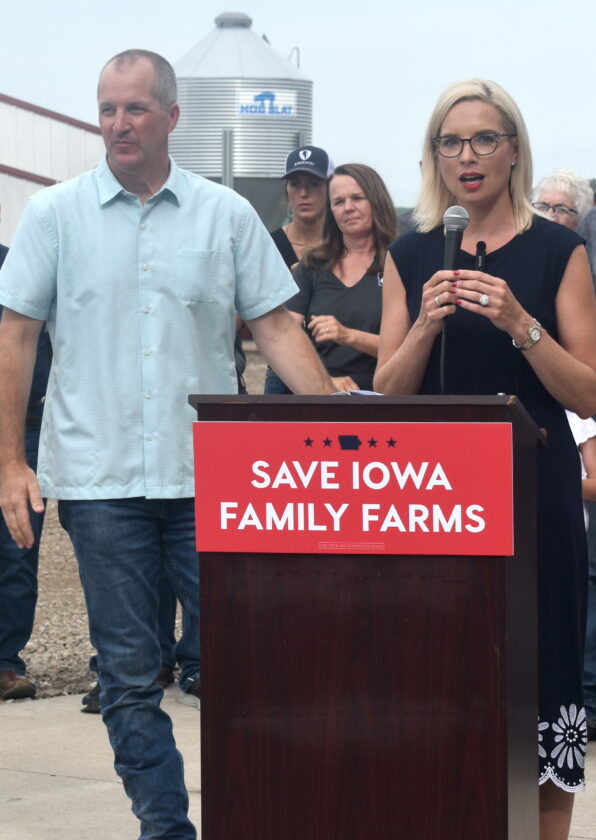
Hinson, right, and Iowa Secretary of Agriculture Mike Naig, left, take questions from the media at the conclusion of Friday morning's press conference in Marshall County.
Once the formal press conference had concluded, Hinson, who is seeking a seat in the U.S. Senate in the November election, stuck around to interact with attendees including State Center area farmer Blake Edler, second from left, who spoke during the event.
T-R PHOTOS BY ROBERT MAHARRY U.S. Rep. Ashley Hinson (R-Iowa) addresses an audience gathered at the farm of Tom and Suzanne Mead northwest of Marshalltown on Friday morning for a press conference about the Save Our Bacon Act, which she has introduced in response to state animal welfare laws like California's Proposition 12.
Tom Mead, the owner of the Century Farm between Marshalltown and Albion, was the first speaker of the morning.
Hinson, right, and Iowa Secretary of Agriculture Mike Naig, left, take questions from the media at the conclusion of Friday morning's press conference in Marshall County.
Trending
Current U.S. Rep. Ashley Hinson (R-Iowa), who is running for a seat in the U.S. Senate this November, convened a group of pork producers and swine industry leaders along Iowa Secretary of Agriculture Mike Naig for a press conference at the Marshall County farm of Tom and Suzanne Mead on Friday morning to advocate for the Save Our Bacon Act, a bill she introduced last summer, and take aim at individual state laws like California's Proposition 12, which they argued poses a grave threat to the future of local family farming operations.
Of the featured speakers, four hailed from either Marshall or Grundy counties -- Tom Mead, Blake Edler of State Center, current Iowa Pork Producers Association (IPPA) President Dean Frazer of Conrad and Iowa Farm Bureau Federation Vice President Brian Feldpausch of Beaman. Emphasizing his own generational pork producing legacy, Mead called Hinson an advocate for farmers and credited her with leading the fight against Prop 12, which "requires veal calves, breeding pigs, and egg-laying hens to be housed in systems that comply with specific standards for freedom of movement, cage-free design, and specified minimum floor space" while also prohibiting a farm owner or operator from "knowingly confining these specific animals in a cruel manner, as well as prohibits a business owner or operator from knowingly engaging in the sale of shell eggs, liquid eggs, whole pork meat or whole veal meat from animals housed in a cruel manner."
"We are grateful to have Ashley here with us today along with Secretary Naig to help tell the truth about what Prop 12 means for Iowa farmers, the pork industry and rural communities," he said.
The Save Our Bacon Act was included in the House's draft version of the Farm Bill, but not the Senate's. It would essentially prohibit individual states like California and Massachusetts from regulating animal welfare practices in other states like Iowa, which produces the most pork in the U.S. Frazer, whose family has been farming in the area for over 155 years, noted that most of the pigs they raised are hauled and processed at the nearby JBS plant in Marshalltown.
He criticized Prop 12 as an initiative championed by "out of state activists" attempting to dictate how Iowa farmers raise their livestock and increasing costs for consumers, with pork typically costing 20 to 25 percent more in California than it did before the law was enacted.
"This is not a debate about animal welfare like they try to make it be. Farmers care deeply about their livestock's health and wellbeing. This is a fight to keep a growing patchwork of state-by-state regulations from squeezing more family farms out of business across the country," Frazer said.
He contended that a coordinated smear campaign had been waged through television advertisements painting the Save Our Bacon Act in a negative light.
"This is unacceptable, and Iowa pork producers will not back down," he said. "Don't believe all the misinformation out there. The campaign against us has spent over $30 million campaigning against the Save Our Bacon Act, including approximately $3 to $5 million in the state of Iowa." a
Edler told the audience that Prop 12 was predicated on misinformation about animal behavior, and he said the standards the law proposes would actually cause increases in lameness, injury and health problems. During his remarks, Feldpausch noted that the Save Our Bacon Act was about more than just livestock standards -- it is a matter of protecting interstate commerce.
"One state shouldn't be allowed to dictate to the other states what's going on. One state can't control what the other 49 do. It shouldn't regulate how farmers and businesses operate across its borders and across the entire country. That's not how interstate commerce was ever designed or supposed to work in America," Feldpausch said. "America works best when we have one national marketplace, one set of rules, not 50 different rulebooks across each and every state. If every state can impose its own standards on everyone else, we'd have nothing but a patchwork of conflicting laws and regulations that no farmer, manufacturer or business would be able to realistically meet and navigate."
While the current conversation surrounds pork, he added, it could eventually include any food product sold across state lines. At a grocery store in Sacramento he visited, Feldpausch said customers are buying bacon by the slice instead of the pound due to the cost, and a package of bacon at the same store sells for over twice what it currently costs in Marshalltown -- $11.99 at the former compared to $5.99 at the latter. He concluded by calling on the Senate to pass the Save Our Bacon Act and the larger Farm Bill so that President Trump can sign it into law.
Other featured speakers before Naig and Hinson included past Iowa Pork Producers Association Trish Cook of Buchanan County and National Pork Producers Council President Rob Brenneman of Washington County, who both warned that Prop 12 would result in the closure of family farms across Iowa and reiterated their commitments to animal welfare.
"Take it from me, a pig farmer for over three decades. Prop 12 is a direct threat to Iowa agriculture and an insult to our way of life. Consumers cannot afford a 50-state patchwork of contradictory laws," Cook said. "They rely on me, as a farmer, to produce a nutritious, delicious and economical protein. And don't forget, the ultimate goal of activists pushing Prop 12 is ultimately a meat-free society. Imagine a life without bacon. It'd be really sad."
Brenneman thanked Hinson and the rest of the Iowa congressional delegation for their efforts and commented that he was "a real-life Iowan," likely in reference to the ads attacking the Save Our Bacon Act as a handout to Chinese-owned pork corporations. Naig noted the Century Farm status of the property where he was speaking and reiterated that Prop 12 has real impacts on family farms and the pork industry in Iowa.
"No state should dictate to an Iowa farmer how they should farm, especially when it comes to preferences in their food selections, especially when those rules are written by people who don't understand agriculture, especially when those rules are specific to the production of food," he said.
He also warned that small and midsize producers will be "squeezed out" if the law is not changed, and he praised Hinson for listening to farmers, standing with farmers and defending agriculture in the state. Finally, Hinson herself took center stage and thanked the farmers in the audience for standing beside her on the issue.
Prop 12, she said, is the concern she has heard about the most during her visits to farms across the state, and she lamented the "out-of-state liberal money" flowing into the state to attack her proposed legislation. The truth, according to Hinson, is that Prop 12 compliance costs as much as $4,000 per sow, and while larger operations can absorb the expense, family farms cannot.
"One of the most insulting parts of the campaign, in my mind, is the suggestion that our farmers only care about the bottom line, that they don't care about the welfare of the animals they are raising," she said. "As you've heard from these folks today, nothing could be further from the truth. The folks standing behind me know better than anyone that animal health and wellbeing is their top priority because that is their bottom line."
Hinson wrapped up her remarks with a bit of self-described bluntness. Any politician who supports a mandate like Prop 12, she argued, is not fit to represent this state in Washington, D.C., and she asked voters to "think deeply" about the positions her Democratic opponent in the Senate race, Josh Turek, would advocate for if elected.
"How can he side with those liberal out-of-state radical anti-ag activists over Iowa's hardworking farmers who are feeding and fueling the world every single day? How can he denounce corporate dark money while looking the other way when these same dark money groups are attacking our Iowa farmers and our way of life?" she asked. "How can he perpetuate the nonsense that our producers don't care about animal wellbeing and sustainability? You either stand with the radical vegan activists who don't know the first thing about farming, or you're like me. You stand with Iowa agriculture."
In conclusion, she said she would not back down in the fight and called out Turek for missing 58 percent of his votes in the state legislature during the 2026 session. Hinson then took questions from the gaggle of media members before sticking around to interact with attendees at the farm on Summit Road located between Marshalltown and Albion.
In response to a question from the T-R about balancing states' rights with interstate commerce, Hinson said the Save Our Bacon Act "threaded that needle" in a bipartisan fashion.
"What our bill does, it doesn't nullify any state laws per se. California can still regulate their own producers. They just can't tell Iowa producers how to do their job," she said. "So I think we've been able to do that -- again, fixing this loophole, I guess you would say, for interstate commerce (and) respecting states' rights in the process. Again, if they want to tell their producers to comply with Prop 12, they can do that, but Iowans should not be shut out from one of the largest markets in the country because of a radical anti-agriculture agenda coming out of California."
Contact Robert Maharry at (641) 753-6611 ext. 255 or rmaharry@timesrepublican.com.