
Marshalltown city council reverses course, OKs four-month data center moratorium
Planning and Zoning Commission will work to recommend regulations
Trending
Three weeks after voting 4-3 against enacting a six-month data center moratorium, the Marshalltown city council returned to the controversial subject during Monday night's meeting and this time, voted 5-2 in favor of proceeding with a four-month moratorium to allow time for regulations and restrictions to be put in place before a project can receive approval.
After spending nearly an hour on the topic during the prior meeting, the council went even longer discussing the item on Monday as Assistant Housing and Community Development Director Clayton Ender kicked off the conversation by recounting his consultation with the city attorney to determine "legal and procedural mechanisms" because the council had previously instructed staff to work with the city's economic development team -- the Marshalltown Area Chamber of Commerce -- to devise a process requiring development agreements for future data center projects.
"We don't really have a codified mechanism in place to establish that currently, and it would potentially be problematic to enforce such a thing, so in light of those legal concerns -- and we also had a motion that failed to refer this to the Planning and Zoning Commission -- it's conflicting information. That's why it's back in front of us tonight," Ender said.
He provided the council with a fact sheet on how data centers, which are not specifically mentioned in the zoning code, are currently regulated, and it would fall on the zoning administrator -- Ender -- to determine comparable uses and make a judgment on regulations. He said it would be classified as a major utility, and such a use is not permitted or prohibited in any zoning district, meaning it would be eligible in all zoning districts within the city while subject to a special use permit. Such an application would start with a staff review, a recommendation to the P&Z Commission and a final decision by the Board of Adjustment.
"At no point does an application require coming before the city council unless they request tax incentives or financial incentives from the council," he said. "We do have to be careful that it doesn't become arbitrary and capricious, that we're not just targeting a single user whereas everyone else is treated differently."
The council would be required to approve any requests for annexation of land outside of the city limits and/or rezoning. According to Ender, some of the "hot button" concerns like noise, vibration and setbacks would already be regulated under the current city code.
Councilor Marco Yepez-Gomez, who led the push for the moratorium at the last meeting, said his goal was to ensure that the council had a say in the process and advocated for a shorter-term moratorium to send the matter to P&Z, and he expressed concern about a data center in Cedar Rapids that uses one gigawatt of power -- calling it "pretty insane."
Communicating remotely from Florida, Councilor Mark Mitchell noted the irony of similar controversies over data centers unfolding there and called them "environmentally damaging" due to heavy water and electric usage and adverse effects on wildlife. He also questioned whether such projects would be beneficial to Marshalltown in the long term with a relatively low number of permanent jobs being created.
Fellow Councilor Gary Thompson asked Ender how long it would take him and P&Z Commission Chairman Jon Boston to come up with recommendations for the council to act upon, and he recommended three to four months with a public engagement element included. If no moratorium is enacted in the meantime, however, any application would be subject to the aforementioned current process that largely bypasses the city council.
Councilor Jeff Schneider, a strong proponent of data center projects, wondered why it would take three months to come up with the zoning language, and Ender replied that it mostly had to do with public notices, public hearing requirements and ordinance readings as outlined in state code along with the optional public engagement elements, which he felt would make sense given the controversial nature of the subject.
"I would encourage as fast of a timeline as possible. These projects do line up, and you have to strike while the iron's hot. I really don't want to see a huge delay in this," Schneider said.
Councilor Sue Cahill encouraged all parties involved to search for legitimate and credible sources as opposed to letting feelings and emotions dictate the debate. Ender said most of the anxiety over data centers, which have existed in some form for decades, arise from the hyperscale single user facilities built by large tech companies like Google, Microsoft and Meta, to name a few.
Because the topic has become such a lightning rod across the country, Ender told the council that there are countless other examples of places where regulations have already been enacted, and Marshalltown could certainly borrow those ideas.
"We don't have to necessarily invent everything from scratch, but we still also are on, probably, the front end of this regulation talk," he said.
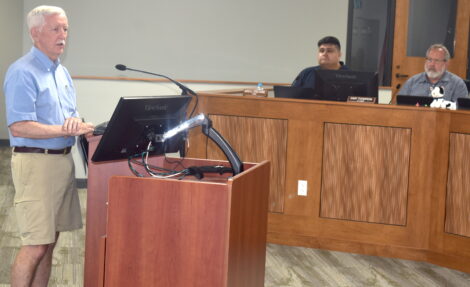
Boston then stepped forward to speak, and he indicated that the commission is already planning to put data center regulations on its agenda for an upcoming meeting, even offering to meet every two weeks if it becomes necessary, recalling past debates over topics such as cell phone towers and electronic signs.
"I think there's a little bit of a learning curve on data centers, but like Clayton says, there's already been a lot of code and a lot of research done that we can take advantage of," he said.
Mayor Mike Ladehoff told Boston the council could enact regulations like requiring a closed loop cooling system to minimize water usage and check with legal counsel on requiring development agreements before construction begins along with guidelines on noise, electric usage and more. Yepez-Gomez, however, reiterated his concern that the best practices handout did not include any limitations on power usage, citing the example of the aforementioned facility in Cedar Rapids.
"We can point to water usage and all that and conflate the history of data centers with what's going on this decade and say there's a bunch of misinformation, but the reality is, there are some data centers, the hyperscale ones, that are taking a bunch of power. And it's not a responsible use of resources," he said. "So I really think the focus is going to be categorizing these data centers and seeing which ones we don't want in our community."
Councilor Greg Nichols opined that he was not as concerned about power usage as ensuring that any infrastructure or extra generation costs are not passed on to consumers.
"I want to make sure the power is available, that it's not gonna cost us extra to put more in place. But if they've got the capacity, I don't see the risk," he said.
After about 25 minutes of discussion, Councilor Melisa Fonseca motioned to direct staff to work with the city attorney and the Chamber economic development team to prepare amendments to the zoning code and return them to the council for consideration, mentioning specifications like land use classifications, appropriate zoning districts, special use permit review criteria, standards for infrastructure capacity, minimum setbacks, buffering, landscaping, screening and lighting requirements, noise, vibrator, generator operation and air quality standards, stormwater management and environmental performance standards, architectural site design requirements, emergency access and public safety considerations, criteria for development agreements and any additional standards staff determine to be necessary.
Mitchell shared concerns about utility rates increasing as a result of data center construction and operation before Nichols noted that Emerson already had one on the east side of town and told the audience that without them, banking, business, software, point of sale transactions and internet usage would be all but impossible. He acknowledged fears of hyperscaled Artificial Intelligence (AI) facilities but said large banks like Chase use small data centers to bolster their operations.
"We need to have a definition of what a data center is and understand that 75 to 85 percent of all uses of data centers are for business, banking and things like that and not artificial intelligence," Nichols said.
Schneider indicated that he would be voting against the motion as he felt it was essentially just restating the council's already established procedure for working with the Chamber, with which it has an economic development contract. Chamber President/CEO John Hall then stepped forward and warned of the negative impact a moratorium could have on businesses, and he added that the council is free to modify the terms of its agreement with his organization before noting that despite limitations on water capacity, moratoriums on other types of large scale projects have never been put in place during his five-year tenure.
Hall also commented that he had already heard "misinformation and disinformation" throughout the meeting and did not feel that Iowa and Florida were comparable -- Iowa has a regulated utility process, and high water users were not approaching Marshalltown with their projects.
"I think there's some standards that can absolutely be looked at. I think what Clayton laid out makes complete and total sense, and I think what Councilwoman Fonseca put on the table for a motion makes a lot of sense. I would just continue to encourage you to figure out ways to keep all the processes moving along," he said. "We brought a couple years ago before you all. We've got projects in the pipeline that are of different sizes and different scales, but asking us to make it a request or requirement to come before as a part of initiation of that process, I don't think is a far stretch and certainly something that we would look to support. And if we had somebody that decided to go around that system, I think I would probably be in front of you saying 'Well, let's put a moratorium in place until it's done because we can't trust the business community to do the right thing by our community.' I think there's a pathway forward that keeps the community open for business and continues to explore what practical development standards look like around these projects."
During Monday's meeting, the public comment period took a decidedly different turn from the June 22 discussion as almost all of the commenters expressed sentiments against data centers, questioning what value they would bring to the community and how they would benefit average citizens, and supporting a moratorium in some form.
"Be more considerate of the people of Marshalltown -- not just the business community, Alliant and every other person with their own personal interest," Roberto Gonzalez said.
Ladehoff responded that data centers have "gotten better" in their water and electric usage, and he pushed back against the assertion that the city would run out of water or electricity. Most of the subsequent commenters returned to the same concerns about resource usage, as Lea Husak argued that the companies building them find ways around the regulations in place, and Layne Pieri pushed for adopting regulations before any applications are considered.
David Arnold felt the council was dealing with "self-inflicted" wounds brought on by a lack of respect for private property rights, and Maggie Valentine advocated for slowing down the process to protect the interests of Marshalltown residents.
"Four months isn't enough time that it's gonna push off developers. I mean, they want these projects. Taking the time to really gather public opinion and really weigh all the options, it does make sense. That's not extreme, in my opinion. That seems like a conservative, common sense thing to do," she said. "The people really want to be able to trust our public officials to represent our interests and to not give in to major corporations."
Dean Stucky restated much of what he had written in a T-R column in which he used AI to generate 10 questions that the city council should be asking about data centers, and Annie Grieshop of rural Melbourne, a former Microsoft employee who noted her experience with data and technology, felt that allowing a data center into Marshalltown without the opportunity for council review would be "crazy."
"Why are you not making sure that no one can move in before you have some rules in place, and what reason is it for Marshalltown other than to say you have a data center?" she asked.
Once public comment had concluded, Yepez-Gomez proposed an amendment to include a four-month moratorium, and it passed by a 5-2 vote with Nichols and Schneider opposed. The original motion as amended then passed by the same tally.
According to documents posted to the P&Z agenda site on Tuesday, the project schedule for revising data center regulations is set as follows: July 16 -- introduction, July 27 -- Council formally adopts moratorium resolution; Aug. 13 -- P&Z Work Session; Aug. 27 -- Community Roundtable session; Sept. 17 -- P&Z work session and review of draft regulations; Oct. 1 -- public open house; Oct. 15 -- P&Z Public Hearing and review of revised draft, and; Oct. 26, Nov. 9 and Nov. 23 -- first, second and third readings for approval by the city council.
In other business, the council:
Approved the consent agenda with an item regarding a facade grant for Grounded LLC at 36 W. Main St. removed.
Approved a Class E retail alcohol license, a retail tobacco permit and a retail device permit for Iowa Smoke Shop at 306 W. Madison St.
Approved a 5-day Class C retail alcohol license for Midnight Ballroom LLC for a rodeo on Aug. 8 at the Central Iowa Fairgrounds.
Approved the FY2025 annual comprehensive financial report for the city of Marshalltown while noting "adverse rulings" regarding the Friends of the Library organization due to their refusal to submit to a financial audit or submit an audit of their own along with the lack of cross training for city employees.
Approved a resolution conveying the city's remaining interest in the vacated east-west alley right-of-way located in Block Two of Bingaman's Addition.