
Social butterflies
Extension office offers monarch tent for Central Iowa Fairgoers
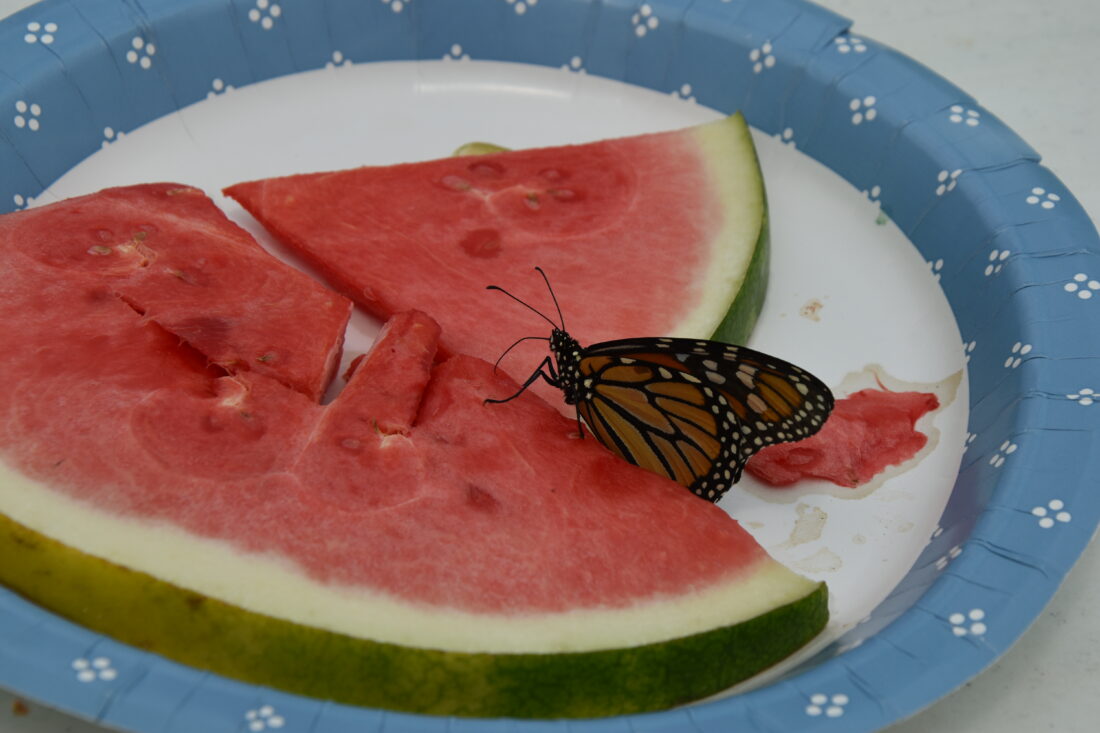
A monarch butterfly feasts on a slice of watermelon during the Central Iowa Fair. The Marshall County Master Gardeners brought watermelon as a food source for the pollinators.
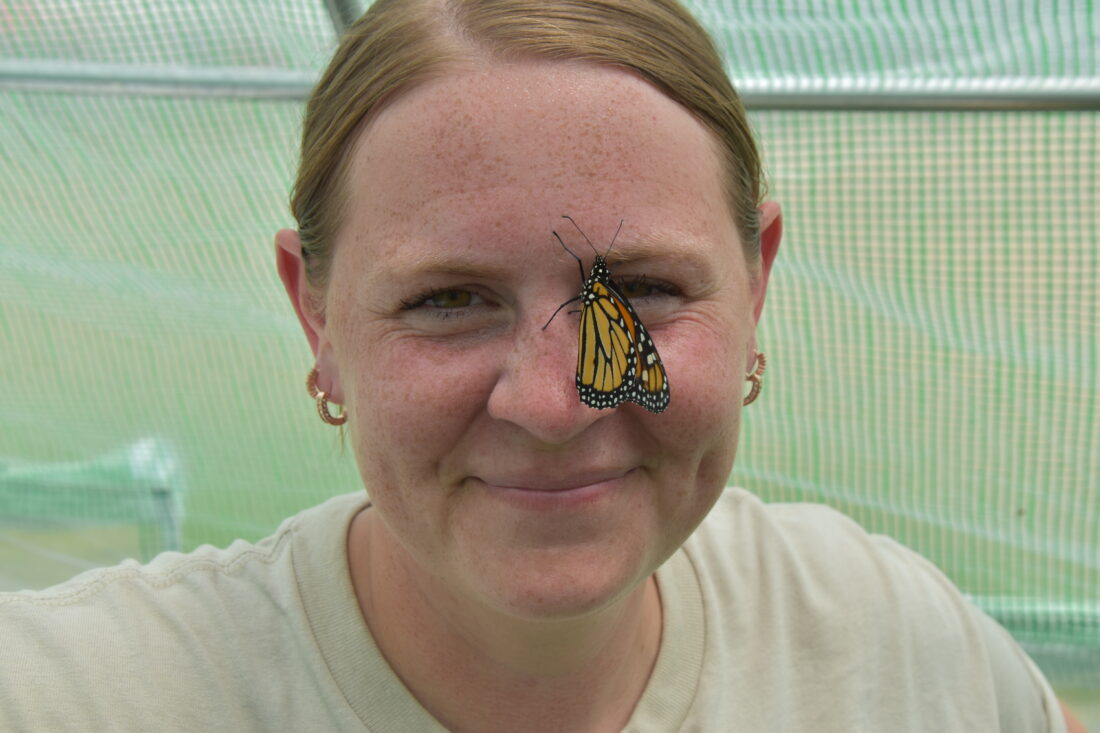
T-R PHOTOS BY LANA BRADSTREAM Marshall County Extension Program Coordinator Chelsea Llewellyn lets a monarch butterfly land on her inside the monarch tent during the Central Iowa Fair. The tent gave the public the opportunity to learn more about monarchs.
A monarch butterfly feasts on a slice of watermelon during the Central Iowa Fair. The Marshall County Master Gardeners brought watermelon as a food source for the pollinators.
T-R PHOTOS BY LANA BRADSTREAM Marshall County Extension Program Coordinator Chelsea Llewellyn lets a monarch butterfly land on her inside the monarch tent during the Central Iowa Fair. The tent gave the public the opportunity to learn more about monarchs.
Trending
Efforts to preserve and replenish the monarch butterfly population are ongoing in Marshall County, and Central Iowa Fair goers were given the opportunity to learn what is being done.
Marshall County Extension Program Coordinator Chelsea Llewellyn said it was the third year a monarch tent had been at the fair. The tent, housing roughly 100 butterflies, was open to the public for a couple hours on Thursday, Friday and Saturday.
Inside, the butterflies flitted around, landing on flowers, the tent tarp, food sources like watermelon slices, the tent tarp and visitors. People were able to come and go as they pleased, but before exiting the tent, they had to turn in a full circle so an Extension volunteer could make sure no monarchs were hitching a ride outside.
Llewellyn believes the efforts to educate the population on the challenges facing the monarch butterfly population is having an impact. Every year MonarchWatch.org posts about the population numbers and she noticed there was a spike in the last 12 months.
"I think things like this gets people to keep their milkweed around, not pull them out or spray them," she said. "Hopefully people will plant more pollination plants. We try to get a lot more pollinator plants in people's hands, and I've heard a lot from the community about how great this is."
Many people only think of bees as pollinators, not butterflies, Llewellyn said. Trying to get people to realize the ecological importance of monarchs is why they have placed focus on milkweed. The plant is the only food source for monarch caterpillars.
"If we don't keep the milkweed around, there are no caterpillars," she said. "That's why the monarch numbers have dropped because people are not keeping the milkweed and spraying ditches. This will hopefully demonstrate we need the milkweed to keep the monarch population and our fruits and vegetables and trees will grow to their potential and we can keep our environment alive."
Residents in Marshall County can get free homegrown milkweed seeds from the Extension Master Gardeners. Llewellyn said they harvest them, package the seeds in bags and include instructions on how to care for the plants. In addition to keeping milkweed and pollinator plants, she said it is important for people to have water sources. If residents want to provide water sources for the monarchs, it needs to be shallow with wet soil to help prevent drowning.
The monarchs in the Central Iowa Fair tent were second-generation, Llewellyn said. The first generation starts the annual migratory process which begins in Canada and ends in Mexico. The fourth generation will eventually reach their destination.
"They only live two to three weeks," she said. "Every generation up to the fourth has a very short life span. That last generation lasts longer so they can get to Mexico."
They had received 100 monarch larvae and a few had yet to come out of their chrysalises.
"We get these lab-grown," Llewellyn said. "They are shipped to us from MonarchWatch.org and we raise them from larvae and I have five Master Gardeners raise them for me.".
One of the Master Gardeners was Katie Schuett. She started with 104 larvae, placed them in petri dishes with milkweed and once they were big enough to "j-hook." Schuett said j-hooking is when the monarch caterpillar reaches a certain size and will crawl to a safe location.
"They will be still and hang out there and make a white, little button," she said. "They will hang from their bottom into a 'J.' They hang there for a few days, essentially bust open and split, turn green and wiggle and wiggle, shed their skin and make their chrysalis. It's quite a process to watch."
This was Schuett's third year of raising monarchs. She is putting more pollinator plants and milkweed in her own yard. This time of year is when the monarchs will start showing up at her house while traveling their migratory route.
Schuett loves learning about the butterflies, their importance to pollination and their migration paths.
"I want to keep putting more native plants in my yard, which are beneficial not only for the monarchs but other pollinators as well," she said. "I put in coneflowers, black-eyed Susans and we have a bunch of sunchokes which I have been moving around the property."
Contact Lana Bradstream at 641-753-6611 ext. 210 or lbradstream@timesrepublican.com.