
Many Marshall County villages have passed into oblivion
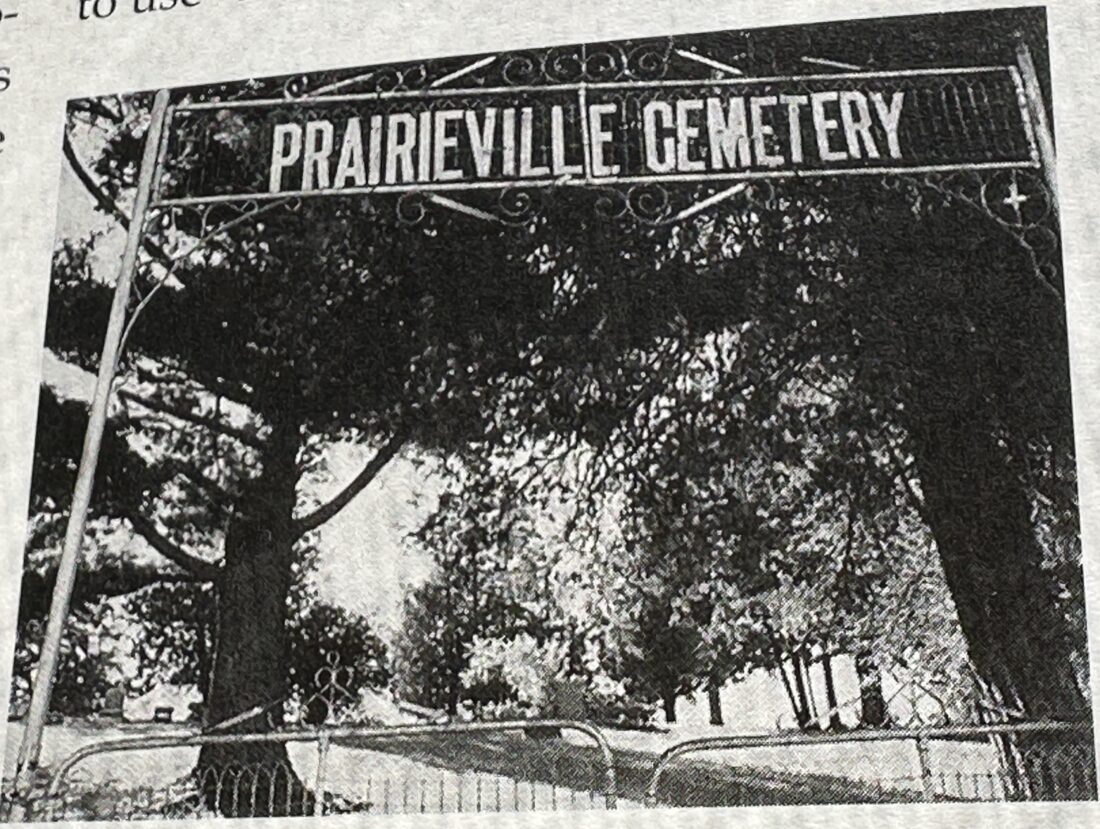
The Prairieville Cemetery had burials in the late 1990s, according to the "Continuing History of Marshall County 1997.”
Editor’s Note: This is part one of a two-part series of former towns and villages from the 1850s. to 1920s. The primary sources for this report was the June 30, 1953 Times-Republican and “The Continuing History of Marshall County” published 1997.” Consequently, both make references to landmarks which have since been removed over the years.
Early in Marshall County’s history ambitious settlers had visions of prosperous villages and towns on sites once deemed desirable.
They frequently were by streams.
In some instances, village surveys were made and town names bestowed before more than a handful of settlers had set down roots.
Next came the post offices and stage coach trails. One village which passed into oblivion was Prairieville near Albion.
Original settlers had a vision; the area was ideal for houses, businesses and more. A blacksmith shop opened, among others. But the only remnants of Prairieville now is Prairie Avenue and a plaque affixed to a large rock marking its location.
Today, other remnants of long-forgotten villages in the county are avenue signs, cemeteries, and oral history passed down by residents.
They were:
BIVEN’S GROVE, founded by Henry Bivens – the first Liberty township settler – was purchased in 1849 from the government (the specific government entity is unclear in resource material) for $1.26 per acre. A post office and blacksmith shop were situated on Minerva Creek – a half mile west of a cemetery.
BROMLEY, on the Story City Branch Railroad in Minerva township was platted Sept. 21, 1881, by Charles Bromley who later became a successful Marshalltown businessman. Bromley Street on Marshalltown’s east side was named in his honor. It had a prosperous brick and tile factory and was a vibrant town until 1920. .
CAPRON, in section three of Logan township and two miles east of Melbourne. Here the former State Center branch of the former Central Iowa Railroad crossed the Chicago, Milwaukee and St. Paul Railroad. There was a station depot where trainloads of coal from the Excelsior mines south of Oskaloosa were received and turned over to the Milwaukee Railroad for locomotive fuel.
CLEMON’S CORNERS, near the Liberty line and the present town of Clemons – opened its post office in 1854. C.W. Clemons – for whom Clemon’s Grove was named – had an excellent hotel and store in the grove, the first to be opened on the stage coach trail west of Marietta.
EDENVILLE, the plat was recorded Oct. 6, 1866, by C.B. Rhodes. The name change to Rhodes was made by local election in 1928.
FREDONIA, founded by A.J. Cooper, had a beautiful large Dunkard church made of stone from the Rock Creek quarries. The post office opened in 1853. The one-time thriving village was located in section 26 of Marion township – five miles east of Marshalltown. A cemetery on East Main Street Road is reportedly a remnant.
GALVIN P.O., was a post station situated in the D.M. Moninger home west of Moninger station and school house.
GREEN CASTLE, southwest of Ferguson – was plated Sept. 1, 1857. The post office opened in 1855. Lots were sold but the town was never developed because the Chicago, Milwaukee and St. Paul Railroad by-passed it by one mile. Blakely Brush, who owned a store there, had a large two-story house which was referred to as “the castle.” Green Castle later became a township.
GREEN MOUNTAIN, P.O., was a half-mile south of a consolidated school at the intersection of the Green Mountain-Garwin road. A blacksmith shop was across the road. The village was later platted Nov. 1, 1855, a short distance north of the present village.
ILLINOIS GROVE, in northwest Marshall County, had a post office established in 1857. There was a school east of the area and blacksmith shop across the road to the east.
JEROMEVILLE, a former “suburb” of the county, was platted July 6, 1857. It was north and east of the Third Avenue highway (now Iowa Highway 14 N.) and north of the Iowa River. Later, Jerome Street – in the town’s northwest quadrant – became part of the city’s street system.
LAFAYETTE was surveyed in August, 1852 but the plat was not recorded until July 21, 1856. The post office was renamed Albion in 1858.
LIBERTY opened a post office on the stage trail in 1857 but was closed in 1867. The plat was filed April 28, 1857, but no development followed. The site was three miles north of Saint Anthony and one and one-half miles east. It later became a township.