
State-contracted report shows broad access to higher education in Iowa
Community colleges argue there are still areas of shortage
Trending
Iowa's community colleges told lawmakers this year that portions of Iowa are lacking access to a higher education and one solution to eliminate "education deserts" is to offer bachelor's degrees at their institutions. Private colleges pushed back against this premise, disagreeing about the perceived need.
A state-commissioned study received by the Iowa Department of Education last month, but not released until now, says the vast majority of the state is in reach of higher education resources, and that Iowa's colleges and universities are rising to meet student and workforce needs. The study attributes workforce shortages to the business climate, not the higher education system. But community colleges argue the study misidentifies higher education deserts and says the state could still benefit from four-year degree programs at their schools.
Parties on opposite sides of the debate on whether Iowa's higher education institutions are adequately meeting student and workforce demand had different takeaways from the report that maps out degree demand and access, though both agree the public and state officials would benefit from seeing it and adapting its recommendations.
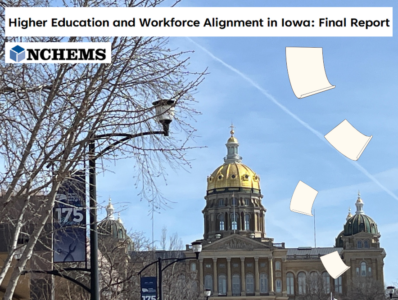
"Higher Education and Workforce Alignment in Iowa: Final Report" was prepared for the department of education by the National Center for Higher Education Management Systems (NCHEMS) after the department contracted the nonprofit consulting organization in December, according to the report. It is dated March 6. The Iowa Capital Dispatch obtained the report Thursday through a public records request.
Iowa Department of Education Communications Director Heather Doe said in an email the department, governor's office and Iowa Board of Regents received the report on June 25, and its aim is to give an overview of Iowa's current higher education and workforce landscapes and "help inform continuous state systems improvement."
"As we continue to partner with education and workforce leaders across Iowa, these findings and recommendations inform our collective work to ensure students get a strong return on their investment and employers have the skilled talent pipelines they need to grow and innovate," Doe said in her email. "Our work to prepare learners for high-demand, high-skill and high-wage careers here in our state will continue to benefit from our improved data and alignment efforts across PK-12, higher education and workforce."
Neither the department of education or the governor's office responded to questions about why the report wasn't released before now.
The 119-page report details Iowa's higher education landscape, its accessibility, student outcomes, the state's population and groups potentially seeking a postsecondary education, demands of the state's labor market and recommendations to improve improve access, align programs with workforce needs and "clarify the roles and missions of different types of institutions in meeting those needs." The state requested NCHEMS "produce findings and recommendations to support data-driven policy and funding decisions."
However, a lack of data was one of the concerns brought up in the report, and the report's first recommendation is to "improve the state's capacity for gathering and analyzing data about the linkages between educational supply and workforce demand."
Other recommendations include strengthening the state's ability to coordinate individual and collaborative work by higher education institutions and putting policies in place to "promote the creation of institutional capacity to deliver programs to remote sites on an as-needed basis" to meet specific needs of that area.
Private, community colleges disagree on definition of 'deserts'
Gary Steinke, president of the Iowa Association of Independent Colleges and Universities, said the report states what he and other private institution officials have been saying throughout this year -- there are no education deserts in Iowa, and private colleges and universities are providing high-quality services to students.
"That was our expectation, and I'm frankly quite happy with the conclusions and with the data now finally all being in one place," Steinke said.
Community Colleges for Iowa Executive Director Emily Shields disagreed, saying the report's definition of education deserts doesn't fit into reality and it identified areas of Iowa where in-person higher education is sparse, partnered with stakeholders expressing dissatisfaction with online education.
"We had a pretty significant conversation about community college bachelor's degrees this legislative session, and one of my frustrations is that we were seemingly not on the same page about whether there was even a problem with educational access to bachelor's degrees, and I think this report demonstrates that there is," Shields said. "There are people who don't have access to bachelor's degrees and other educational opportunities, and I think that is a problem worth solving."
Report shows education access, areas of improvement
The report states that its analysis and findings are mostly based on quantitative, public data, supplemented with stakeholder interviews and submitted information.
From this work, the NCHEMS team found that the current higher education offerings in Iowa have capacity to meet state college-educated workforce needs, both current and future, and current data on degree and credential attainment "more than adequately meets the state's needs."
Iowa tops 42 other states for the number of higher education institutions per 100,000 people, the report stated, and college and university main campuses, branch locations and Iowa State University Extension and Outreach create "postsecondary access point(s)" that are spread across the state and could be used to expand educational reach.
Rather than educational capacity, the report stated that "troubling population and migration trends" are a more likely cause of "workforce misalignment" and other problems Iowa faces. While the state brings in more college students than it sees leave, it also sees more college graduates leave than move here or stay here. Wages in certain parts of Iowa are lower than those in surrounding states, drawing people outside of Iowa to work.
According to the report, 40% of Iowa public university graduates and 60% of community college graduates are employed in Iowa five years after program completion, with graduates of baccalaureate education programs and associate-level health care programs more likely to remain in the state.
Iowans are also getting older, with only eastern and central Iowa expected to see growth in their populations of people aged 25 to 44. Iowa's unemployment rate is below the national average, leading more recent high school graduates to be recruited by employers "eager to hire workers directly out of high school" and opening up potential opportunities for upskilling employees through higher education, the report states.
Working adults are a potential source for enrollment that could offset decreasing numbers of traditional collegegoers, the report stated, especially as postsecondary credentials become required in more and more job fields. Another area of Iowa's "education-to-work pipeline" that could be strengthened, the report stated, is transfers from community colleges to four-year institutions, something public and private areas of higher education have devoted resources to.
Issues like a lack of college graduates to hire in certain areas were generally found in specific occupations, the report stated, such as nursing, and "real challenges" identified in stakeholder interviews and data had a higher chance of being specialized to that locality.
"The primary education and workforce challenges from a statewide perspective, therefore, are not how to produce more college graduates, or how to align programs with occupations better, but instead how to motivate college graduates to stay in Iowa, how to retain workers, and how to provide working adults with continuing education and upskilling while they remain employed," the report stated.
Education deserts versus broad access
Shields and Steinke differed in their opinion on how the report categorizes "education deserts" and how access to higher education is spread across the state as shown in the report. Researchers noted that the areas where degree attainment is consistently below the state average can be found in western Iowa along Interstate 80 and in the southwest corner of the state.
A report by Community Colleges for Iowa exploring the feasibility of having bachelor degree programs at community colleges used a smaller measurement for education deserts than the report -- citing a 30-mile drive rather than the report's 60-minute drive.
The deserts identified by Community Colleges for Iowa were one point toward a lack of access for certain placebound Iowans, but Shields said that's not the only factor that must be considered. Affordability must be brought into the question as well, she said, and the report stated that while higher education costs differ widely between different institutions, private colleges and universities were on average more expensive than other avenues to education.
"I think that 60 minutes is not supported if you talk to actual human beings about their abilities to get places," Shields said. "One thing the report didn't do was that -- you know, talk to actual people who live in Iowa who might be looking for additional education."
Other concerns she had with the report was its inclusion of Iowa State University Extension and Outreach offices as entities that provide educational access at the level the report is discussing, as well as a lack of evidence showing how retirements will impact the number of needed employees with bachelor's degrees.
Steinke said the report concluded that anywhere in the state with internet access is an "education-rich environment as a result" due to online offerings from private and public higher education. The report stated that the stakeholders researchers interviewed were dissatisfied by online education delivery, and encouraged institutions to create "more effective and creative student supports for online learners" in addition to strengthening transfers.
Report recommends better coordination, data gathering
Included in the report were three recommendations, which the executive summary lists as:
Improve the state's capacity for gathering and analyzing relevant data for use in designing and evaluating policy, but also to help institutions align programs to demonstrable needs.
Consider enhancing the state's ability to plan and coordinate how its higher education assets work separately and together to achieve state priorities.
Develop policies that promote the creation of capacity to deliver programs to remote sites on an as-needed basis.
Shields said many of the recommendations are "spot on" for what Iowa needs to do and what is happening across the U.S., specifically with better data collection. Part of that work needs to be done on the workforce development side of operations, she said, like getting enhanced wage records.
She added that greater coordination at the state level would be helpful as some duties and responsibilities have been separated between the state's workforce development and education departments, and she is "obviously very interested in increasing community college capacity to deliver programs at remote sites."
"One of my biggest takeaways from this report is we're doing a lot of things well, but we need to do a better job of reaching adult students," Shields said. "I think we do a good job with recent high school grads who know what they want to go do, but if you start college and stop, or you get an associate degree and then you want to continue later, or you don't go right into higher ed but decide you want to later, I don't think we're meeting those people's needs very well, and that is something the community colleges do a lot of, but with targeted resources could do even better."
While he believes private colleges and universities "do a pretty darn good job of" data gathering and sharing, Steinke said he doesn't disagree with the recommendation that universities provide more data for statewide tracking. However, some data held by private institutions is "proprietary" as they work to keep a competitive edge over other colleges and universities, public or private.
Data on graduate outcomes like employment and residency are "the most difficult types of data to provide," he said, as students are often relied on to respond to surveys and not everyone can be followed after they receive their degree.
One area of the recommendations Steinke said he "absolutely" disagrees with is tying increased data collection and reporting to eligibility for the Iowa Tuition Grant program, a move private colleges have opposed in the Statehouse for years.
"Never, ever, should a student's financial aid depend upon what it is an institution feels that it can or cannot provide in the way of data or in anything else," Steinke said. "You know, this is a financial aid program, it's not a hammer that you hang over students' heads in order to get private institutions to do what you want to do."
Looking back and moving ahead
Steinke said "all three sectors" of higher education interacted with NCHEMS in its work to compile the study, and he joined Zoom calls with the researchers in January. He was told that they were trying to get the report completed as soon as possible but he didn't expect to see it during the legislative session, which ended in May. Shields herself was not involved in this process, she said, but community college officials were, and no one was provided a timeline.
Josh Lehman, senior communications director for the Iowa Board of Regents, said in an email the board provided requested data to the report and "a few Board members participated in a focus group."
"We are carefully reviewing the report and its findings now and hope it can help inform future work on the value of higher education and the Regent universities in preparing Iowa's workforce," Lehman said in his email.
Steinke said it would have been nice to have the report in January for the legislative session, where discussions of academic alignment with workforce needs and issues of access were prevalent.
Iowa lawmakers introduced a number of bills aimed at expanding certain programs, changing curriculum and providing funding to the state and its initiatives, including bills to pilot bachelor's degrees at community colleges and require certain university endowments to be taxed.
Private universities were also urged to conform to changes in general education requirements and core curriculum that were signed into law this summer.
Both Steinke and Shields said they're sharing the report with institution heads across the state with the goal of going through it and identifying areas where they can improve and apply the included recommendations.
What the report showed Steinke about Iowa's current higher education climate and where it's headed is that the state has "three wonderful, quality sectors of higher education" that each serve students' particular needs "as long as everybody stays in their lane."
Shields said she wouldn't take away from the report that "we have no room for improvement," and she hopes the rest of Iowa's higher education industry will use the report to find ways to improve like Community Colleges for Iowa does. She supports the idea of further exploring community college bachelor's degrees, but said efforts from them and the state should span farther than that.
"I think the conversation is not necessarily about community college bachelor's degrees; it's about a lack of access in some parts of the state," Shields said. "And community college bachelor's degrees may not be the right solution, but I would love to talk about other ones then, because we do have an issue, and it is worth addressing."