
Fed begins inflation fight with key rate hike, more to come
Trending
WASHINGTON -- The Federal Reserve launched a high-risk effort Wednesday to tame the worst inflation since the early 1980s, raising its benchmark short-term interest rate and signaling up to six additional rate hikes this year.
The Fed's quarter-point hike in its key rate, which it had pinned near zero since the pandemic recession struck two years ago, marks the start of its effort to curb the high inflation that followed the recovery from the recession. The rate hikes will eventually mean higher loan rates for many consumers and businesses.
The central bank, in a policy statement, along with quarterly projections and remarks by Chair Jerome Powell at a news conference, pointed to a somewhat more aggressive approach to rate hikes than many analysts had expected.
The projections showed that seven of the central bank's 16 policymakers favor at least one half-point rate hike this year, suggesting that such a large increase "is a live possibility," said Michael Feroli, an economist at JPMorgan Chase.
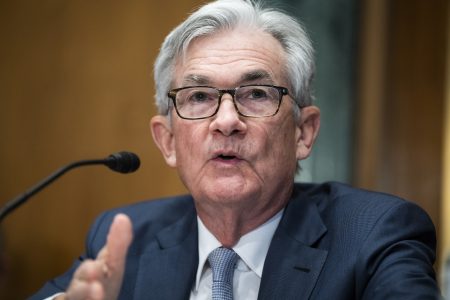
At his news conference, Powell stressed his confidence that the economy is strong enough to withstand higher interest rates. But he also made clear that the Fed is focused on doing whatever it takes to reduce inflation, over time, to its 2 percent annual target. Otherwise, Powell warned, the economy might not sustain its recovery from the pandemic recession.
"We're acutely aware of the need to restore price stability," the Fed chair said. "In fact, it's a precondition for achieving the kind of labor market that we want. You can't have maximum employment for any sustained period without price stability."
The Fed also released a set of quarterly economic projections Wednesday that underscored the potential for extended interest rate increases in the months ahead. Seven hikes would raise its short-term rate to between 1.75 percent and 2 percent at the end of 2022. Fed officials also forecast four more rate increases in 2023, which would boost its benchmark rate to 2.8 percent.
That would be the highest level since March 2008. Borrowing costs for mortgage loans, credit cards and auto loans will likely rise as a result.
"Clearly, inflation has moved front and center into the Fed's thinking," said Tim Duy, chief U.S. economist at SGH Macro Advisers.
The central bank's policymakers expect inflation to remain elevated, ending 2022 at 4.3 percent, according to quarterly projections they released Wednesday. The officials also now forecast much slower economic growth this year, of 2.8 percent, down from a 4 percent estimate in December.
But many economists worry that with inflation already so high -- it reached 7.9 percent in February, the worst in four decades -- and with Russia's invasion of Ukraine driving up gas prices, the Fed may have to raise rates even higher than it now expects and potentially cause a recession.
By its own admission, the central bank underestimated the breadth and persistence of high inflation after the pandemic struck. And many economists say the Fed has made its task riskier by waiting too long to begin raising rates.
The Fed's projections show that by the end of next year, the policymakers expect their short-term rate to be above "neutral" -- the level at which they think the rate neither fuels nor slows economic growth.
Roberto Perli, an economist at Piper Sandler, questioned Powell's assurances that the economy could withstand such higher rates.
"In the past, whenever the Fed has approached -- let alone exceeded-- neutral, the economy weakened sharply," Perli wrote in a note to clients. "The risk of recession in 2023 and beyond is increasing."
Yet Powell downplayed the likelihood of an economic setback.