
Fed raises key rate by half-point and signals more to come
Trending
the associated press
WASHINGTON -- The Federal Reserve reinforced its inflation fight Wednesday by raising its key interest rate for the seventh time this year and signaling more hikes to come. But it announced a smaller hike than it had in its past four meetings at a time when inflation is showing signs of easing.
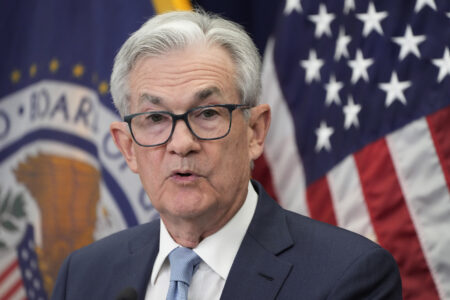
The Fed made clear, in a statement and a news conference by Chair Jerome Powell, that it thinks sharply higher rates are still needed to fully tame the worst inflation bout to strike the economy in four decades.
The central bank boosted its benchmark rate a half-point to a range of 4.25 percent to 4.5 percent, its highest level in 15 years. Though lower than its previous three-quarter-point hikes, the latest move will further increase the costs of many consumer and business loans and the risk of a recession.
More surprisingly, the policymakers forecast that their key short-term rate will reach a range of 5 percent to 5.25 percent by the end of 2023. That suggests that the Fed is poised to raise its rate by an additional three-quarters of a point and leave it there through next year. Some economists had expected that the Fed would project only an additional half-point increase.
The latest rate hike was announced one day after an encouraging report showed that inflation in the United States slowed in November for a fifth straight month. The year-over-year increase of 7.1 percent, though still high, was sharply below a recent peak of 9.1 percent in June.
"The inflation data in October and November show a welcome reduction," Powell said at his news conference. "But it will take substantially more evidence to give confidence that inflation is on a sustained downward path."
In its updated forecasts, the Fed's policymakers predicted slower growth and higher unemployment for next year and 2024. The unemployment rate is envisioned to jump to 4.6 percent by the end of 2023, from 3.7 percent today. That would mark a significant increase in joblessness that typically would reflect a recession.
Consistent with a sharp slowdown, the officials also projected that the economy will barely grow next year, expanding just 0.5 percent, less than half the forecast it had made in September.
"The Fed is not done -- it sees a prolonged slowdown and a rise in unemployment as the only way to fully derail inflation," Diane Swonk, chief economist at KPMG, said in a research note.
Though Powell said he thought the economy could still avoid a recession, the Fed's economic forecasts show the policymakers expect job losses to result from its higher rates.
"They really need the unemployment rate to go higher and wages to start coming down," said Subadra Rajappa, an investment strategist at Societe Generale. Powell has said that slower wage growth would reduce inflation pressures.
Powell said Wednesday, "I just don't think anyone knows whether we're going to have a recession or not. … I wish there were a completely painless way to restore price stability. There isn't."
In recent weeks, Fed officials have indicated that they see some evidence of progress in their drive to bring inflation back down to their 2 percent annual target. The national average for a gallon of regular gas, for example, has tumbled from $5 in June to $3.21.
Many supply chains are no longer clogged, thereby helping reduce goods prices. The better-than-expected November inflation data showed that the prices of used cars, furniture and toys all declined last month.
So did the costs of services from hotels to airfares to car rentals. Rental and home prices are falling, too, though those declines have yet to feed into the government's data.