Thrashers sing more than 1,100 songs
Today’s featured creature is another bird, just not any bird, but one that uses its skills of watching and listening to help make its living for another season successful. It is hard for this scribe to understand the ability of Brown Thrashers to listen, learn and then repeat songs of other species in addition to its own specific calls. To the researchers who figured out that more than 1,100 different song types can be made by thrashers, my tip of the hat to them for trying to decipher bird communication.
One theory for the reason a thrasher is so good at songs has to do with food and the territory it takes to provide for itself and its mate. Songs of other birds repeated into the airwaves may serve to tell other bird species that there are more mouths in the vicinity than there actually are. The deception trick may just work to fool other birds that this space is occupied. In effect, airwaves filled with bird songs of birds that really aren’t there may be a key piece of the puzzle, a scheme that works for brown thrashers.
The diet of brown thrashers is extensive. Insects, arthropods and fruits, seeds and nuts all work for this species. They can catch insects in mid-air. Animal foods include beetles, grubs, wire-worms, army worms, cutworms, tent caterpillars, gypsy-moth caterpillars, leafhoppers, cicadas, grasshoppers, crickets, wasps, bees, sowbugs, lizards, snakes and tree frogs. There isn’t much that thrashers do not like to eat.
Brown thrashers are serious defenders of their nests. They work together to build and incubate a bulky cup of twigs, dead small pieces of tree bark and grasses. Two to six eggs will be laid, perhaps even two broods will be raised over the course of the summer. Eggs are about 1 inch long and may be speckled with red-gray splotches. Once the eggs hatch after 10-14 days, it takes another nine days for the young to be feathered enough to leave the nest.
Cowbirds are noted for finding nests of other birds, laying their eggs in that nest, and leaving the raising of the young to unsuspecting surrogate bird pairs. Brown thrashers get hit with this extra egg in the nest trick but many times recognize the game for what it is, and reject cowbird eggs. Thrasher nests are usually built in low trees or thorny shrubs. They will use forsythia, gooseberry, sumac, Osage-orange, multiflora rose, eastern red cedar, elm and honey locust, or even make the nest on the ground. They are very adaptable.
q q q
This scribe has been hunting for an eastern wild turkey. This is bird watching of another venue, one filled with hard work, lots of time spent sitting, waiting and watching for this elusive biggest game bird to come to my calls. I think it would be best if I could capture a brown thrasher, train it to mimic the sounds of a wild turkey hen or gobbler, and do so convincingly enough to draw in a big tom. So much for my confidence of using human turkey calling mimicry. I’d pay the brown thrasher handsomely with large quantities of suet.
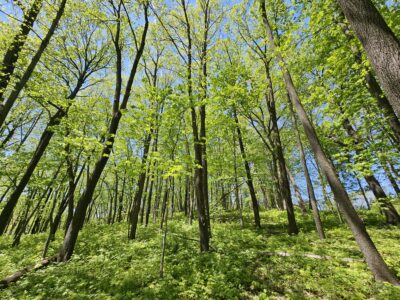
Now back to the real world. Turkey hunting at this time of year involves waking up at 4:30 a.m., getting ready to walk out the door by 5 a.m, and be at the timber edge by 5:30 a.m. at the very latest. The sun is still out of sight, way below the horizon. Only the faint dull glow in the eastern sky tells me that daylight will slowly advance to make a new day. But I’m now walking slowly into the dark timber, carefully and slowly placing footfalls over sticks and onto soft ground. Silence is what I’m striving for I make it to may tree where I will sit in silence.
I’m listening for wild turkey calls, particularly the gobbles of big toms still high in their tree top perches. If I’m lucky, I will have walked close to where they are roosting without spooking the bird from its night time perch. That is why getting into the forest in the dark is so important, to arrive stealthily and unnoticed. I wait. Dawn is trickling into the eastern sky. It is time for turkey talk.
Every morning is different. One day the tom turkeys are unstoppable as they talk to each other. The next day in this same setting, they are much quieter and not talkative at all. But If one does gobble, I carefully try to spot it. But then another gobbler may let loose his response from another segment of the forest. Maybe even a third tom turkey will call back. Some early mornings are like that. Once on the ground however, everything gets quiet again. It is nice to be there immersed in the forest and the life that transpires within it.
An added bonus for each early morning trek to the forest are other wildlife sightings. Wood ducks announce their presence in a little flooded pool of backwater. Woodpeckers chime in by their rat-a-tat- tat on a tree. Wrens hop along tree branches hunting for their breakfast. Crows filter through the trees with great ease. Overhead an occasional pair of Canada geese wing their way closer and closer, honking as they fly, with the sound of wind over their wings and their calls getting louder and louder until they are right overhead.
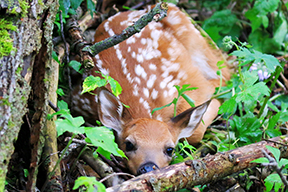
Then those same goose calls fade with the predictability of the doppler effect as the geese get further away from my ears. And then a brown thrasher makes a brief appearance as it investigates low lying tree limbs. An extra bonus is the appearance of deer as they meander through the forest. The buck have antler buds at this time of year only a few inches long at best. Their old winter hair coat is blotchy and ragged. As it is being shed, new summer hairs of soft reddish brown are starting to show. They will stay cooler this summer with hair that does not insulate as well.
This scribe may have been hunting for wild turkey. However, I think the forest went hunting and found me, a willing participant. Life is good.
q q q
SPORTING CLAYS SHOOT is coming to the Izaak Walton League grounds southeast of Marshalltown. The date will be May 3, tomorrow, with registration beginning at 9 a.m., closing at 2 p.m. The cost for a shooter will be the same as last year, $35 for 110 bird round for those age 22 or older. Just $20 will register anyone age 16-21. Shooters age 15 or less get a free pass. Lunch will be available for a slight fee or donation.
Sporting clay shoots have stations set up along trails, forest edges or deep in the woods. A clay bird, or two, will be snapped into the air. Quickly the shotgun must be brought to the shoulder, aimed and fired with perfect follow through to have a load of pellets hit and pulverize the clay bird. This type of practice shooting is very close to real world grouse, pheasant, quail, dove or rabbit hunting scenarios. Attending a lot of area clay bird shoots will help the shotgunner develop the coordination it takes before fall bird seasons resume this year.
Be sure to mark the date of June 7 for the next clay bird shoot at the Ikes grounds. The site is located 2 miles south of Iowa Avenue on Smith Avenue. As soon as the hard surface roadway ends, be prepared to turn right at the top of the hill, the gate into the Izaak Walton League area.
q q q
WALLEYE FISHING season opens today in Iowa’s Great Lakes region of Spirit Lake and Okoboji. A slot length of 17-22-inch fish must be returned to the water immediately. Fish under 17 inches are a favorite for a few left in the creel to take home for a meal. Only one walleye longer than 22 inches may be retained. Elsewhere in the state, walleye has a continuous open season. Special length regulations at some Iowa waters will be posted so take care to abide by the rules. Today is the 139th walleye fishing season opener for the Great Lakes area of northwest Iowa. And to help celebrate the walleye season kickoff, the Chamber of Commerce will host its 33rd annual Great Walleye Weekend Fishing Contest. For details go to www.okobojichamber.com
q q q
“Fishermen who miss church are not necessarily out of communion with God.”
– Paul Quinnett,
essayist and author
____
Garry Brandenburg is a graduate of Iowa State University with BS degree in Fish & Wildlife Biology. He is the retired director of the Marshall County Conservation Board. Contact him at P.O. Box 96, Albion, Iowa 50005