
On the ground and in air
Paramedic Grobe finds gratification while on the job
Trending
Editor's note: This is the 12th in a series of articles profiling the public servants/first responders who serve the citizens of Marshalltown and Marshall County. Each month in 2016, the T-R will profile a member of the Marshalltown Police Department, Marshalltown Fire Department, the Marshall County Sheriff’s Office or an EMT with Central Iowa Healthcare.
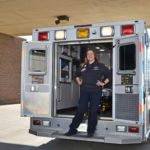
While sitting in the EMS (Emergency Medical Services) office at either Central Iowa Healthcare in Marshalltown, or Iowa Methodist Medical Center in Des Moines, paramedic Heather Grobe never knows if the next 12 hours of her shift will be staying relatively in one place on hospital grounds, or if she will be speeding down the highway in an ambulance or getting ready for takeoff in a helicopter. Or perhaps, it's more like a combination of checking up on emergency room patients, dashing out to calls in rural lands, attempting to resuscitate an unresponsive child, or flying someone to the Mayo Clinic.
"I'm definitely a Type A personality," Grobe said, which is classified as having ambition, drive, competitiveness and striving for quality over quantity. "The best part of the job is never knowing what you'll get."
A native of Nashua, Grobe earned an associate degree, with an emphasis in emergency medicine, from North Iowa Area Community College in Mason City. She recalls dating back to her junior high days she had an interest in going into the firefighter and emergency services fields.
"I have uncles that worked in EMS and fire, and my dad did medical training in the National Guard, so I grew up immersed in that area," she said.
While in college, Grobe worked at the Chickasaw County Ambulance Service as an EMT. Next, she got a job with the Eldora Ambulance Service, as well as with the Eldora volunteer fire department, becoming the first female firefighter with that service. She began her career with an EMT basic certification, advancing to EMT-I/85 (a step below paramedic, and a program no longer offered). Paramedic certification came a few years later, after she completed courses at Iowa Central Community College in Fort Dodge.
"I was a full-time paramedic and a volunteer firefighter. I've always held down two to three jobs at once. I like to stay busy," Grobe said.
Parents Steve and Terri Becthold, have been supportive of their daughter's career, but Grobe noted, they did have more reservations about her putting out fires than working in an ambulance.
"I have a twin brother, Justin, who also has this interest. He just started with the Clear Lake Fire Department. He's wanted to be a firefighter for quite some time now," Grobe said.
While working in Eldora, three years ago, the paramedic got a call from Central Iowa Healthcare in Marshalltown informing her of a job opportunity.
"I was looking for a career with a faster-paced emergency service, so I interviewed and ended up staying in Marshalltown," she said.
Grobe said what she likes about working in Marshalltown is experiencing a wide variety of calls.
While at CIH, she learned about Iowa Methodist's LifeFlight program. She interviewed for a job there, but wasn't hired. Instead, she honed her skills through a mentorship, doing fly-alongs with other paramedics. After overcoming an apprehension of heights, she said she was "hooked." After a Methodist staff member retired, Grobe was offered a full-time job as a LifeFlight paramedic, becoming a certified critical care paramedic through the State of Iowa.
With her strong work ethic, she divides her time between Methodist and CIH, picking up shifts in Marshalltown whenever she can.
"I got the job at Methodist because of my job in Marshalltown. It's a great effort here in Marshalltown with paramedics, police officers and firefighters working together, and at Methodist, there are just more specialized departments, so they are different experiences," Grobe said. "But flight paramedic was always my ultimate goal."
Working as a paramedic in a helicopter, versus in an ambulance, poses unique challenges and opportunities.
"There is so much of the ER we bring to patients in a helicopter or ambulance," the paramedic said. "We help get people off that cliff in that critical amount of time between where we find them and the hospital. It takes us 17 to 19 minutes to fly from Des Moines to Marshalltown, for instance, so it's faster than traveling that route by ground. But ground crews have to pick up [the time difference] and they don't get the recognition they deserve."
As a flight paramedic, Grobe travels the state attending to patients who have requested to be transferred to a different hospital, or need to be sent elsewhere to a facility that specializes in a particular ailment. Every helicopter or "air ambulance" pilot works 12 hour shifts, regulated by the FAA, plus two adult crew members come along. In the case of children and infant patients, a pediatric nurse or neonatal nurse also accompanies the crew.
While she doesn't get to fly at CIH, the pace of the work rivals that of Des Moines. On average, CIH EMS workers respond to 15 to 16 calls a day. Last year, the team attended to 5,200 calls -- a number that rivals the emergency calls received in West Des Moines.
Education is a key component of the job, with paramedics constantly needing to stay current with changes in technology and certifications. She takes courses online and in person. At Marshalltown Community College, she teaches at least one EMS course a year. Doing hours worth of paperwork is a necessary, yet unglamorous, aspect of the job. She noted that EMS workers are mandated to complete a report within 24 hours of going on a call. Accuracy matters, as the reports are filed in patient records and can even be used during court proceedings.
Like all EMS workers, Grobe gets asked about how she handles those difficult calls.
"I like to think I do a decent amount of debriefing. I became an EMT at the period where students were no longer being taught to keep their feelings bottled up," she said.
When asked about what were some of the more difficult or life-changing calls she has responded to, Grobe has many memories flash through her mind.
"I find certain smells, sounds and sights might trigger a memory, but there are things the lay public wouldn't want to hear about; they couldn't truly grasp what that's like. There are bits and pieces of every call that have impacted me, and my mind races back and forth among them; no one wakes up in the morning thinking they will need a paramedic," Grobe said. "My parents had concerns with me being a firefighter, but I also know flying bothers them. They maybe wouldn't come out and say it, but helicopter crash stories bother them."
The paramedic relies on a strong support system, consisting of her parents, EMS colleagues and her new husband, Jay Grobe. The newlyweds got married on Nov. 5 at Hope United Methodist Church and reside in Marshalltown, both returning to work soon after their nuptials. Jay works as a focus group leader at Marel in Des Moines, a global company based out of Iceland, that provides equipment, systems and services to the food processing industry. Grobe is a stepmother to Ryan, 7, and Leah, 5, who live with the couple part-time. In their downtime, the family likes to go camping, spend time with loved ones, and care for their two dogs.
"I try not to bring my work home with me, but he's very good at understanding," Grobe said. "Jay travels extensively for his job and my hours are crazy, so home time is at a premium. We get creative with making time for each other."
Her role as stepmom has influenced the way she looks at her job.
"Having children in my life has changed how I look at things. It has made me a lot more empathetic. When you get wrapped up in your day-to-day life, you forget how everything can change in an instant," Grobe said.
The couple met in July 2015 on a blind date, with Jay picking the paramedic up in the emergency room parking lot for their first time out together.
"She works hard, and more than she should," Jay said. "She's the type of person, if a call comes up, she drops what she's doing and helps. It's tough, but we all understand what her career entails and how she always wanted to help people … You watch shows on television about her line of work, and what people don't understand is how much takes place in that three minute ride in that ambulance. It's the paramedics who have done the ground work."
Grobe encourages those interested in her line of work to take an EMS course. She said she has held down many jobs in her life: secretary, camp counselor, lifeguard, pizza maker at Casey's, college tour guide, etc., but no job has been as gratifying as fire/emergency work.
"I didn't want to sit behind a desk and do the same thing every day. In my job, I get to play detective and figure out what's going on with a patient. Doctors consider me a big part of the patient care team," Grobe said. "But you need to find the support system you need before you start this career."
Grobe said the older she gets, the more she could envision transitioning from working out in the field to teaching, but she has trouble picturing herself not working in an ambulance or helicopter. While she misses aspects of being a firefighter, she said she likes where she's at currently in her career, and wouldn't feel comfortable taking on any more assignments.
"There's something we can learn on every call. I'm a paramedic student every time I go to work," Grobe said. "I have met some very amazing people and I've heard life stories. It's an opportunity not many people have. I've brought new life into the world, and held people's hands as they took their last breaths. My voice was the last voice they heard. I've done CPR on infants, I've pulled people out of houses, seen people dismembered in car accidents. I held a dying man's hand who was trapped under a tractor. We are put in really horrific positions … it's a powerful place to be in, and no class can prepare you for some of what you see."