
Parking, one-way street conversion plans explained

CONTRIBUTED PHOTOS — Casey Byers, senior project manager with Bolton and Menk, displays concepts of streetscape elements being considered for implementation downtown during a virtual open house on Wednesday.
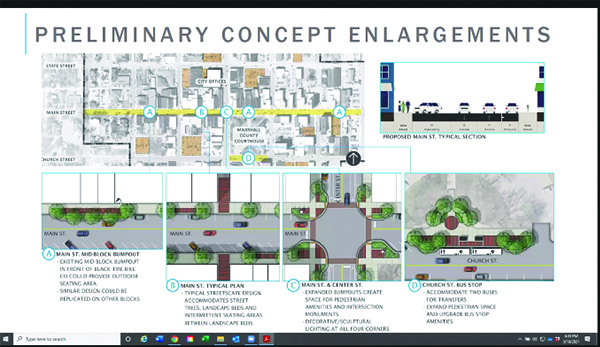
This diagram, displayed during Wednesday’s Downtown Implementation Plan virtual open house, shows concepts of streetscape elements being considered for implementation downtown.
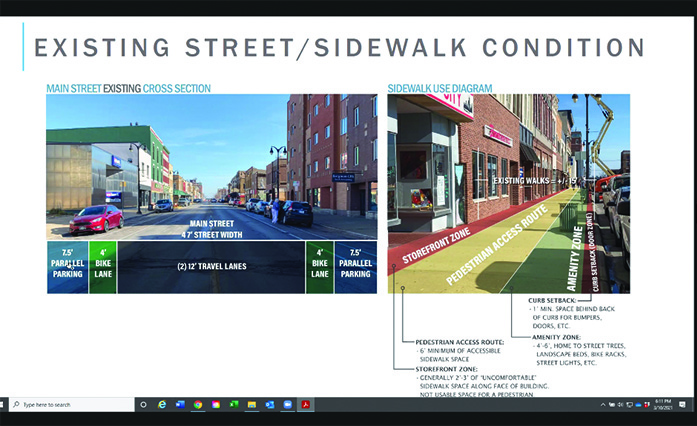
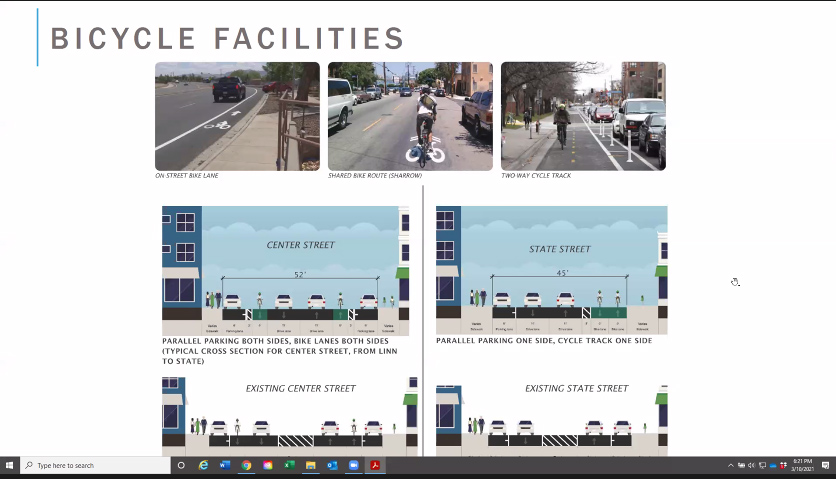
Jennifer McCoy, senior traffic engineer with Bolton and Menk, shows her proposed plan for changing bicycle facilities downtown, moving them from Main Street to State Street.

Jennifer McCoy, senior traffic engineer with Bolton and Menk, shares what she found when studying different options for parking in the downtown area.
CONTRIBUTED PHOTOS — Casey Byers, senior project manager with Bolton and Menk, displays concepts of streetscape elements being considered for implementation downtown during a virtual open house on Wednesday.
This diagram, displayed during Wednesday’s Downtown Implementation Plan virtual open house, shows concepts of streetscape elements being considered for implementation downtown.
Jennifer McCoy, senior traffic engineer with Bolton and Menk, shows her proposed plan for changing bicycle facilities downtown, moving them from Main Street to State Street.
Jennifer McCoy, senior traffic engineer with Bolton and Menk, shares what she found when studying different options for parking in the downtown area.
Trending
Bolton and Menk shed light on several possible changes coming to the downtown area during a virtual open house on Wednesday.
More than 50 interested attendees logged on via Zoom to watch the Downtown Implementation Plan presentation, participate in a poll on some ideas and ask questions.
The ideas discussed during the open house were based on the results of a recent public survey.
"One of the project objectives is to develop a plan for implementation based on the recommendations of the 2019 Downtown Master Plan," said Casey Byers, senior project manager with Bolton and Menk. "This is essentially an extension of that project."
Some of the goals for the plan are to make downtown a space where pedestrian, bike and vehicle traffic can occupy the same space; create a vibrant and attractive space; have safe and efficient parking and provide achievable recommendations to reach these goals.
Among the more talked about changes which was rated as a priority in the survey was the conversion of Church and Linn streets from one-way to two-way traffic. As part of making this transition Jennifer McCoy, senior traffic engineer, recommended taking out the traffic signals where Church and Linn intersect with Center Street and placing circular intersections or traffic circles instead.
McCoy noted the traffic signals would need to be updated anyway and switching to traffic circles would be a lower cost and safer option.
"Crash rates at the current intersections are higher than state averages. We know there was one fatality at the Church Street intersection," she said.
Traffic circles also create shorter distances for pedestrians to cross, leaving them less exposed to oncoming traffic which is also coming in at slower speeds.
Further west on Church Street, in the residential area between Third Street and Ninth Street, the speed limit would be reduced to accommodate the two-way traffic.
The use of angled parking versus parallel parking in the downtown retail district was also discussed. Bolton and Menk highlighted some areas where angled parking could make sense but in most cases it would only be done on one side of the street. McCoy said angled parking is related to a higher frequency of crashes.
Parking on Main Street is a particular concern voiced by residents. Byers explained a lack of parking is often a matter of perception rather than reality.
"In one study we've done we found that over 50 percent of the land mass downtown is dedicated to parking," he said. "Typically you can find a spot or two per block at any given time."
Bolton and Menk is proposing angled parking on one side of Main Street and parallel parking on the other. To go along with this plan, bicycle facilities would be moved from Main Street to State Street.
McCoy said the way Main Street is currently designed, the bike lanes and parking lanes are at a minimum width which means bicyclists have very little room to travel without entering into the space where vehicle doors are opening.
"Main Street is a pretty active area. It puts the bike rider with 1 foot of usable space if you want to ride outside of the door zone," she said. "Bikes can still ride on Main Street. They just have to share that lane."
During a live poll of people attending:
66 percent were in favor of moving bike lanes
74 percent were in favor of pursuing circular intersections
83 percent were in favor of the angled parking plans proposed
During the public question period of the open house, Byers responded to a question about cost estimates for implementing some of the proposed changes.
"Our civil engineering team is working with city staff and public works to basically develop a baseline cost for different improvement strategies," Byers said. "I anticipate a combination of a couple years of smaller projects. Then every three to five years a larger reconstruction project.
------
Contact Joe Fisher at
jfisher@timesrepublican.com.