
Prosecution, defense attorneys give closing statements in Isom murder trial

T-R PHOTOS BY LANA BRADSTREAM — Assistant Attorney General Monty Platz shows a picture of Isaiah Forest during Friday’s closing statements of the first-degree murder trial of Amarrion Isom. He is accused of killing Forest in March 2023.
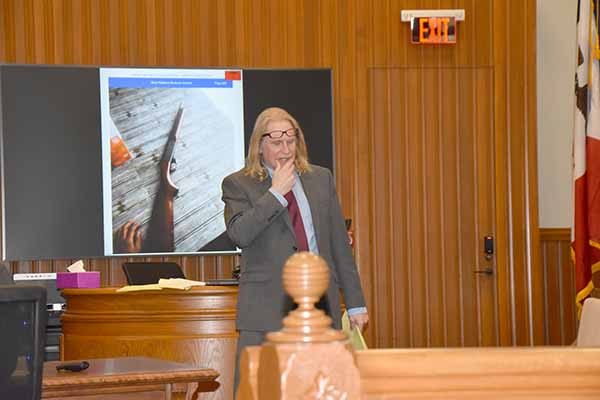
T-R PHOTO BY LANA BRADSTREAM Defense attorney Ted Fisher asks the jury about inconsistencies regarding the alleged weapon used in the killing of Isaiah Forest. Fisher is representing defendant Amarrion Isom in the first-degree murder trial. The jury had not yet returned with a verdict by presstime.
T-R PHOTOS BY LANA BRADSTREAM — Assistant Attorney General Monty Platz shows a picture of Isaiah Forest during Friday’s closing statements of the first-degree murder trial of Amarrion Isom. He is accused of killing Forest in March 2023.
T-R PHOTO BY LANA BRADSTREAM Defense attorney Ted Fisher asks the jury about inconsistencies regarding the alleged weapon used in the killing of Isaiah Forest. Fisher is representing defendant Amarrion Isom in the first-degree murder trial. The jury had not yet returned with a verdict by presstime.
Trending
Closing statements were given in the Amarrion Demeir Isom trial on Friday.
Isom, 21, is accused of the March 17, 2023 first-degree murder of Isaiah Forest, 27. He pleaded not guilty on March 29.
After a long week in the courtroom, Assistant Attorney General Monty Platz gave the first closing argument to the jury. He told the members the case against Isom is strong, and the requirements for finding him guilty of first-degree murder are present.
Using evidence presented to the court, Platz said Isom did not only kill Forest for some money owed but also because of disrespect. He said Isom wanted Forest dead and found a way to do it with evil intent.
He summarized the evidence which established a timeline of events, and where Isom was when certain events occurred on March 17. Cellphone metadata provided the locations of Isom during 11 critical minutes. His phone was tracked from Isom's place of employment to a Dollar General and then to the Boone Street crime scene.
"He brought his phone to the crime scene -- bad idea," Platz said. "He had it on -- bad idea."
Marshalltown Police Department (MPD) officers were also able to determine that it was possible for Isom to travel from one location to another in the minutes indicated in the timeline.
"We know the math works," Platz said.
He also addressed the eye witness of the crime -- a juvenile who testified in court. Platz said the juvenile was scared for their safety and had no reason to come forward to testify about the "cold blooded murder."
"[The juvenile] is a high school kid," Platz said. "[The juvenile] is not a criminal mastermind, just a scared kid who thought it would be fun to hang with a tough crowd. Every word of [the juvenile] has been verified from day one."
He brought up Isom's story of Forest accidentally killing himself. Isom said he showed up at the Boone Street residence where Forest was and pulled a shotgun.
Forest grabbed and yanked on it, which caused the gun to discharge. If that was the case, Platz asked why Isom then decided to let his "friend" die, get rid of the evidence, establish an alibi and tell different versions of the story to two separate law enforcement officers.
Showing a smiling picture of Forest, Platz told the jury the life was not Isom's to take.
"In the eyes of the law, Isaiah's life, and all life is sacred," he said. "He deserves justice. His life was taken in a selfish, violent act."
Defense
Defense attorney Ted Fisher, who said Forest's death was a tragedy, asked the jury to consider finding Isom guilty of involuntary manslaughter, which, under Iowa Code, occurs when "the person unintentionally causes the death of another person by the commission of a public offense other than a forcible felony or escape."
He brought up the credibility of the juvenile, who said a pistol-grip shotgun was used. However, there were photos of a shotgun with a regular stock.
Fisher said the witness was "absolutely sure and absolutely wrong." He wondered why the prosecution did not ask why the shotgun pictured did not have a pistol grip.
"I do not know how the state can explain the bizarre inconsistencies to [the witness's] testimony," Fisher said. ". . . I can't figure out why the state did not ask about that. It's a huge problem."
Fisher spoke about messages sent between Isom and Forest's phone. Platz said Isom's messages indicate premeditation, but Fisher said Forest's girlfriend had linked access to his phone. One message told Isom he was not writing to Forest, and then Isom referred to the person as "shorty." Fisher said that indicates Isom thought he was writing to Forest's girlfriend.
He also addressed the claim Isom killed Forest over a debt. Fisher showed a picture of a $20 bill in Forest's pocket when he died.
"When you kill someone over a debt, you need a plan," he said. "You take the money. You take the phone. This is consistent with no plan. Something went wrong."
Fisher told the jury the state needs to prove, beyond any reasonable doubt, that Isom is guilty of first-degree murder, and some of the inconsistencies indicate otherwise.
The jury did not reach a verdict on Friday, so the trial will continue Monday.
Contact Lana Bradstream at 641-753-6611 ext. 210 or lbradstream@timesrepublican.com.