
Trending
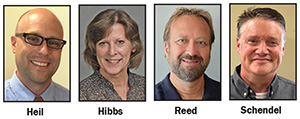
With the primary election date rapidly approaching on June 2, the Times-Republican sent out a questionnaire to the four Republican candidates seeking the party's two nominations for four-year seats on the Marshall County Board of Supervisors -- incumbents Jarret Heil and Carol Hibbs and challengers Tony Reed and Bill Schendel. Heil served as the Marshall County Treasurer for 12 years before running for his current position in the 2022 election and, along with Hibbs, emerging victorious out of a four-way GOP primary and then winning easily in the general election.
Hibbs, the retired CEO of the Marshalltown YMCA/YWCA, is also seeking her second term in office. Reed, the former director of the Central Iowa Juvenile Detention Center (CIJDC) in Eldora and the owner of All-American Property Management in Marshalltown, unsuccessfully ran for an Iowa House seat in 2020, and Schendel, the owner of Schendel Pest Control in Marshalltown, narrowly lost a 2024 Republican primary for supervisor to the late Kevin Goodman.
The two winners of the June 2 primary will be on the ballot alongside Democrat DeMorris Dean, a retired Marshall County Sheriff's Office (MCSO) deputy, who is running uncontested in his primary.
Goodman's son Christian, who was appointed to his father's seat earlier this year, is running to serve out the remainder of that term in November as a Republican against Independent Kyle Hall, a former GMG school board member.
The responses of the candidates who are running in the competitive GOP primary are printed in their entirety below and arranged in alphabetical order by the last name of the candidates. Part 1 of the questionnaire was printed in Friday's edition, and this is part 2.
6. Do you feel that secondary roads are currently being adequately addressed, and are there any specific projects you would advocate for if elected?
Heil: While we have increased funding to our secondary roads department, there are budgetary limits on the road projects that can be addressed in a year. Many of our bridges were built 100 years ago and many of our gravel roads were built up in the 1960's. Over time and use, and the enhancements in size of farm equipment these roads and bridges need attention and repair for adequate drainage for ideal driving conditions in our current day farm to market needs. Additionally, areas like Ridge Road/260th Street and Fairman Avenue are areas I'd love to see paved. But projects like these and widespread improvements to our gravel roads are extremely costly and don't fit in a quick-fix within our budget. We need substantial new revenue and I will work with an all hands-on deck approach to economic development to use our growth to make these projects a reality and keep our taxes low.
Hibbs: There is always a need for continued investment in maintaining roads and bridges. The Supervisors recently approved a 5-year plan that included more than $11 million in planned improvements, repairs and maintenance in FY27 alone. There are still projects that need to be addressed that are not in the plan yet. Of the 240+ county-owned bridges, approximately half need some structural maintenance work. The Secondary Roads Department is responsible for maintaining 937 miles of road, so the work never stops and is never finished! The Supervisors work with the County Engineer and his department to identify priorities and help address those areas as quickly as possible.
Reed: Secondary road maintenance is a challenging service for all counties. Our Iowa climate can definitely take a toll on these roads. As your supervisor I would work closely with our incredible county employees that maintain our roads everyday. I would listen to the taxpayers and spend the time and energy to look at the areas of concern they have and help develop viable solutions.
Schendel: I would continue scheduled improvements and updates to roads and bridges based on age and condition.
7. A representative from IMWCA recently called on the supervisors to "turbocharge" safety efforts in light of an increase in worker's compensation claims from county employees. Do you believe the supervisors are doing a good job handling the situation, and if not, how would you propose changing course?
Heil: Yes, our Supervisors and employees are doing a great job handling the worker's compensation issue. Our safety committee at the county has done a deep dive into our worker compensation claims. While there have been a couple outliers of employees that had repeated claims, they were very small dollar claims and no abuse of the system was found. When you have law enforcement, secondary roads and maintenance employees, there will always be more risk of worker compensation claims than if the county only had desk employees. Our representative from IMWCA did his job on making the county aware of what he sees on his end and the county has responded by reviewing our processes and promoting further safety practices starting at our robust safety committee and trickling down to the appropriate departments.
Hibbs: I believe we (the Supervisors) have provided clear communication to department leaders and employees that workplace safety is a top priority for us. We have emphasized correcting unsafe worksite practices and encourage reporting safety concerns. Our commitment is to provide a safe and healthy workplace, as well as help department leaders utilize the resources available to them for the safety of their employees.
Reed: The work comp rates the county pays are based on past experience. Since the IMCA Work Comp Representative has asked the county to "turbocharge" our efforts, it is obvious that not enough is being done. As your County Supervisor I would ensure that we are providing all safety programs, policy and the necessary equipment to help keep these rates as low as possible. All the overages that we currently have in rates directly affect every taxpayer through increased taxation.
Schendel: To "supercharge" these safety efforts, I am in favor of an incentive program. By offering rewards for those going free of claims and raising deductibles on repeat offenders, we could focus on making sure that claims are legitimate.
8. Work on a scaled down set of improvements to the Jail/Sheriff's Office facility is nearing completion. Are there further improvements you would like to see in the future (or the construction of a new facility altogether), and do you believe it would require a public bond vote to secure the necessary funding?
Heil: I'm very happy to have some necessary upgrades at the Sheriff's Office since the last renovation was nearly 30 years ago. There is another phase proposed for the Sheriff's Office. I would not like to see this go to a public bond vote to fund it, I'd rather see revenue from future growth from economic development pay for the next phase. This would continue to keep our taxes under control, enhance our infrastructure and strengthen our public safety.
Hibbs: Yes, the improvements being made to the Sheriff's Administration Building/Jail are addressing the most urgent issues, but there are still improvements to be made in the facility. It was an established building that was retrofitted for its current purpose, which means there are some areas that do not best serve the needs of our law enforcement personnel. Replacing the windows will help a great deal with energy efficiency and lower the heating and cooling costs. Reconfiguring and constructing a new booking area will improve the process for handling and processing those being brought into the jail. There is still a lot of work to be done, so if the public agrees, it may take a bond issue to address the remaining work. The size and scope of the remaining work is yet to be determined. I am committed to supporting our law enforcement personnel and ensuring they have a safe work environment. I have supported the investment of current county resources to increase funding for public safety.
Reed: The county is currently working on a scaled down set of improvements to the Jail/Sheriff's Office. Counties need to keep up infrastructure to ensure buildings are safe, efficient and hazard free. Design, features and equipment are large factors in the cost of these improvements and new building projects. I have supervised many multi-million dollar construction projects in my administrative career. I've always committed a keen focus on the details because in construction projects the cost can escalate rapidly based on small details. My years of experience in construction management would be a great asset for our County.
Schendel: I think they have done a good job keeping the older part of the building running. If the heating and cooling need to be replaced in the next 5 years I am not sure spending millions on an oversized inefficient building is the best option. Might be best to consider putting that money towards a new addition.
9. If it hasn't been mentioned yet, what is a major issue you would like to address if elected?
Heil: EMS as an essential service and ambulance service is a major issue on the horizon. It's easy to say EMS should be an essential service, but the framework is the big question that comes with a price tag. We have a two-part issue at hand. Number 1, UnityPoint claims they are losing $1 million a year on ambulance service that could possibly lead them to getting out of the ambulance service business. Number 2, EMS and first responders in the rural areas are dwindling due to a shift in our society on volunteerism among other varying issues. The price tag of our problem we need to solve is up to $1.04 million annually (up to $1 million ambulance and $40,000 EMS/first responder). Our solution on the table is increasing county taxes by $1.7 million to fund an annual $3.8 million new ambulance service that is managed by the City of Marshalltown. This kind of math should give the Board of Supervisors and Marshalltown City Council a strict warning that the business plan needs to hammered out from every possible angle and sustainability for decades to come must be solidly proven to the people if we firmly believe that this is the right solution to our EMS and ambulance service problem. I look forward to seeing more details in the plan from the task force to determine if this is the right solution to bring before the voters.
Hibbs: Public resources are limited. Working collaboratively with public and private partners to meet the needs of our citizens is not only efficient, but more effective. I would like to see this spirit of cooperation continue.
Reed: Already addressed.
Schendel: One thing I'd like to address is the franchise fee, which is essentially a phrase for tax. City property owners should be able to vote on property related issues whether they live in town or not. If vested interests are at stake, I believe property owners should have a say.
10. What do you believe is the best path forward on EMS services in Marshall County, and would you support an essential services levy if it is placed on the ballot in the next year or two?
Heil: Addressed the issue in question 9.
Hibbs: In 2021, Gov. Reynolds signed into law legislation allowing counties to declare Emergency Medical Service (EMS) as an essential service, which meant that a levy of up to 75 cents per $1,000 of assessed taxable value to fund EMS services could be passed by voters (60% approval is needed) to support emergency medical services, including ambulance service and the necessary equipment and personnel. Marshall County residents have had the benefit of having emergency ambulance transportation provided by our local hospital, in addition to independent ambulance services provided by volunteers from our smaller communities. Over the years, the local hospital (currently Unity Point Health) has provided the emergency ambulance transportation service based only on what fees they could generate from billable emergency responses. When the Affordable Care Act was enacted into law, it changed the way hospitals are paid for their services, and emergency ambulance transportation became much more difficult to maintain financially because the financial reimbursement was put together with an established amount for treating a patient for specific conditions. However, if patients refuse treatment or transportation after an ambulance has been dispatched, or are treated at a different hospital, there is no way for the local hospital to recover their costs. This differs from independent ambulance services, which because they are not a hospital, receive financial reimbursement based on a fee-for-service model. Hospitals are NOT required to provide emergency ambulance transportation, and most do not. Most hospitals now only provide transportation for those people who are already a patient, generally just between hospital facilities-as in the case of a patient being transferred. Emergency ambulance transportation is not financially viable and has become a drain on the over all operation of the hospital, putting the financial viability of other needed services at risk. In Iowa, cities and counties have generally not funded emergency ambulance service for their residents because there has not been a funding mechanism designated for EMS.
Most ambulance services are struggling with adequate staffing and increasingly expensive equipment required to maintain the standard of patient care. EMS in Marshall County has been provided by the hospital, in addition to dedicated volunteers who were often able to leave work to attend to the needs of the community. In recent years, the ability for employees or business owners to leave work is no longer as available as it once was. A decrease in volunteers, together with increased education requirements, along with increased expectations for EMS care capabilities has resulted in the need for paid staff to cover gaps in the number of volunteers providing the service.
Residents expect and need an ambulance with trained personnel to be available to them in an emergency. To date, 21 Iowa counties have now passed a resolution declaring emergency medical services as an essential service, and voters have approved an essential services levy supporting EMS in those counties.
The EMS Task Force, consisting of myself and other representatives from the County, as well as the City of Marshalltown, UPH-Marshalltown Hospital and EMS volunteers from State Center and Gilman have been meeting to assess the current situation, research how other counties are dealing with this same issue, and recommend a sustainable service model for the future. After reviewing the results of a study and getting approval from the governing bodies to move forward with researching options, the Task Force is currently interviewing representatives from other counties that have established a county-wide emergency ambulance service. We hope to have a recommendation for a sustainable ambulance service model for the governing bodies in the next few months.
With the right plan for providing a county-wide emergency ambulance service (utilizing assets currently available, supplementing with paid staff, in addition to supporting current volunteers), I would support bringing an essential services levy to the voters of Marshall County.
Reed: I would not support an essential services levy at this time. I feel the taxpayers need to see a lot more transparent information on this topic before anyone can make an intelligent decision on it.
Schendel: There is no doubt that the EMS system is a major issue. I do not support an essential services levy. This places the burden completely on the taxpayer. I am confounded that the panel formed to address the hospital (a privately owned entity) losing money over what they were allowed to bill for or not led the group to the idea of forming a new government department. This proposed department would add 28 new employees and all of the costs that go along with it. This creates far too much strain on our local government, and ultimately, most taxpayers don't want the government to grow. I believe there are many other solutions available without the city, county, and ultimately the taxpayer taking this on.
11. Why are you the most qualified candidate for the seat you are seeking?
Heil: I love Marshall County, it is home for my family and I have a lot of pride in where I've come from and where I live. I have extensive experience in government and working with finances. I've managed our budget with conservative principles and the results speak for themselves. We have set the table for economic growth and a plan to improve our infrastructure. My management style is open minded to others to find common sense solutions without compromising fiscal responsibility and Christian values that make Marshall County great. I've enjoyed my time serving Marshall County and I'd be honored to have your vote for Marshall County Supervisor on June 2.
Hibbs: I have appreciated the opportunity to serve the residents of Marshall County. A positive culture has been established within our county government, and I have worked to bring people together and focus on opportunities for improvement and economic growth. I am grateful for the chance to work with others to make things better for the next generation. If elected by the voters of Marshall County, I will continue that work.
Reed: I feel I am the most qualified candidate for this position based on my 35 years of leadership experience. During this time I have accumulated a vast amount of business knowledge that will be extremely valuable in managing county business. I have worked closely with hundreds of Supervisors throughout the state of Iowa which has taught me so much about county government. Over the past 35 years I have worked with most of Iowa's counties which has given me an unparalleled advantage on the inner workings of counties. I believe government should run efficiently and I will work hard and put in the time needed to ensure we are providing the best for the citizens of Marshall County.
Schendel: I am running purely to make sure your tax dollars are handled properly. I am not running in search of a job or in search of a career. I want Marshall County to grow and thrive for your family and mine. I don't have any connections to any interest groups or a history of working for the state or county. My goal is that Marshall County can continue to be a place where people want to raise a family.