
Rural road names pt. 6: From Judge Smith to Vance
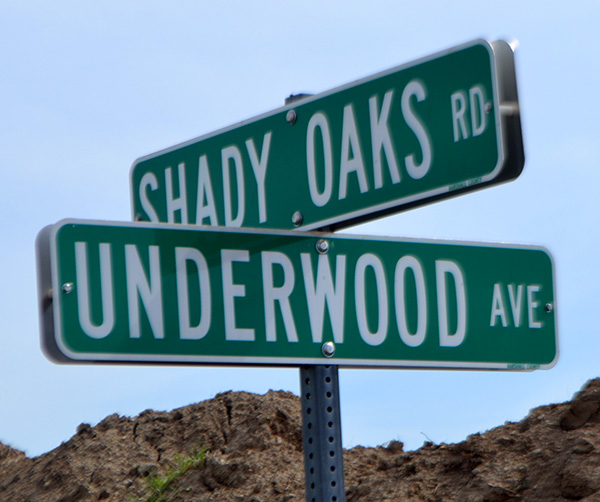
CONTRIBUTED PHOTOS — Pictured recently is the intersection of Underwood Avenue and Shady Oaks Road in Marshall County. Eliza M. Underwood was the wife of a bridge builder among other businesses. Construction work was underway near the intersection.
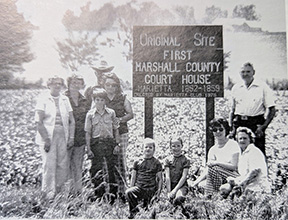
Shown from this 1976 photo are members of the Marietta Club standing by a sign identifying the site as the location of Marshall County’s first courthouse. Smith Avenue in Marshall County was named for Judge William Smith who ruled on a number of motions to keep Marietta as the county seat.
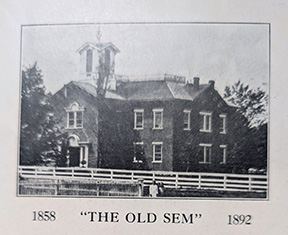
Shown is the former Albion Seminary in Albion. Taylor Avenue in Marshall County was named for professor Charles Taylor who was on staff there.
CONTRIBUTED PHOTOS — Pictured recently is the intersection of Underwood Avenue and Shady Oaks Road in Marshall County. Eliza M. Underwood was the wife of a bridge builder among other businesses. Construction work was underway near the intersection.
Shown from this 1976 photo are members of the Marietta Club standing by a sign identifying the site as the location of Marshall County’s first courthouse. Smith Avenue in Marshall County was named for Judge William Smith who ruled on a number of motions to keep Marietta as the county seat.
Shown is the former Albion Seminary in Albion. Taylor Avenue in Marshall County was named for professor Charles Taylor who was on staff there.
Trending
Editor's Note: This is the sixth in a series of articles reporting on Marshall County residents of the mid to late 1800s whose names are posted on rural avenue road signs.
Last names -- and names of former towns and villages -- were mandated by the E-911 county system. They were approved unanimously by the Marshall County Board of Supervisors in a July 16, 1986 resolution.
Joseph Armbrecht – chairman of the board -- signed the resolution and it was attested to by Sherrill Snider, county auditor, according to county documents.
County officials used 1847 as a benchmark for avenue names, since the first claim for land in Marshall County was made in that year according to county archives.
"The (avenue) names were taken from the "History of Marshall County 1878," sponsored by the Central Iowa Genealogical Society in Albion," according to county documents. Names used are no reflection on present county residents."
A further review of county records showed an attempt was made to use names of attorneys, businessmen, Civil War veterans, farmers and female and male settlers. Also included were those who made significant contributions to Marshall County's and Marshalltown's initial development.
There were three exceptions to individuals being named.
The first was Lafayette Avenue -- which was named for the town by that name and later renamed Albion.
A second exception was Oxford Avenue reportedly named for the former town according to county documents.
A third is Prairie Avenue - also reportedly named for the former village of Prairieville near Albion.
Resources used for this series have been the "Marshall County History 1862," "History of Marshall County, Iowa, 1867," "History of Marshall County, 1887," "History of Marshall County 1955 by Gerard Schultz," "The Continuing History of Marshall County 1997," and "Marshalltown Illustrated." The latter is not dated and was published as a supplement to the Times-Republican under the supervision of the Marshalltown Retail Merchants Association.
Reader Shelley Barron recently commented on the series:
"Just a clarification and correction to article about county road names," she wrote in an email to the T-R recently: "Article stated east west roads are labeled streets and are numerical. It might have been helpful writing they begin at the north county line with 100th Street. Correction: named roads go beyond Zeller to Zola and Abbott."
Smith: Judge
William C. Smith was a farmer in the Timber Creek area - and later a resident of Albion – who was elected county judge. As judge, he ruled on numerous efforts by county residents to move the county seat from the village of Marietta to the village of Marshall. (It would later be renamed Marshalltown in 1862. Marietta had been awarded the county seat in 1851). Initially, Smith made several decisions to keep the county seat in Marietta. However, he ruled Marshalltown as the county seat in 1863 only after a number of Marshall men stole county records from a building in Marietta on New Years Eve and transported them to Marshall.
"A significant amount of political debate preceded the incident. During the theft temperatures were reported to be 10 degrees below zero. Another key factor was the Cedar Rapids & Missouri Rail Road being awarded the east/west railroad rights across the state of Iowa under lease by the pioneer parent of the Chicago & Northwestern Railway."
Taylor: Professor
Charles J. Taylor listed as a professor in the commercial department at the Albion Seminary in Albion.
Tiffin: Farm Wife
Mary. Born in Ohio. She married Joseph Baker Nov. 6, 1864. He was a farmer in Sec. 27 of Edenville (Later renamed Rhodes). From this union were born seven children of which five were living: William, Clara, Maryette, George and Samuel.
Underwood: Wife of Bridge Builder
Eliza M. She was born in Columbiana Co., Ohio, Aug. 12, 1836. She married Benjamin Lewis Pyle, also a native of Columbiana Co. Ohio. Pyle was a farmer, stock raiser and bridge builder. They were married Oct. 9, 1864 and resided in the village of La Moille. From this union four children were born.
Vance: School Teacher
Jenny (nee Bradbury) was the wife of Willis Vance, according to the "History of Marshall County, Iowa, 1878."
"The first schools in the town of State Centre (a common spelling at one time) were rather of the primitive order. The first school was taught in a little old shanty that could not be used for anything else. Bradbury taught here. This was 1865, in a building that stood near where the Presbyterian Church is at present. There were 10 pupils. In 1866 school was taught in a room (location unknown). The total population of the town as taken up to Aug. 20, 1878 is 992. The total number of residences – 256."