
After hourlong special meeting, council pushes viaduct chain link decision to next regular meeting
Trending
At the last regular meeting on Monday, June 22, the Marshalltown city council voted to "press pause" on approving chain link fencing around the currently closed Center Street Viaduct to replace the deteriorating railings so that more options could be considered. On Wednesday, however, the council reconvened for a special meeting to once again discuss the same topic, apparently due to the fact that a manufacturer had already started producing the chain link fencing and "needed an answer" on whether the council intended to proceed with it by July 1.
An hourlong meeting held over the noon hour became contentious at times as at least one councilor questioned why it was even being held, and the two most passionate public advocates against chain link fencing took the city to task for a perceived failure to manage the project and gather relevant information needed to make decisions.
City Engineer Ben Daleske again returned to the microphone to share history of the viaduct and repeated the Union Pacific (UP) standards for new fencing and the projected costs for each option. The motion before the council was to proceed with a change order for $109,050 to install the chain link fencing, which would include saving $290,000 for removing the painting of the current railings but also an additional of $399,050 for the chain link materials.
He also showed examples of other cities with chain link fencing over major bridges in Iowa, including Des Moines, Council Bluffs and Mason City, to name a few. In response to a question from Councilor Greg Nichols, Daleske reported that there had not been any testing conducted on the existing railings.
During the public comment period, Heidi Dalal, who had urged the council to pause on their decision at the last regular meeting, asked those in attendance why a special meeting had been called. According to Daleske, it was because the supplier of the chain link fencing material needed to resume or cancel the order by July 1, or it will push back the arrival date and in turn affect the completion date on the project.
"If we pause or say we're gonna try to do a different option, that would possibly delay what we're trying to do. They're wanting to have an answer by July 1," he said.
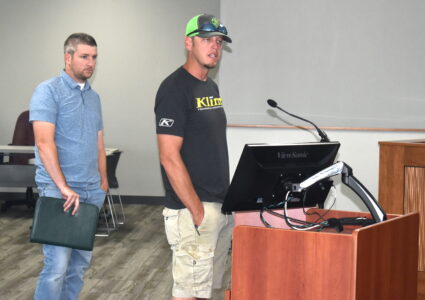
Luke Kjormoe of Boulder Contracting, the general contractor on the viaduct project, then addressed the council with an update on the project from the company's perspective and some of the change orders, and Councilor Sue Cahill asked him about options for "embellishing" the chain link fencing to make it more aesthetically appealing.
"We can definitely do something along those lines if you guys want us to. You just have to let us know what you want us to price," he said.
In response to another question from Councilor Greg Nichols, he told the council that work could be done after the project is completed without necessarily impacting the completion timeline. When Councilor Gary Thompson asked Kjormoe why the city wasn't getting more credit toward the overall cost with the chain link change order, he said the numbers came from a subcontractor and would need to look further into how they arrived at them.
Councilor Jeff Schneider, communicating remotely, wondered aloud why the special meeting was being held at all considering that the council had voted during its previous meeting to delay the decision until its next regular meeting scheduled for Monday, July 13.
"I know that it said we had to come back today because our vendor screwed up. That is not our problem. I'm gonna be voting no on this today if we vote on this, but I'd rather table it for a week and a half so we can get some real options in the agenda ahead of the meeting so we're not discussing design at this meeting," he said.
Nichols worried that any decision on designing the artistic flourishes on the viaduct would require public input and could take over a year to reach a consensus followed by community fundraising.
"I'm gonna vote to go to the chain link fence because I want this to be open before Christmas," he said.
Thompson liked the "compromise" idea thrown out of proceeding with chain link fencing but adding other elements later, and after more discussion, he invited Dalal to speak. She echoed Schneider's frustration and felt the council was trying to solve a problem it didn't understand.
"You don't know the materials. You don't know the vendors that are DOT approved. You don't know the costs, so this is why, initially, I had reached out to just inquire about why the decision on chain link," she said.
Her goal in asking to remove the item from the consent agenda at the last meeting, she added, was to provide more time to explore options, and she noted that a formal change order had never been approved by the council regarding chain link -- at a May meeting, the council unanimously voted to bring back a resolution to that effect, but it was then pulled from the consent agenda and delayed as previously mentioned.
As the conversation shifted back to the council, Nichols expressed concern that if the council leaves the current rusted railings in place without doing anything, the city could be at a legal risk in the event that a pedestrian is injured. Thompson shared his doubts that the council would receive any real information on the condition of the railings before the July 13 meeting, and he urged the council to cut its losses, install the chain link fencing and add decorative elements after the fact.
"Let's just put this to bed and then make the best of it, move on with decorative features after the fact because we can't get answers on what percentage of the railing is bad and needs to be replaced. And I don't understand why we're not getting that information," Thompson said.
John Hermanson, who had spoken during the last regular meeting, told the council he was in "utter shock" about the entire process, the contract and scope of work with Boulder and the inability to get cost estimates.
"We need to be making decisions based on information and not based on what we don't know," he said.
He was also shocked that the initial design didn't include an aesthetic solution, which he felt was as integral as the steel and the pavement.
"It's like going out to dinner at a restaurant, and you don't have enough money to pay the tip. Well, you shouldn't be eating at that restaurant," Hermanson said. "Well, if you're building a bridge, you need to build it right."
The city council should be pursuing courses of action that seek to improve and beautify the community, he argued, instead of negotiating like they had "a gun to their heads."
"Why has chain link been fabricated when it was never approved?" he asked. "We don't know what it costs. We don't even know the cost of replacing with chain link."
He was also disappointed that more citizens weren't attending the meeting and wondered where the citizens who "give a darn" were on Wednesday and quoted a man he met who described the chain link fencing as looking like "a gauntlet on the way to a prison camp."
Before he departed the meeting, Ladehoff lamented that safety had not been a focus of the discussion, and he also mentioned budget constraints and the timeliness of the project. Mitchell questioned whether everyone in the audience knew about the risks of sandblasting old steel only to watch it get thinner and thinner and urged the council to move forward with chain link fencing.
Dalal then commented that she didn't have a firm number on how much the community could potentially raise for the bridge without sufficient information, and she claimed that most of the individuals she had spoken to in the community wondered why the council was pursuing chain link fencing.
Councilor Marco Yepez-Gomez asked what difference delaying the vote another two weeks would make, and Daleske replied that it would likely result in additional working days for the contractor. Kjormoe also noted the volatile nature of steel pricing with tariffs and other factors in play.
Finally, after nearly an hour of discussion, Schneider motioned to do what the council had already agreed to do at its previous meeting -- postpone the decision until the next regular meeting on July 13 -- and before the vote, Cahill asked to make another comment and pushed the special meeting over the 60 minute mark, sharing her reluctance to vote for the change order as presented given the aforementioned unknowns. Mitchell worried about wasting time and delaying the project further, and Thompson felt reopening the bridge should be the highest priority at this point.
In response, Schneider contended that if the vendor had already started making the chain link fence, they'd still sell it to the city, and he urged city staff to be creative in exploring all available options.
"I don't want to come back to the next meeting with one crappy option. I really want to see some good options," he said.
A motion to delay the vote until the regular meeting ultimately passed 4-3 with Cahill, Fonseca, Schneider and Yepez-Gomez in favor and Mitchell, Nichols and Thompson opposed.