Locals work to reduce number of feral cats with TNR program
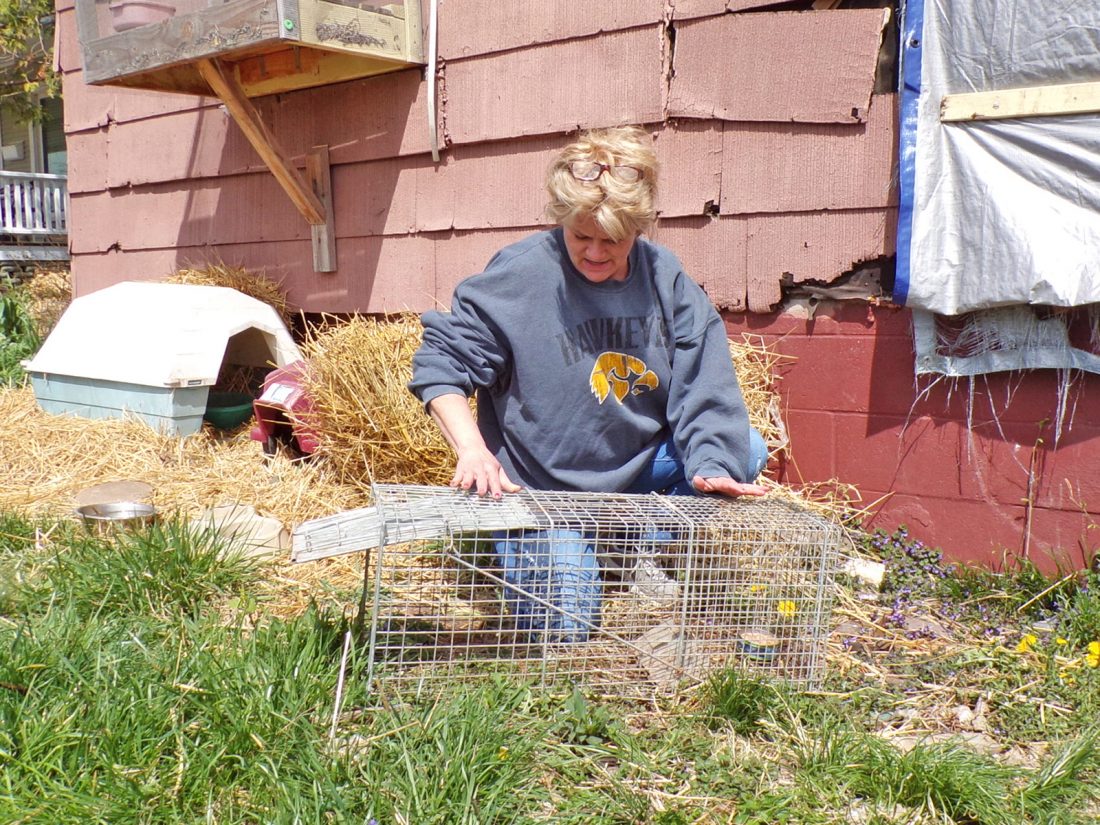
T-R PHOTO BY SARA JORDAN-HEINTZ - Cara Jackson, founder of Marshalltown Strong TNR (Trap, Neuter, Return), said the population of feral cats has increased since the July 2018 tornado. Here she sets up a trap in a Marshalltown neighborhood.
Not all cats observed sitting on street corners, in yards and crossing roadways are strays. Rather, they’re feral cats, born in the wild. These cats avoid human contact and live in colonies, keeping to themselves. Cara Jackson, founder of Marshalltown Strong TNR (Trap, Neuter, Return), said the population of these cats has increased since the July 2018 tornado.
Jackson, whose home was damaged in the tornado, forcing her to relocate to Garwin, still returns to Marshalltown to implement TNR in places where her services have been requested. She said this past winter’s cold snaps made the need increase even more.
“Some homes were destroyed in the tornado that were serving as feeding stations for these cats, so when people (were displaced) the cats weren’t being fed but still coming back to those neighborhoods,” Jackson said. “Then during those cold snaps, I’d get calls about cats just out in groups, needing shelter and I would work to find them shelters.”
Jackson, who has been spaying and neutering these cats out of her own pocket, took to social media for help, posting on the Marshalltown Tornado Recovery Page, seeking donations. Once a cat has been trapped, she takes it to veterinarian Dennis Drager and his colleagues at Animal Clinic-The Vet to be fixed and vaccinated.
“The disease and overpopulation will decrease by controlling the population,” Drager said. “It’s been shown that a population of feral cats will maintain themselves and keep others from joining, so if we have them taking care of themselves, the population will continue to decline.”
Drager said these cats then have a small part of the left ear tipped, which is the universal sign that a feral cat has been altered.
“There has been great concern because they’re in the areas significantly affected by the tornado. There certainly are animals that are not getting the care they were before, which is increasing the problem,” he said.
People interested in helping to cover the cost of the altering and vaccinations may phone the vet clinic or drop off monetary donations. Jackson said she is not personally handling the funds.
“We got a really nice donation recently that will allow us to spay/neuter 12-15 more cats, in addition to the four we have done already,” she said.
There is an estimated 30 to 40 million community stray and feral cats in the United States, according to the Humane Society of the United States.
Denise Yantis, founder of the Rescue Inn, a licensed rescue and a 501c3, located west of Marshalltown, has been a supporter of TNR.
“People don’t get it. The education is important. This is the only way to control the cat population without just killing them off,” she said.
She has provided traps for people interested in TNR, and has helped find barn homes for cats not suitable for adoption.
Yantis and Jackson have coordinated efforts in identifying places in Marshall County in need of TNR. Yantis has helped set up feeding stations and TNR in the town of Beaman, which has led to a reduction in that town’s feral cat population.
A TNR program was adopted in Beaman in July 2013. The council also adopted a policy that states cats kept as pets and go outdoors have a collar on to signify they belong to someone and are current on immunizations and have been (neutered/spayed).
“Everybody thinks there are more feral cats than there really are,” Yantis said. “TNR really needs to be adopted in small towns.”
The city of Marshalltown does not have a formal TNR program.
“I just recently became aware of their efforts. The city is not involved in their initiative or any others related to feral cats,” City Administrator Jessica Kinser said.
Marshalltown Police Chief Mike Tupper said he is supportive of the TNR efforts by these volunteers.
“I think TNR programs are helpful,” Tupper said. “It does not seem like we are hearing more than the normal amount of complaints about cats at large. I am not certain things have worsened because of the tornado. I am certain the wild cat problem is a concern in some neighborhoods. This is a complex issue. I am excited to see community members working together to address these concerns.”
Because feral cats are not accustomed to human interaction, residents are advised to use caution when approaching them. Jackson said she puts chicken legs or tuna in the traps to lure the cats. She returns to check the traps a few hours later. If full, she then takes the cats to the vet clinic.
“I trap from 8 a.m. to 4:30 p.m. I would love to have volunteers set traps at 11 p.m. and check them at 7 a.m.,” Jackson said.
She said it is important to return cats to the same place they were trapped because that is where their colony lives.
Cats are familiar with an area’s food sources and places that offer shelter, other cats and threats to safety. Even when all community cats are removed, new cats will soon move in and set up camp, according to the ASPCA.
Jackson said she has been met by some opposition.
“(A landlord) told his renters that if they feed the cats, he will evict them. I’ve had several requests for TNR, but if I return the cat there and there is not a feeding station, I can’t help the problem. This is the worst way to go about it,” Jackson said. “The problem isn’t going away. I just want a better life for them. If you can’t help them, don’t hurt them. These cats control the rodent and snake populations. Once they’re fixed they aren’t going to fight or spray (to mark territory).”
For more information, Jackson may be reached at carajackson2018@icloud.com
Todays News
Over 200 Meskwaki objects returned to Tribal Museum
MCSD Polar Plunge supports Special Olympics athletes

MCSD welcomes new associate principal at Marshalltown High School

Woodbury students enjoy dancing, ribbons, masks, colorful dresses
Seven Ranges survey changed the country