
City council opts against putting franchise fee on November ballot
Petition could still force special election
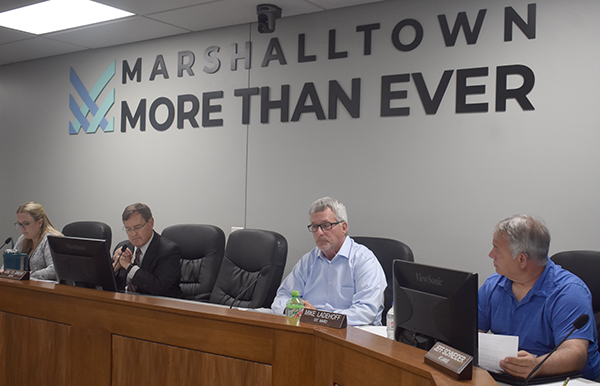
T-R PHOTOS BY ROBERT MAHARRY — Interim Marshalltown City Administrator Robert Fagen, second from right, discusses the proposed electric and gas franchise fees while Councilor Mike Ladehoff, right, City Clerk Alicia Hunter, left, and Mayor Joel Greer, second from left, look on during Monday night’s city council meeting.
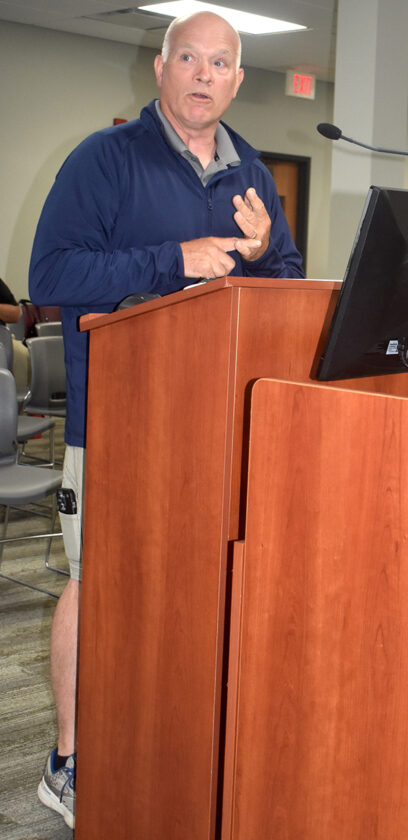
Local business owner Jim Palmer expressed his opposition to proposed franchise fees during Monday night’s Marshalltown city council meeting.
T-R PHOTOS BY ROBERT MAHARRY — Interim Marshalltown City Administrator Robert Fagen, second from right, discusses the proposed electric and gas franchise fees while Councilor Mike Ladehoff, right, City Clerk Alicia Hunter, left, and Mayor Joel Greer, second from left, look on during Monday night’s city council meeting.
Local business owner Jim Palmer expressed his opposition to proposed franchise fees during Monday night’s Marshalltown city council meeting.
Trending
The debate over a controversial proposed five percent franchise fee on gas and electric bills for Marshalltown residences and businesses resumed during Monday night's city council meeting, as the council unanimously voted against putting the matter on the November ballot but subsequently moved forward with amending city code to accommodate the fees by a 5-2 tally.
During the initial discussion about the proposed election, Councilor Gary Thompson -- an outspoken opponent of the franchise fee -- worried that a November election, if held at the same as a vote on reauthorizing the use of Local Option Sales Tax (LOST) dollars, could jeopardize the fate of those dollars.
"Until we get our financial situation under control and balance the budget. This council needs to do a better job, and the new city administrator, (but) I think we would be committing suicide to do away with the Local Option Sales Tax," Thompson said. "So I'm not in favor of putting this on the November ballot. I would rather us let there be a special election and let the franchise fee be a standalone on its own merits, for or against."
Interim City Administrator Robert Fagen then explained that his goal was to present all available options to the council and the public before a decision is made. From there, the floor was opened up to public comment, and Mark Eaton opined that voters were "smart enough" to decide two questions at once. He added that having the franchise fee on the November ballot as opposed to a September special election would save the city approximately $20,000.
The first of several related motions to call an election on the gas franchise fee with Interstate Power and Light Company (Alliant Energy) failed by a 7-0 vote, and the next agenda item called for a vote on setting an election on the electric franchise fee. Thompson again spoke up with concerns that an across the board five percent fee would disproportionately impact lower-income residents and reiterated his previous suggestion about the council cutting spending before asking the taxpayers for more money to fund street improvements.
Councilor Barry Kell responded to Thompson and said the matter was always intended to go to the public, noting that streets are one of the most common complaints council members receive and highlighting the fee as a potential solution.
"There's been a narrative out there that we're driving something at the council level. That's not true, so I just wanted to clear that up," Kell said.
During public comment, Eaton questioned the logic of taking the item off of the November ballot and thus requiring a petition (which would require about 250 signatures) to force a special election in September and wondered if the revenue generated would actually be used to fix existing streets or simply to fund new developments and road projects.
Jim Palmer then shared his experience as a local business owner and told the council that the cost of the franchise fee would ultimately be passed on to consumers.
"That's exactly what I have to do in order to stay in business," Palmer said. "I can't cut my profit margins because I'm being assessed what I consider a tax on being able to do business. You've done it already with the stormwater, and now you want to do it again when it comes to this fee. So I really want you to think about that, because the other thing that starts to happen with businesses my size (is) I'll find another community to go to that's not trying to force me out of here. And I'm not afraid to be able to pick up and move."
Several other commenters -- Linda Clark, Doris Kinnick, Jim Shaw, Bill Schendel and Lyle Hineman -- all spoke at the podium, and all were opposed to the franchise fees. Schendel worried they would put even more strain on local nonprofits dedicated to assisting low-income individuals and families with their bills, and Hineman compared the council's actions to the board game Monopoly.
"You guys seem like you're gonna take a chance and roll the dice and hit us again, so I'd like to see the city run like a business. Balance the budget and represent what the people of Marshalltown need," he said. "No one in this room appears to be in favor of this franchise fee unless someone can tell me different."
The second motion also failed unanimously before the council moved to a third related motion calling for an election on establishing an electric franchise fee with Consumers Energy. Without any discussion, that motion also failed by a 7-0 vote.
After quickly moving through a few other agenda items, the franchise fee discussion again continued during public hearings on amending the city's code of ordinances to implement them. Clark and Kinnick restated their opposition, and Eaton said he would have petitions available to sign in hopes of forcing the matter to a special election.
Councilor Gabe Isom lamented what he considered a constant cycle of potential cost of living adjustment reductions and furloughs for city employees during budget conversations and hoped the franchise fees could catalyze measurable infrastructure improvements with an investment of approximately $35 million.
"We've had the same conversation ever since I've been on council with regards to the budget. Dollars keep getting worse and so it's a revolving door with that. This at least dedicates the dollars to go toward where we say they're going," he said. "It doesn't solve all of our problems, but it solves a big portion of them or at least gets the ball moving in the right direction."
Fellow Councilor Jeff Schneider said the city wouldn't have the money to make improvements otherwise and indicated he would be supporting the measure. Thompson used the analogy of his own mother giving his children $5 on their birthdays as opposed to his much wealthier former in-laws giving them $100 for their birthdays to explain how much harder the franchise fee would hit low income residents.
"The people on the north side of town can't absorb this. It's just too much of an impact on them. We need to step up and do a better job of managing your finances, your money, before we just go get more," he said. "Let's fix the problems we have. We've never held a city administrator accountable since I've been on the council to have a balanced budget. We've always bailed it out."
He added that contributions to nonprofit entities like the Marshalltown Central Business District may need to stop if the budget can't be brought under control. Councilor Dex Walker said he's heard more about streets than any other issue since he first took office, and he argued that resolving annual budget deficits around $200,000 still wouldn't come close to actually addressing the poor condition of the city's roads.
"We really do, as a community, need to talk long term about the infrastructure needs. It will go to a vote, and it's important we have this discussion," he said.
Even if a vote fails, he added, it could kickstart a meaningful conversation about what a real solution looks like. Councilor Mike Ladehoff noted the city's 170 miles of streets and cited the fact that hundreds of other cities already utilize franchise fees, and Kell said the city would need to more than triple its current annual investment in roads to "catch up."
All three motions to move forward with the ordinance amendment passed by a 5-2 margin, with both Thompson and Hoop opposing.
In other business, the council:
• Approved the consent agenda as listed, with Hoop opposing.
• Approved a motion to approve two 14-day special class Class C alcohol licenses for Thirsty Pigs for the Live After Five events, a five-day special Class C alcohol license with outdoor service for Zamora Fresh Market and a five-day special Class C alcohol license for the 13th Street District, with Hoop opposing all three.
• Approved a resolution providing for the conveyance and transfer of title to a portion of vacated but unconveyed alley to the Marshalltown Community School District.
• Approved the third and final reading amending the code of ordinances by repealing and replacing Chapter 91 of the fire prevention code and adopting a new one.
• Approved the first reading of an amendment to the city code regarding alcoholic beverages.
• Approved the first reading of an amendment to the code of ordinances regarding offenses against peace and safety.
------
Contact Robert Maharry
at 641-753-6611 ext. 255 or
rmaharry@timesrepublican.com.