
Life of a Union soldier ably portrayed at history event
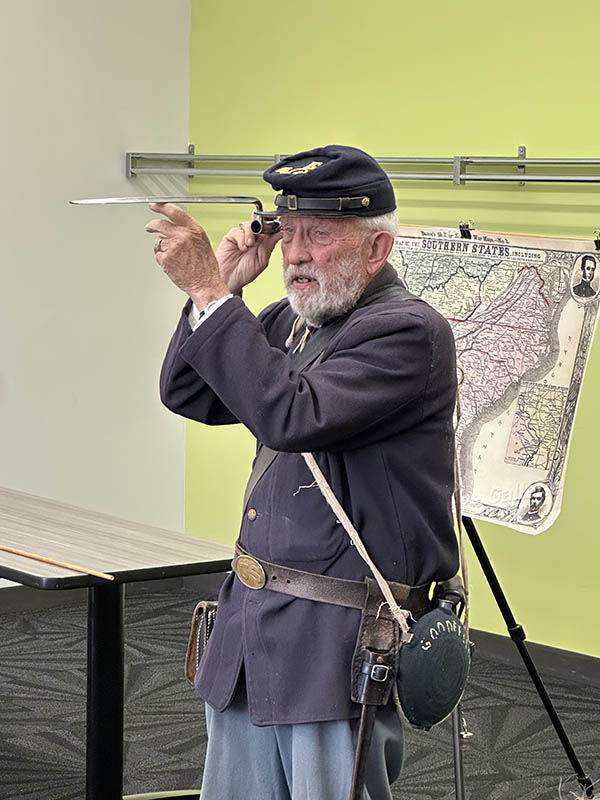
T-R PHOTOS BY MIKE DONAHEY — Civil War reenactor O.J. Fargo of Creston displays a Civil War bayonet used by Union forces during his presentation at the Marshalltown Public Library Tuesday evening. It was co-sponsored by Humanities Iowa and the Historical Society of Marshall County.
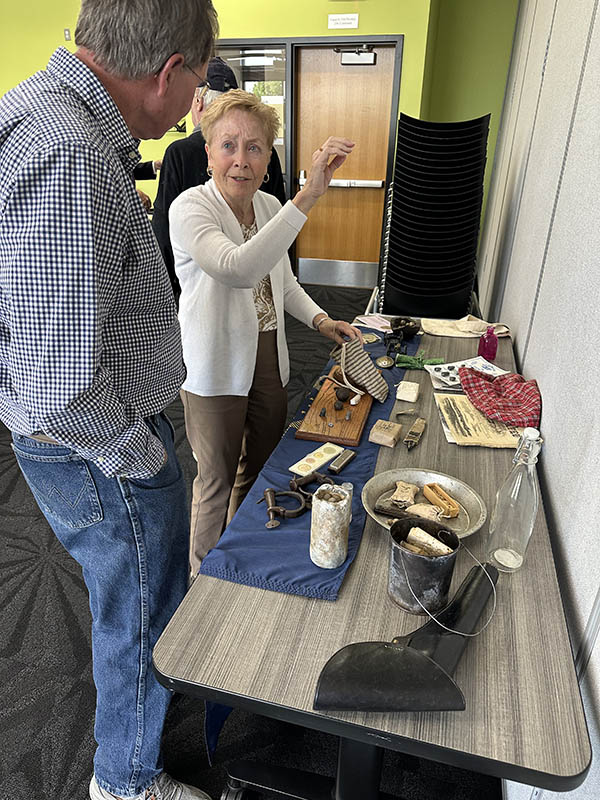
From left, State Center Mayor Craig Pfantz himself a Civil War soldier reenactor - listens to Elaine Fargo of Creston explain Civil War memorabilia at a Humanities Iowa/Historical Society of Marshall County event Tuesday at the Marshalltown Public Library.
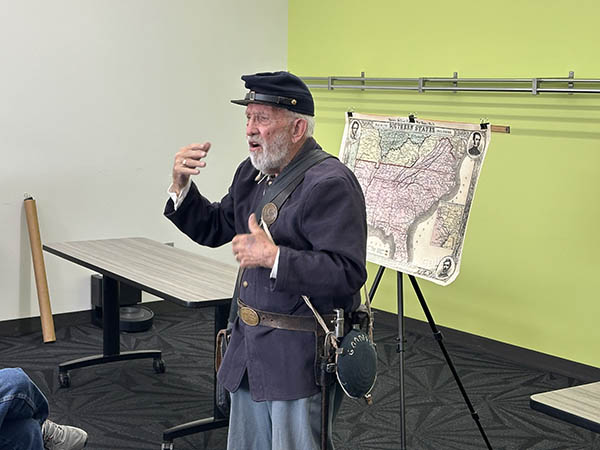
Civil War reenactor O.J. Fargo of Creston is shown in a Union uniform portraying soldier Thomas Longfellow of Afton in an event co-sponsored by Humanities Iowa and the Historical Society of Marshall County. It was held Tuesday evening at the Marshalltown Public Library.
T-R PHOTOS BY MIKE DONAHEY — Civil War reenactor O.J. Fargo of Creston displays a Civil War bayonet used by Union forces during his presentation at the Marshalltown Public Library Tuesday evening. It was co-sponsored by Humanities Iowa and the Historical Society of Marshall County.
From left, State Center Mayor Craig Pfantz himself a Civil War soldier reenactor - listens to Elaine Fargo of Creston explain Civil War memorabilia at a Humanities Iowa/Historical Society of Marshall County event Tuesday at the Marshalltown Public Library.
Civil War reenactor O.J. Fargo of Creston is shown in a Union uniform portraying soldier Thomas Longfellow of Afton in an event co-sponsored by Humanities Iowa and the Historical Society of Marshall County. It was held Tuesday evening at the Marshalltown Public Library.
Trending
For more than 90 minutes Tuesday evening at the Marshalltown Library, O.J. Fargo made the life of an Iowa Civil War soldier come alive.
Fargo, of Creston, portrayed Thomas Goodfellow of the Iowa 4th Iowa Infantry regiment in his compelling program "After the Battle Mother."
Fargo was dressed in a Union military uniform and had "Goodfellow" written on his canteen and spoke in the first person during the presentation and afterwards during a question-and-answer session.
"I was drawn to the name Goodfellow," Fargo said.
Goodfellow was born in Rock Island, Ill. and later moved to Afton, Iowa in search of making a living. It was in Afton Goodfellow enlisted after Confederate forces attacked the Union-held garrison at Fort Sumter, S.C.
"Actually, Goodfellow served as chaplain," Fargo said. "During the war, chaplains and officers could resign at any time. But I gave him the persona of a soldier in my presentations to make the audience understand what four years of service was like."
In detail, Fargo described a soldier's life from boot camp drills to food to military strategy to weapons. And indeed, he did.
The Iowa 4th Infantry -- 1861-1865 -- traveled through Missouri, Arkansas, Mississippi, Tennessee and Georgia during the war, Fargo said.
"We participated in significant battles such as Pea Ridge in Arkansas and the Battle of Lookout Mountain in Tennessee," said Fargo. "They marched with General Sherman through Georgia."
The regiment was initially organized by Grenville Dodge of Council Bluffs. Soldiers were paid $16 per month.
"We marched on foot extensively -- sometimes walking many miles in one day," he said. "The Army provided shoes -- but only one size and no left or right."
The shoes came equipped with heel plates to reduce wear on the heel and to prolong shoe life. Soldiers had to wear several pairs of socks to prevent blisters and other foot maladies.
They slept in tents and carried bedrolls and mess kits. Beans and "hardtack," a combination of water flour and salt, were staples.
Union and Confederate troops used Pattern 1853 Enfield rifle-muskets made in England. Later, Union troops used Springfield rifles made in Springfield, Mass., the re-enactor said.
Both were reliable weapons -- which in addition to artillery and disease -- caused an estimated 620,000 to more than 750,000 Union and Confederate casualties. Some historians believe the 750,000 figure is the most accurate.
Diseases such as diarrhea, dysentery and typhoid fever caused a significant number of deaths due to poor sanitation in camps. Deaths received from wounds in battle also dramatically increased the death toll.
Fargo does numerous presentations annually. A Marshalltown soldier played a major role in the war, according to numerous archives found at the Historical Society of Marshall County.
Nicholas Messenger of Marshalltown, serving in the 22nd Iowa Volunteer Infantry, distinguished himself at the Battle of Vicksburg -- a pivotal event because the Union victory there split the Confederacy in half.
Messenger was wounded in the battle and would suffer from the wounds the rest of his life. He would later become the Marshall County Recorder. Marshall County men were also well-represented.
Ingram, Jessup and Sanford avenues in rural Marshall County were named for men who had served in the war among other achievements. Jessup was killed in the war and Sanford was an officer.
The History of Marshall County 1878 has extensive listings of Marshall County servicemen by regiment. Iowa had the highest number of residents per capita join the Union Army and fight in the war per historical archives.
On display for the approximately 35 attendees to view were battle flags, belt buckles, cartridges, period publications and more which were organized by Fargo's wife Elaine. The re-enactor had numerous attendees hold a vintage Enfield rifle.
"I was pleased with Faro's detailed and first-person presentation as Goodfellow," said Michelle Roseburrough, Historical Society of Marshall County president. "His knowledge of the Civil War and Iowa's regiments are impressive."
The event was co-sponsored by Humanities Iowa and HSMC. Fargo is a member of the Army of the Southwest Reenactors. For more information, contact Fargo at 641-782-8625 or ojfargo@iowateecom.net or the HSMC -- 647-752-6664 or info@hsmcia.org.