
Trending
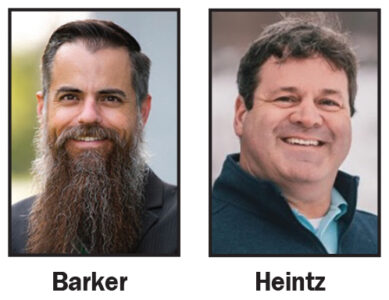
Two Republicans from Nevada will face off against each other in the June 2 primary election for the Iowa House of Representatives District 51 seat. The first is incumbent, former Nevada Mayor Brett Barker who is seeking a second term after being elected for the first time to a state seat in 2024. The other is political newcomer Shane Heintz, who announced his candidacy in March. He is a farmer and small business owner.
District 51 covers the northwest, southwest and northeast quadrants of Marshall County -- including communities like Green Mountain, Albion, Liscomb, St. Anthony, Clemons, Rhodes, Melbourne and State Center -- along with a large swath of Story County outside of Ames.
The winner of the primary will face Democrat candidate Teresa Perin of Rhodes in the November general election. The candidates' answers to the T-R's questionnaire are printed below.
What do you propose the legislature should do to provide further property tax relief for Iowans?
Barker: With the bill we passed this session, we introduced some much needed accountability into the system to reign in out of control government spending. I think this will be something we can continue to build on going forward. I believe all levels of government should be looking for ways to be more efficient in their delivery of services. For too long, the property tax system cared more about protecting government budgets than it did about protecting family budgets. We have to put the taxpayers first.
Heintz: The state needs to tighten their belt just like most Iowa families are doing right now. Start working on a budget the first day of session. Lower the budget across the board. Lower the levies, lower the rates. Whatever it takes. It needs to be a comprehensive approach, not just settling on property taxes alone.
Eminent domain reform failed to get to the governor's desk. Are you in support of getting rid of the eminent domain option for the construction of carbon pipelines? Should the state go further with eminent domain bans?
Barker: Iowa's eminent domain process is broken. We have had issues with oil pipelines, carbon pipelines and will soon see it with hydrogen pipelines. Our process is set up to breed conflict and not cooperation. While we must protect landowners, prohibitions must be paired with common sense reform in order to protect the future of Iowa's economy and provide new markets for our farmers. A reformed system will provide for a fully voluntary process that fuels our economy, raises commodity prices for our farmers and promotes demand at our factories.
Heintz: Eminent domain should only be used as a last resort for government use and NOT for private business at all. I feel the carbon pipeline is being proposed for tax credit purposes only and at this point has no significant benefit to Iowans.
State funding for schools is consistently an issue, especially with the price of everything rising. Is there a way for the legislature to give the districts what they need and keep the taxpayers happy? If so, what is it? If not, why not?
Barker: Iowa's K-12 public schools receive funding from three levels of government. Local, state and federal governments all provide various amounts of tax dollars for K-12 school districts. Across all three levels of funding plus various other financing sources, the total amount of taxpayer funding in the 2023-2024 school year for public schools was about $11.6 billion. That is a significant investment from the taxpayers into public schools. It's worth noting that right now, public schools spend almost $24,000 per K-12 student. We should always look for ways that we can improve our public schools, but that doesn't mean throwing money at the problem without oversight. We need to make sure those dollars are being used on things that actually benefit students and teachers.
Heintz: When I was in school in the 80s and 90s, we were among the best schools in the nation. Every year since then we have poured more money into education and the results haven't gotten better. More money isn't the only answer. Schools need to look inward for that answer, and it's going to be some tough reflection and work to get us back to the top. Our schools are very top heavy with too few people actually involved with educating our kids.
Rising cancer rates are a concern for Iowans, especially as they watch many of their friends and neighbors get new diagnoses. If elected, what will you do to address the increasing rate?
Barker: I am proud to have supported our state's historic investment in cancer research so we can ensure policy is evidence based to address the root of Iowa's cancer problem. We have received the first report from the University of Iowa researchers. The major outlier in Iowa is lung cancer, which is why I have supported policies to address tobacco and radon, which are the top two causes of lung cancer in Iowa. I have also supported cancer screening for first responders. I am a champion for a specific appropriation for pediatric cancer research, and hope that my colleagues will support this funding.
Heintz: There needs to be research on what is causing the different types of cancers. Is it from chemicals applied to the ground, chemicals in food, genetics, age, etc? Once factors are identified we need to move forward with policy to correct and protect Iowans where we can. I do not believe that it is one factor alone causing this problem.
Data centers are becoming a big topic in the area. Should the legislature pass any bans or requirements on incoming or proposed centers ? If so, what?
Barker: We need to ensure that any tax benefits being used for data centers are actually resulting in positive results for the taxpayer. If they aren't, we must make changes. We should not have open-ended incentives but should move toward a model that requires transparency in utility use and ensures that the heavy infrastructure costs of these facilities are borne by the companies themselves, not added to the monthly bills of Iowa families.
Heintz: There definitely should be some real scrutiny on any data centers. They are extraordinarily large users of water and electricity and some long term environmental impacts. From what I have seen elsewhere, the utility upgrade costs tend to get dumped on the locals while the data center takes the tax incentives and allows the tax burden to fall on the local citizens. I would like to see local governments establish rules and requirements that work for them while working with the state to protect and prevent environmental issues.
If elected, what will you do to encourage economic development in Marshall County?
Barker: One of the biggest things we can do is make sure we are effectively investing in the growth of our workforce. In a manufacturing hub like Marshall County, that means we move away from pouring money into higher education degrees that don't result in a job and put more money into apprenticeships and similar programs that train Iowans who want to work their hands to provide a real, immediate need for Iowans. This session we passed the Skilled Workforce Act to provide additional funding to apprenticeships and create the Career Training Physical Expansion Program to provide the financial backing to build new, state-of-the-art facilities at community colleges and within both union and non-union private sector programs. It also removed unnecessary red tape and gave these programs additional flexibility to scale up their efforts.
Heintz: My wife and I are small business owners and know how hard it can be to get started and stay going. It can be very difficult. I would like to stay out of the way of the local people and government and let them do what they think is best for their community, Marshall County knows better what they need than anyone else. I would help only if asked. I would be happy to participate in any economic development discussions posed to me.
Should the legislature restrict libraries on what reading materials children can obtain from them?
Barker: I believe in common-sense safeguards to keep inappropriate content in a separate section from where children can access them. I also think certain books with mature content should require parental permission for a minor to check out and that parents should have visibility into the content their children are accessing.
Heintz: Just like movies, tv and music, there should be age restrictions on books as well. There are some historically significant books that do come into the classroom in middle school or junior high but as I recall there were notes to the parents before we started into the Holocaust and WWII information. Those are things people need to know about. Books that are essentially porn have no place in school libraries especially in elementary school. The parents can do as they like at home.
Vaccines remain a volatile topic, particularly amongst parents who choose not to get their children vaccinated. Do you support the removal of vaccine requirements from schools?
Barker: I did not support this bill this session. We currently have processes in place for reasonable exemptions. I want to see additional transparency in the system so that every parent can have access to accurate information and be confident in their decisions regarding vaccination of their children.
Heintz: I don't have a good answer here. Doctors and medical professionals really shot themselves in the foot with how COVID was handled. They have created a lot of doubt (and rightfully so) in the minds of numerous parents. I think people deserve informed consent. There are some good vaccines that have been around for decades that have been endlessly researched and have been successful. On the other hand, the schedule of vaccines has gotten far too long and some are being pushed without ample research to support them.
Why should Marshall County voters cast ballots for you in the June 2 primary?
Barker: I pledged two years ago that I would not be outworked. I have proven to be dedicated, persistent, and laser focused on advocating effectively for Marshall County. I have delivered results by getting 24 of my bills passed by the House with 12 of those reaching the Governor's desk. I have worked closely with Marshall County constituents including Marshall County Rescue League and the Green Mountain and Albion Fire Departments to draft legislation addressing specific local needs. A vote for me is a vote for proven conservative leadership delivering results at the state house.
Heintz: I am not a politician. I am a regular guy that couldn't sit back and watch what was happening at our statehouse any longer. I am not looking for a political career. I want a reset on our local politics to put citizen voices back in charge. I am not for sale and am willing to have open and honest conversations with all parties.
Final comments
Heintz: Can I be loud? Sometimes. Can I be brash? If need be. I am a fighter and won't back down from what is right. The middle class has had all it can take and I'm here to represent them. I have reached out numerous times to Brett Barker for a townhall or just a meet and greet for the people to meet us and ask questions in an informal setting. I saw him this weekend and tried again to set something up and he dismissed me. These are not the actions of a leader, but a coward. He will not serve you, only his special interests and donors (one of which is Bruce Rastetter of Summit Ag and the carbon pipeline). Nevada's financial woes lay largely at his feet from his time as mayor. Our $30 million waste water plant has crested to $70 million, is two years behind schedule and is still not functioning properly. Water bills have almost doubled in the last 12-18 months because of this project. I also can't forget to mention the $22.2 million mess with Nucara and Brett's "no idea" approach. That doesn't sit well with me or many others. Where's the money and the accountability?
Contact Lana Bradstream at 641-753-6611 ext. 210 or lbradstream@timesrepublican.com.