
Rural road names pt. 4: Three farmers and ‘Temperance Reformer’ named
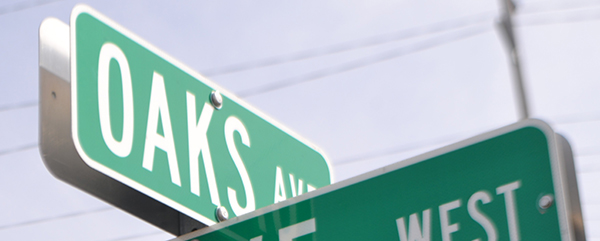
T-R PHOTOS BY MIKE DONAHEY — Oaks Avenue in Marshall County is a north-south roadway and intersects with Iowa Avenue West.
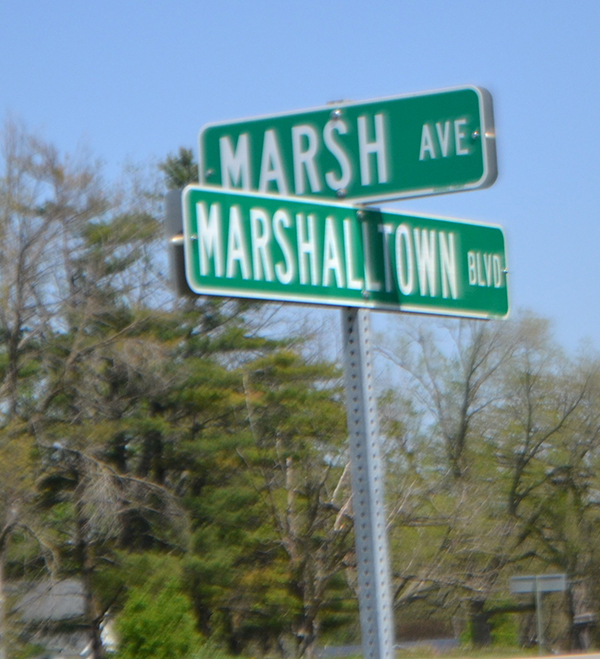
Marsh Avenue in Marshall County is a north-south roadway and intersects with Marshalltown Boulevard.
T-R PHOTOS BY MIKE DONAHEY — Oaks Avenue in Marshall County is a north-south roadway and intersects with Iowa Avenue West.
Marsh Avenue in Marshall County is a north-south roadway and intersects with Marshalltown Boulevard.
Trending
Editor's Note: This is the fourth in a series of several articles reporting on Marshall County residents of the mid to late 1800s whose names are posted on rural avenue road signs.
Last names -- and other names -- were mandated by the E-911 county system. They were approved unanimously by the Marshall County Board of Supervisors in a resolution effective June 16, 1986.
Joseph Armbrecht -- chairman of the board --signed the resolution and it was attested to by Sherrill Snider, county auditor, according to county documents.
County officials used the year 1847 as a benchmark for avenue names, since the first claim for land in Marshall County was made in that year according to county archives.
"The (avenue) names were taken from the "History of Marshall County 1878," sponsored by the Central Iowa Genealogical Society in Albion," according to county documents. Names used are no reflection on present county residents."
A further review of county records showed an attempt was made to use names of attorneys, businessmen, farmers, female and male settlers, and those who made an impact on Marshalltown and Marshall County's initial development.
Lafayette Avenue was named for the former town which was renamed Albion.
Resources used for this series available from the Historical Society of Marshall County (HSMC) have been the "History of Marshall County, Iowa, 1867," "History of Marshall County, 1887," "History of Marshall County 1955 by Gerard Schultz," "The Continuing History of Marshall County 1997," and "Marshalltown Illustrated." The latter is not dated and was published as a supplement to the Times-Republican under the supervision of the Marshalltown Retail Merchants Association. Also used were other HSMC archives and social media references.
Some biographical information available in the aforementioned resources has been limited.
Part three of the series was published in the T-R May 2-3 -- and reported on the biographies of county residents/towns Hart, Hopkins, Ingram, Jessup, Knapp and Lafayette. Series one and two reported on Arney Avenue through Glick.
Marshall County's economy was agriculture and ag-related businesses in the 1840s and remains so. Consequently, three residents with signs named in their honor were listed as farmers and one of the three was also listed as "Temperance Reformer." One resident was listed as a druggist and also a physician.
Marsh: Druggist
"Based on historical records, a physician named Marsh opened a drug store in the county circa 1850s, as noted in the Continuing History of Marshall County, Iowa (1884) by L.E.B. Holt, according to social media sources. This aligns with the early development of Marshalltown and surrounding areas during that decade."
Meyer: Horticulturist/farmer
Three farmers named Meyer were listed. An Aggee Meyer, of State Center was born in Hanover, Germany in 1844. He owned 160 acres valued at $25 per acre. He was a member of the German Reformed Church. Secondly, Reinhard Meyer, also of State Center. He too was born in Germany in 1857. He also owned 160-acres but valued at $30 per acre. W. Meyer, farmer of Laurel, was also listed with no other information.
Newby: Farmer
Two farmers named Newby were listed and both resided in the same section 15 in Lamoille. They were Axum Newby and Samuel Newby. Samuel was born Dec. 9, 1844, in Grant Co. Ind. He arrived in Marshall County in 1865; owned 90-acres, valued at $40 per acre. He was a member of the Society of Friends and a Republican in politics. His wife, Martha C. Pemberton, was born in Miami Co., Ohio, May 31 1845. The couple was married April 21, 1864. To this union five children were born : Rosella, Jesse, Sarah, Ruthana and Clara.
Nichols: Farmer and temperance reformer
Nichols was a common name in Marshall County in the "History of Marshall County, 1878" with 33 references. Found were B.K. Nichols - a farmer in Sec. 33 - Green Mountain. Additionally, F. Nichols - farmer, Sec. 28, and J. Nichols - farmer, Sec. 20 of Marshalltown. Also listed were J.H. Nichols and S.J. Nichols identified as "grain." Both resided in State Center.
County temperance reformers throughout the years were extremely active, driven by Methodist influence and local chapters of national organizations like the Women's Christian Temperance Union (WCTU), founded in 1873. These reformers, often termed "drys," worked to combat alcohol consumption in small towns.
Key aspects of the temperance movement in the area included:
Active Organizations: The WCTU and local Methodist churches were pivotal in promoting abstinence, supporting both the moral case against alcohol and promoting legislative prohibition.
Influential Figures: Archives report that the WCTU enlisted prominent church and local elected officials to promote and implement legislative temperance.
Social and Religious Ties: The movement was intricately linked with evangelical Protestantism, particularly Methodist churches in the region.
Oaks: Butcher
First name John. Only information listed. The roadway runs north-south like other rural avenues in the county.