
Council passes first reading of new chicken keeping ordinance
One rooster per breed will now be allowed on lots five acres or larger
Trending
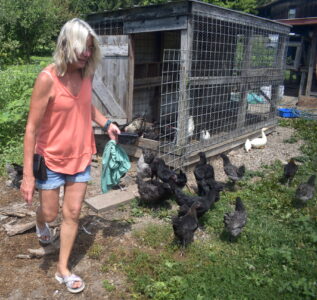
After a lengthy discussion on the matter and a groundswell of support for the Appleberry Farm during the previous meeting on June 22, the Marshalltown City Council passed the first reading of an ordinance to allow the keeping of poultry and domestic fowl during Monday night's meeting.
Once a motion and second had been made, Assistant Housing and Community Development Director Clayton Ender came forward to define terms and provide a summary of the policy changes, which would only allow domestic poultry such as chickens on lots five acres or larger -- for reference, the Appleberry Farm is approximately 20 acres. It also raises the lot minimum for both livestock and domestic poultry/fowl (previously, it was just two acres for livestock) with the opportunity to grandfather in properties that already have livestock on 2-5 acre properties.
The previous motion still banned roosters outright, a provision that would ultimately be revisited later in the conversation.
As he opened the floor up for council questions, Councilor Mark Mitchell asked about setback requirements before Mayor Mike Ladehoff opened up the floor for public comments. Dennis Mowery recommended restricting chicken keeping to agricultural, low density residential and rural residential land, which he felt would make a two-acre limit feasible, and worried about the rooster ban for how it might affect Appleberry Farm.
Doris Kinnick argued that roosters should be allowed, especially at a place like Appleberry, but Ladehoff stressed the importance of getting into a spot zoning situation. David Arnold felt the restrictions on keeping and raising animals for food contradicted the nation's founding principles of life, liberty and property.
"I think I just fundamentally disagree with that," he said. "You know, earlier, this council passed a resolution to grant licenses for alcohol, tobacco, all of which have known harms to the public, and yet here you are trying to restrict our right to grow food, to fertilize our lawn without buying processed products, and I just don't like that. I don't think it fits with the character of the country."
Annie Grieshop of rural Melbourne noted the tiny number of residential properties that would qualify for chicken keeping under the proposed ordinance and said it constituted a lack of equality and opportunity. Linda Clark told the council she no longer owns chickens but didn't feel they should be restricted based on lot size and said she was upset by recent code changes.
Nicki Ahrens asked if the council has sought public input on the topic, citing a previous T-R story posted on Facebook as evidence that a vast majority supported a less restrictive policy toward allowing chickens within city limits.
"Why are we still resisting this? Is there something about letting homeowners have the freedom to choose how to steward their property that is problematic? Is there something about chickens that endangers our city and its prosperity? I would ask that this ordinance be loosened rather than tightened," she said.
Joe Darter, the business partner of Appleberry Farms owner Kelly Mason, felt the rooster ban would be harmful to the business, noting its importance in the breeding process. Lea Husak also called for a less restrictive policy.
Councilor Gary Thompson then joked that he'd learned more about chickens in the last three weeks than he ever thought he would, and he agreed with Darter's opinion on roosters before proposing an amendment to allow one rooster per breed onto the new ordinance.
"I don't think the rooster's the issue we thought it was to begin with because of what I learned about the chickens," he said.
The amendment passed by a 4-3 tally with Thompson, Sue Cahill, Marco Yepez-Gomez and Greg Nichols in favor and Mitchell, Melisa Fonseca and Jeff Schneider opposed. From there, Thompson asked Ender about "visiting animals," which he replied was currently undefined and would need to be revisited later.
The motion to pass the first reading of the amended ordinance then passed 5-2 with Mitchell and Schneider opposed. Two more readings are still required before it can officially take effect.
Contact Robert Maharry at (641) 753-6611 ext. 255 or rmaharry@timesrepublican.com.