
Firefighters, EMS professionals receive pre-RAGBRAI simulation training
Trending
Accidents tend to happen during RAGBRAI, and Marshalltown EMS and hospital personnel are getting prepared for thousands of bicycle riders to visit on July 22.
The University of Iowa Simulation in Motion – Iowa (SIM-IA) has provided pre-RAGBRAI training along the route during the last five years. On Thursday, the trailer, decked out in Hawkeye colors, pulled into the back parking lot of the Marshalltown Fire Department (MFD) building to provide special training, and trainees were impressed with the state-of-the-art technology.
Inside the trailer, two simulation labs had high-fidelity human patient mannequins with pulses, breathing movements, blinking eyes, body sounds and vocals. In the middle section of the trailer, a trainer in a control area spoke into a microphone to supply the mannequin with real-life responses to trainees' questions.
MFD Firefighter JJ Simms is taking first-responder classes and was one of the trainees.
"The lung sounds, the eye flutter, the pulses -- insane," he said. "It's so cool."
SIM-IA Instruction Services Coordinator Dave Lyons said they provide as realistic training as possible and reached out to Marshalltown to offer the service.
"Since the inception of SIM-IA, we've worked with the RAGBRAI organization and brought training to the overnight towns during the second or first week before," he said. "We simulate training similar to what they may encounter with such a large group of riders, and it gives [responders] a chance to practice, go back into their skill base and warm them up."
While he has not responded to any RAGBRAI accidents, Lyons said they occur each day because of the mass grouping of bikers traveling over uneven terrain.
"It's not uncommon," he said. "The riders of RAGBRAI are very good and will shame others into wearing helmets. If they don't wear one, they probably put one on because they are tired of everyone yelling at them. Many times the helmets we wear while riding bikes will reduce the injury, but not necessarily eliminate it. They are still getting head injuries. Plus, they are on a moving vehicle, falling to the ground which is a hard surface, so trauma is going to play a role."
Lyons said the first of the two created scenarios was a rider who was in a multiple-bike crash and had a fractured collarbone. The second is a rider who sustained a significant head injury in a bicycle crash.
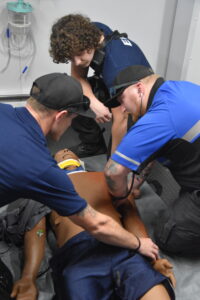
Trainees were able to tend to the mannequins in small groups of three or four to allow for movement.
The mannequin with the broken collarbone was a 25-year-old male named Chris and treated by UnityPoint EMS personnel Hunter Block and Ryan Wanat, along with Simms. As Simms and Wanat checked vitals and prepared the mannequin for intravenous pain medication, Block asked Chris questions about what happened during the accident and what symptoms or pain he was experiencing. As part of the training, the patient had a history of anxiety, and Chris got agitated as the EMTs secured his arm and prepared to move him.
The only thing the trio did not do for Chris was ask for his medical history, but the trainer told them that is why the simulations are held. According to Lyons, assigning a history of anxiety to the mannequin means the trainees have to help manage the anxiety and stabilize him.
"They need to do a careful assessment," he said.
Contact Lana Bradstream at 641-753-6611 ext. 210 or lbradstream@timesrepublican.com.