
New Petersen sculpture installed in Morrill Hall
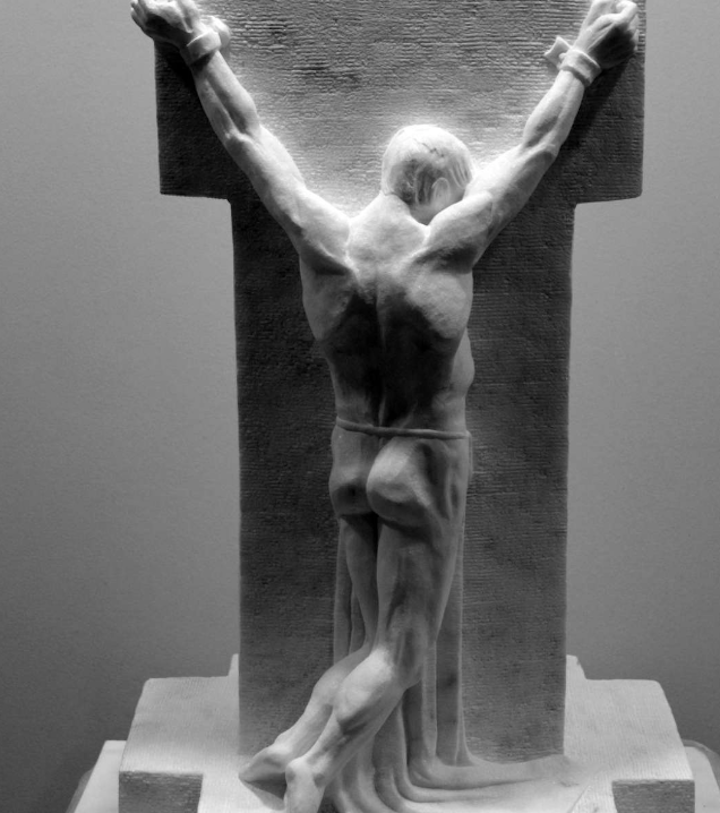
CONTRIBUTED PHOTO
Christian Petersen (Danish-American, 1885-1961) made his plaster maquette for Monument to the Unknown Political Prisoner in the early 1950s, during the period he was employed by Iowa State University (1934 to 1955). It is believed he intended it to be life-size and placed in an open landscape as a permanent monument. It depicts a male figure who hangs face-forward, arms extended and restrained, with the identity obscured. The shape suggests crucifixion but resists it: no nails, no wounds, no audience.
The art had been submitted to the 1952 international competition organized by the Institute of Contemporary Arts in London – a Cold War-era effort to assert the values of Western democratic societies. The jury, administered in the United States by the Museum of Modern Art, preferred abstraction. Petersen’s realism was out of step, and his entry did not advance. He kept the maquette on a shelf in his studio, in full view. For decades, University Museums didn’t have the correct title or date.
Art historian Dr. Lea Rosson DeLong, whose years of research on this sculpture shaped what ISU now knows about it, has lectured about the story behind this work of art and what this moment, today, represents for Petersen’s legacy. The lecture is available to read at: museums.iastate.edu/news/torture-and-transcendence.
Regarding the recently installed sculpture, Rosson DeLong explained:
“Because the University Museums believes that this sculpture – and others by Petersen – deserve to be better known, we have made some decisions. During his lifetime, Petersen was very poor, and he did not have the money to carry out many of his sculptures on the scale and in the material that he would have preferred. He might have preferred to carry out a sculpture in bronze rather than plaster or to make it larger or even life-size rather than in the small scale of a maquette. The Museums wishes to grant to Petersen and his legacy opportunities that he did not have in life. Therefore, we have cast in bronze several of his sculptures that were left to us in perishable materials. Now they are more secure and more permanent.
“In the case of his Monument to the Unknown Political Prisoner, we are enlarging the scale of his maquette and rendering it in marble rather than plaster. We feel confident that we are doing what Petersen would have wanted, and that our enhancements are respectful and appropriate.”
On June 9, a 1,600-pound marble version of that sculpture was installed on the ground floor of Morrill Hall, near the elevator. Longtime art conservator for University Museums, Francis Miller of Conserve Art, LLC, led the installation with help from Iowa State University Facilities Planning and Management staff members Gary Puls, Brandon Bartleson, Cory Ritland and Dustin Lynch.
The marble was carved by Nicholas Fairplay, a master stone carver trained at Chichester Cathedral and Westminster Abbey, and whose work appears at Windsor Castle, St. Paul’s Cathedral, the Houses of Parliament and St. John the Divine in New York City. Fairplay worked from Petersen’s original plaster maquette. The result is roughly one-third the scale Petersen may have envisioned for his monument, but it is the first time this sculpture has existed in permanent material.
The installation in Morrill Hall places the sculpture in the building that houses the Christian Petersen Art Museum, steps from the gallery where the original plaster maquette and Petersen’s preparatory drawings are on display.
The exhibition Forms of Remembrance: The Unknown Political Prisoner is on view in the Roy and Bobbi Reiman Public Art Studio Gallery through July 24 and brings together Petersen’s plaster maquette, related drawings and sculptures that trace his thinking in his later years, alongside editorial cartoonist Frank Miller’s I Said — We Sure Settled That Dispute, Didn’t We? and two World War II propaganda posters issued by the U.S. Office of War Information in 1943. Miller won the 1963 Pulitzer Prize for Editorial Cartooning for the drawing on view.
The exhibition and the new sculpture are on the ground floor of Morrill Hall (603 Morrill Road Ames, Iowa), open from 10 a.m. to 4 p.m., Monday through Friday. It is open to the public, and there is no admission fee.