
Where’s the beef?
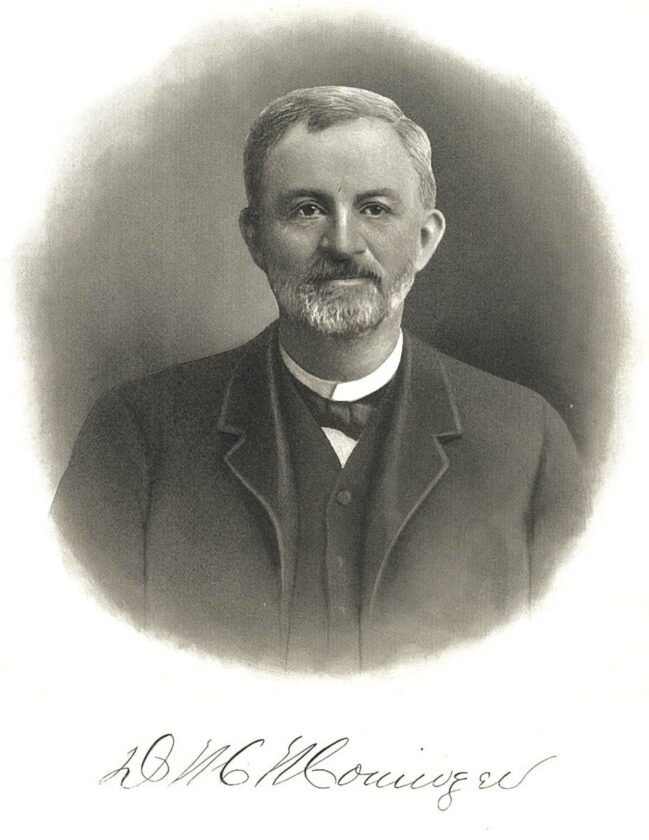
Demas McFarland Moninger
Anyone doing normal shopping for groceries these days may have noticed the increasing high price of all beef products, from burgers to steaks to prime rib. They seem to have reached record highs and no sign of falling soon. Without delving into the realm of political controversy, most people might wonder why the cost of this normal staple of the American diet has lately risen so far and so fast.
The quickest answer to this “sticker shock” is a severe supply shortage. Overall, the American national beef herd has dropped to its lowest point since the 1950s. This downturn has been caused by increased demand by consumers, years of significant drought, higher costs of feed, loss of grazing land, and a slowdown of imports, among other factors, like tariffs, or insect borne diseases.
The shrinking numbers of beef livestock brings to mind, at least to members of older generations, the famous tag line of a 1980s Wendy’s Hamburgers TV ad, “Where’s the Beef?” featuring a tiny patty on a huge bun. (Unfortunately, we lost our own local Wendy’s only a few months ago).
This apparent beef shortage encouraged Past Times to take a closer, and timely, look into Marshall County’s early role in beef production, which in some cases had led Iowa, and the nation, and possibly the world in the high quality cattle industry, only a few decades after Iowa had achieved statehood in 1846.
A favorite go-to source, found at both the city public library and our county historical society on West Main Street is a 34-page publication put out by the Statesman newspaper in 1888, called “Marshalltown, Iowa, Queen City of the West.” It is a useful, concise summary of information about our early manufacturing and business interests, and our local agricultural resources. At the time of publishing, Marshalltown had a population of around 10,000.
Here is what it says about our beef supply: “Marshall County is second to none in the quality of her cattle. There are few districts in the country where the cattle are so uniformly highly graded. This is well evidenced by the fact that cattle fed by the following parties have invariably topped the Chicago market…”
This is followed by a list of 20 names of cattlemen throughout Marshall County who had raised, and proven, the “superiority” of their livestock numerous times at the Iowa State Fair, and at the American Fat Stock Show in Chicago.
Some of the names on this list of “excellence” of beef breeders were from towns still familiar to all of us in Marshall County, but some were men listed as hailing from places no longer in existence, like Galvin, and Capron. Galvin was WSW of Albion, Capron was close to today’s Van Cleve.
Phineas Stevens, an early Marshalltown banker, appraised the agricultural lands surrounding Marshalltown to be “unqualifiedly” the finest in the world. He himself purchased nearly 2,000 acres of local farmland when he resettled here.
Two men, however, were singled out by “Queen City of the West” for special praise as the best cattle breeders in our area: Demas M Moninger, from near Galvin, who raised Short-horns; and Stephen B Packard, who focused his efforts with breeding Herefords on his property just west of Marshalltown.
Moninger doesn’t get much mention in early Marshall County history books, but he gets plenty of attention in Improved Stockbreeders Association publications and elsewhere. The frequent boasts of this association that Iowa beef was top in contention for best in the world is not unreasonable. Moninger was often at the top of any listings of the very finest beef producers in Iowa.
Texas may have had plenty of range beef, left to graze on scrubby, wild, uncultivated lands. They were rounded up in great numbers, driven long distances by cowboys, and loaded into cars for shipping by rail eastward to large stockyards, commonly Chicago. It has made for many a good tale in books and cinema.
But Moninger raised his carefully bred cattle to grow fat comfortably here at home, just north of Marshalltown, in lush pastures of green grass. That made all the difference in the quality of their meat.
Moninger’s cows won award after award in Chicago livestock shows, sometimes singly, and other times as a “herd” award (sort of like Olympic gymnasts get individual medals for their personal performances, and additional medals for top team as a whole).
Demas McFarland Moninger was born March 1833, in Washington County, Penn. In the 1850s he came to Marshall County, first to the Bangor area, then later to Galvin in the vicinity of Marietta. He was soon afterwards appointed postmaster of Galvin, which he operated from a room located in his house. He maintained that postal position the rest of his life.
He married Mary Ringland in 1859 and they raised several children together, but sadly a daughter died as an infant and two sons drowned while swimming in the Iowa river near their home. Other children grew to adulthood and made their own marks of success in their separate callings.
He won a seat in the state legislature, serving from 1874 to 1876. His official state biography says the Hon. Moninger had a “massive” role in revolutionizing the entire American beef industry.
He won glowing accolades for his breeding and feeding ideas, achieving “national renown” for his championship livestock. The meat they provided was said to set the “gold standard” for tenderness and marbling. As a producer, and judge, of fine meats, he was truly considered top tier in the state, the nation and the world.
Demas died on Feb. 5, 1899, from a stroke (apoplexy) and was interred in Riverside Cemetery after a massive funeral at his home. Reverend McMillian, pastor of the Albion Presbyterian church, conducted the services. (By sheer coincidence the Albion church closed this past week after 170 years of service to the local community). His wife and other family members are buried there with him.
The other man singled out for fame as a top beef producer from Marshall County’s early days, was Stephen Packard. A detailed Past Times article of March 2020 (written by Dorie Tamman) gives an excellent short biography of this accomplished local leader. One early history of our county calls him a strong, virile leader, “a commanding presence” and “strong personality”. The same article modifies that image by recalling him as an “independent thinker” and a “wide reader.”
Those two sides of Packard are quite reflective of his entire life at home, and in public. He had wonderful public achievements, and some significant defeats. He was married to a beautiful and loving wife, but their lives as parents were stricken with tragedy after tragedy dealing with mental instability in some of their children.
He was extremely successful here as a breeder of cattle.
Born in Maine in late April, 1839, he was devoted to obtaining a good education. He went on to study law but the Civil War intervened. He enlisted into the 12th Maine Infantry as a First Lieutenant. His regiment was sent to participate in campaigns in Louisiana and New Orleans.
He was promoted to Captain of his regiment, which then went on to serve in several key actions, like at Cedar Creek and Winchester in the Shenandoah Valley, to close out the War.
After the War he returned south to help restore Louisiana’s state Constitution and with the administration of their state government. He served on a board to administer oaths to register ex-rebels back into the Union, among other responsibilities. President Grant made him a U.S. Marshall for Louisiana. Packard settled down to make the New Orleans area his permanent home.
He married the cultured, talented and beautiful southern “belle,” Emma Steele of New Orleans, in 1863. They soon had several children. Unfortunately, some of these children died at very young ages and they are buried in Louisiana. (Other children, suffering severely as young adults, are buried in state mental institutions).
He was then elected governor of Louisiana but, ironically, the former confederates he had helped to restore their citizenship rights voted for a rival governor more to their liking. When both men claimed to be the rightful head of state, Washington D.C. supported Packard’s opposition in order to secure Rutherford B. Hayes’s controversial election to the White House.
Hayes, in turn, then appointed Packard to be a consul to Great Britain.
A consul is a step below ambassador. An ambassador deals with matters of state between 2 governments. A consul handles matters of private citizens living in a foreign county. Packard served in that office from 1878 to 1885.
Leaving England behind, Packard moved to Iowa, to Marshalltown specifically, where he purchased a large tract of farm land a couple miles west of the “new” Iowa Soldiers Home where Summit Street Road ends. He named his Iowa estate of over 1000 acres, “Strathmore.”
It was at Strathmore that he made his reputation as a skilled breeder of prime beef on an “extensive scale.” He served on the State Board of Agriculture, and many other agricultural positions, including the commission to plan the Iowa exhibit at the Chicago World’s Fair.
Packard’s quiet, happy and fulfilling life in Iowa came to an abrupt end when his beloved Emma suddenly died in 1907 of “apoplexy” while preparing family dinner in their “commodious and substantial” farm house, one of the largest this area had ever seen. She died within an hour. Emma and at least one son are buried at Riverside.
Packard moved to the Seattle area to join his daughter Ada Abbott and her husband, Edson Gilmore Abbott. (Look for more about these Abbotts in a future issue of Past Times.)
At the end of January, 1922, Gov. Packard passed on to his next assignment, to be reunited with Emma in a better world. His remains are entombed in a Seattle niche with some of his adult children including Stephen B. Jr. who served during the Spanish American War in Company H from Marshalltown.
Moninger and Packard were among the most noted citizens of Iowa just over a century ago, but sadly, like most of us will be, memory of them has largely been lost to time. The kind of beef they bred and perfected, however, is still savored by diners all over this country and the globe. The next time you grill out, or enjoy BBQ, drink a toast to these industrious and imaginative men of Marshall County.