
Deer seeking food where they find it
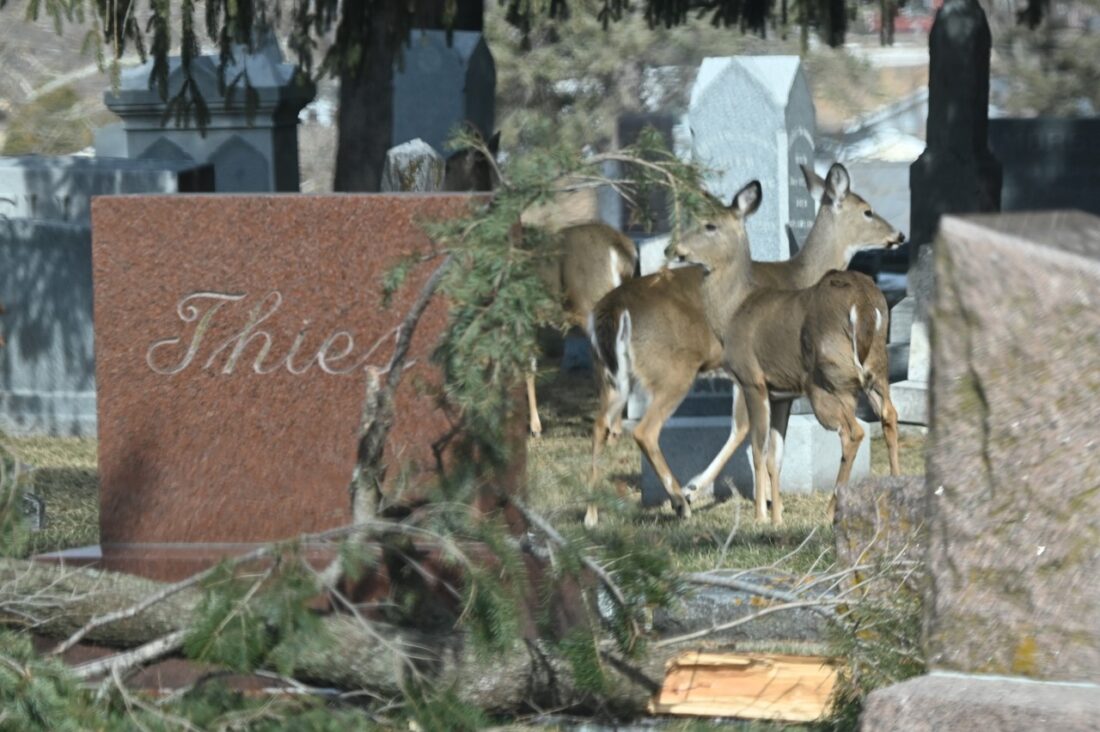
PHOTOS BY GARRY BRANDENBURG — White-tailed deer are adaptable, and when really hungry, as is typical at this time of the year, they will adapt and improvise to find something to nibble upon. Such was the case recently inside the Harlington Cemetery in Waverly last weekend. A drive through the older portion of the cemetery found a group of about eight deer mulling around a broken tree branch lying on the ground. The large tree limb with its green needles and buds was being worked over by the deer. The tree’s buds and small branches may not be the best nourishment available. However, for the deer, it was perhaps just enough to help them get through this winter season.
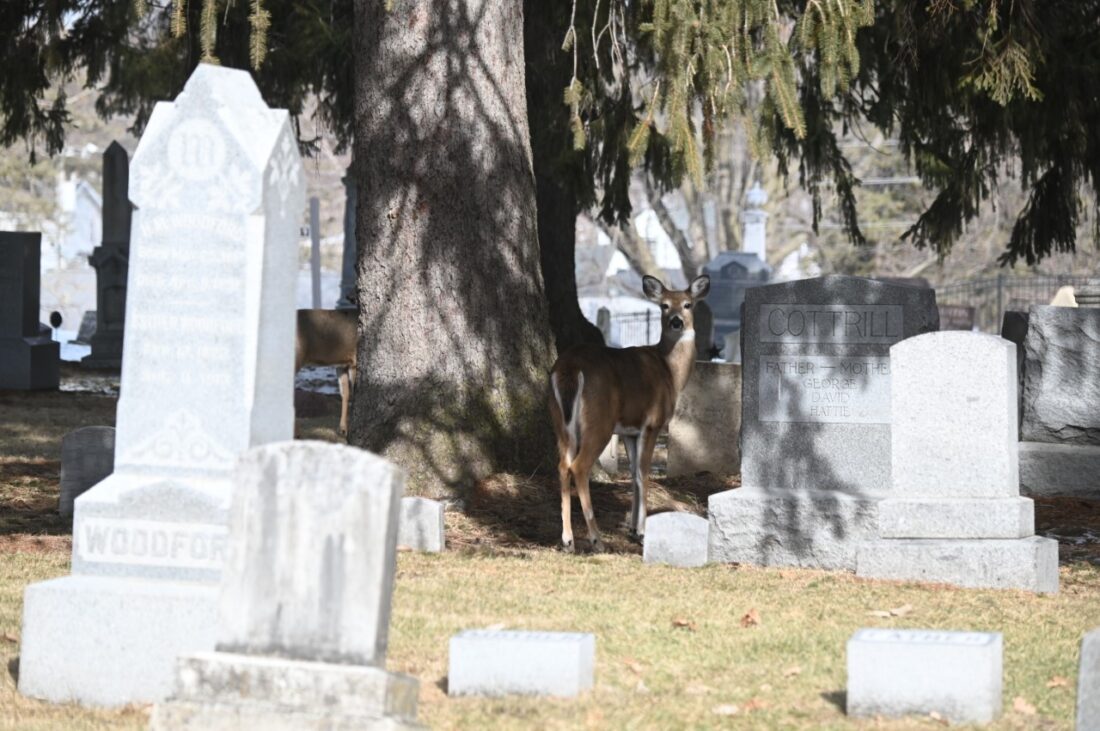
PHOTOS BY GARRY BRANDENBURG — White-tailed deer are adaptable, and when really hungry, as is typical at this time of the year, they will adapt and improvise to find something to nibble upon. Such was the case recently inside the Harlington Cemetery in Waverly last weekend. A drive through the older portion of the cemetery found a group of about eight deer mulling around a broken tree branch lying on the ground. The large tree limb with its green needles and buds was being worked over by the deer. The tree’s buds and small branches may not be the best nourishment available. However, for the deer, it was perhaps just enough to help them get through this winter season.
Trending
Hungry deer at this time of year are yearning for any foods just to get by until Spring's new growth can begin again in another month to six weeks' time. The body fat layers deer were able to acquire last summer and fall is normally adequate to get them through the toughness of low food supplies of an Iowa winter.
This week, I was able to observe large groups of deer near Marshalltown's West Summit Street road during the dwindling evening light after sunset. The deer were fanning across old corn fields looking for any waste grain that may still be on the ground, and those deer were in large numbers -- easily more than 30 animals in one group. At another close-by location, a group of 10 to 12 were face down in the corn stalks of last year's harvest.
Large concentrations of deer at this time of year is a safety thing for these large wild ungulates. All the eyes and ears and noses of multiple deer make it very unlikely that a predator, coyotes primarily, will have any success approaching a vulnerable animal.
A term commonly applied to large numbers of deer together is "yarding up," a term framed from decades worth of observation in northern Michigan, Wisconsin and Minnesota, where deer in deep snow fields huddled together for safety.
Come spring, they would disperse far and wide. But for now, winter is survival time, and doing what it takes to endure winter snows and cold weather.
What people should not do is feed deer. It is better for deer to live off their fat and whatever few morsels of browse they can obtain from the forests, field edge vegetation, and waste grain from farm fields.
It is highly dangerous to the deer's digestive system to have off season high quality alfalfa hay as an example, provided to deer by humans. People may think they are helping, but such is not the case.
Instances of deer dying with a belly full of the wrong foods have been documented. Biologists call it killing the deer with kindness.
It was a misdirected empathy on the part of people who thought they were doing good, but in reality were not. The mix of internal deer gut bacteria during winter is way different than what they will develop next spring and summer. The wrong foods at the wrong time can adversely affect that balance.
Are the deer going to starve? No! Deer live in all the states of the USA and southern Canada and portions of southeast Alaska. Much colder temperatures exist in some of these locations and the winter season is longer, more snow and air temperatures way colder than an Iowa winter.
In spite of all these adversities, white-tail deer survive wherever they call home. Many landowners with the time, land space, and resources create wildlife food plots each summer.
The crop in these cases may get partially harvested for its grain, but the idea is to leave a sizable portion of the crop standing in the field all winter long.
Specialty grains, turnips and special grass mixes can be planted with the entire premise being to have winter food for wildlife, not just deer. These food plots are helpful as supplemental protein sources above and beyond the normal browsing on woody plants they utilized all last spring, summer and fall.
-------
I attended the informational meeting last Tuesday evening at Otter Creek Lake Park. This was a time to listen to overviews from Iowa wildlife from biologists on everything from waterfowl, upland game birds, deer, small critters common and not so common, and other aspect if wildlife
diversity in the Hawkeye State.
There were some proposals offered for adjustments to some counties for antlerless deer, bucks only first season changes in a few counties, and other tweaking of the regulations to maintain seasons similar to prior years.
Iowa deer hunter numbers saw license sales last year increase by about two percent. Those hunters took 109,600 deer which was a seven percent increase over the prior year statistics.
A graph of the estimated Iowa deer population offtake and the remaining breeding population showed a steady to slightly increasing trend for deer. All of the management tools at hand for biologists, researchers, and game wardens is aimed at holding a steady deer population for all districts across Iowa.
Working with landowners and hunters is a cooperative venture that needs to be maintained. One proposal regarding fur bearing animals was to extend the seasons through the month of February next year. This extension will offer fur trappers more time and opportunities.
Even with that idea in place, the known rate of success on trapping is very low. Dedicated fur trappers already know the hard work involved with making this outdoor activity viable for them. Overall populations of raccoon, muskrats, beaver, skunk, opossum, or coyotes are not in any danger of over harvest. Special limits are in place for otters and gray foxes. Bobcat numbers continue to increase slowly.
For one iconic Iowa species, the Bald Eagle has made a tremendous comeback from 50 years ago. Iowa now has over 5,000 eagles overwintering.
Come spring, as dispersal resumes, Iowa will retain many and have over 400 active eagle nests. Every county in Iowa has bald eagle nests that careful observers monitor.
The finances to accomplish fish and wildlife research, management and conservation law enforcement come from license sales, not general fund tax money. Recruitment and retaining active hunters, fishers and fur harvester advocates is a long term need of every state's department of natural resources.
-------
Iowa native Aldo Leopold was born in 1887, the same year that the Boone and Crockett Club was founded by Theodore Roosevelt and George Grinnell. Leopold would add immensely to the knowledge of wildlife conservation as his career took root much later.
To get to that point, Leopold, being the oldest of four children, learned many principles of observation and hard work while growing up. His family was not poor, nor were they wealthy, just comfortable.
Aldo's father owned Leopold Desk Company and because he was also an avid outdoorsman. He admired Roosevelt's strenuous life and taught his son how to hunt and enjoy the outdoors.
Aldo went to college prep school in New Jersey. In 1906, he enrolled in Yale's Forestry School and obtained a master's degree in forestry in 1909.
The first assignment for Aldo took him to Apache National Forest in Arizona. While sitting on a rimrock in that forest in 1912, he shot a female wolf.
That act would stay with him for the rest of his life. The last glimmer of life in those wolf eyes haunted and impressed Leopold to such an extent that future writing would focus on the relationships of predator and prey.
Leopold was doing his job at the time, hunting predators thought to be a threat to game populations and ranchers. In those early years, wolves and mountain lions were considered a menace to healthy landscapes.
Leopold used his knowledge and powers of careful observation to think about his work and long term healthy landscapes. He observed degradation at the Grand Canyon from unregulated tourist operations.
Aldo wrote a memo to his supervisors calling for a system by which game populations could be enhanced. His suggestion was for game refuges that hunters could access after purchase of permits.
The idea was rejected, at first. Revenue would pay for rangers and control of predators and enforcement.
While Leopold was disappointed, he held fast to his ideas. He wrote a submittal to the Forest Service, its title being "Game and Fish Handbook for the Forest Service." The year was 1915. In his writing, he focused on the value of all wildlife species, from big game to songbirds.
Predators were left out, however. Leopold also was friends of William Hornaday and convinced Hornaday to speak on behalf of wildlife at rallies promoting game protection. These actions eventually got the attention of Theodore Roosevelt in 1917 when he wrote a letter to Leopold praising him for his efforts.
One of the first scientific management studies of the Black Mesa area of Arizona was aimed at finding solutions to the die off of mule deer in the Black Mesa. One outcome of that study was this: Mule deer, without predators, were eating themselves very well, to the point of exhausting
browse and crippling plant regeneration.
Leopold surmised correctly that predator and prey balance was key to a healthy environment. That finding changed how managers viewed wolves and mountain lions.
Leopold called for large tracts of land set aside as wilderness, devoid of roads, kept natural in its plant and animal life, and devoid of tourists. His first example was the Gila River headwaters on the Gila National Forest.
Leopold's ideas were published in 1921 in the Journal of Forestry, complete with detailed maps and boundaries. The idea met with support and virulent opposition, but the idea had been planted. Leopold continued to tell others and garner support.
In May of 1924, Leopold moved to Wisconsin. Five days later, he learned that the nation's first wilderness area had been approved. His idea was now reality.
While in Wisconsin, he was assigned to the Forest Products Laboratory. He did not like the job. From 1928 to 1933, he worked as a wildlife management consultant. At age 52, he became chair of the Department of Wildlife at the University of Wisconsin. Wildlife management became a common subject of his teachings.
At his cabin near Baraboo, he penned his classic book, A Sand County Almanac, in 1944. A classic essay was titled Thinking Like a Mountain, in which he related the memory of the wolf he had shot, looking into her eyes and noting that while fewer wolves was the mantra at that time because that meant more deer, what he had learned was that deer could destroy the environment for both deer and wolves.
After seeing the wolf's life die in her fading green eyes, Aldo stated "I now suspect that just as the deer herd lives in mortal fear of its wolves, so does the mountain live in mortal fear of its deer. And perhaps with better cause, for while a buck pulled down by wolves can be replaced in two or three years, a range pulled down by too many deer may fail of replacement in as many decades."
His manuscript for the Sand County Almanac was accepted by Oxford University Press. While celebrating the news at the shack near Baraboo in April 1948, a grass fire broke out at a neighbor's farm. All hands worked to put out the flames.
Aldo felt a tightening in his chest, folded his arms and died of a heart attack. His book was published the following year. His legacy book, The Sand County Almanac, lives on.
------
Garry Brandenburg is the retired director of the Marshall County Conservation Board. He is a graduate of Iowa State University with a BS degree in Fish & Wildlife Biology.
Contact him at:
P.O. Box 96
Albion, IA 50005