
Marshall County ag producers feel effects of drought
Trending
The rain finally came to Marshall County, but the timing was off. The slow downpour, equal to roughly 1.5 inches, did not prevent the early harvest farmers are undertaking as a result of the long-standing drought.
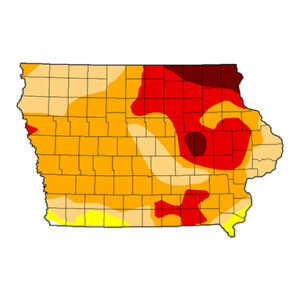
The U.S. Drought Monitor shows roughly half of Marshall County -- the north and east sections -- in a "severe" drought. The north and east part of the county entered a "severe" drought within the last week. With severe drought, corn yields are significantly lower and livestock are stressed. Surface water levels are low, and it is encouraged to conserve water.
The other half of Marshall County -- the south and west sections -- are in a "moderate" drought. A moderate drought brings brown grass, higher risk of grass fires and struggling corn crops.
Compared to three weeks ago, the "severe" drought area was only "moderate." The current "moderate" drought area was considered "abnormally dry." Those previous drought conditions were consistent during the last 12 months in Marshall County.
Meaghan Anderson, Central Iowa field agronomist for the Iowa State University Extension Office, said 20 to 25 inches of water is necessary for Marshall County corn and soybean farmers to recover. The lack of soil moisture has led to an increased rate of crop maturity.
"We need to build our soil reserves," she said. "The water needs to come from the soil, or air, or a combination of both."
In the nine years Anderson has been working for the Extension, she said this is one of the longest droughts, with it starting in 2020. Even though the dryness has waxed and waned, overall she added it is just one big drought. Farmers, she said, need to get out into the field to salvage what they can.
"Get the crop out of the field as soon as possible," Anderson said. "Get started with the harvest."
To help determine whether or not it is the time to harvest corn, she said farmers should scout their fields, determine how dry the corn is, and see how the corn is standing.
Many Marshall County farmers, such as Allen Burt of Marshalltown, have already started harvesting. He decided to start when he saw how the corn was standing, and was concerned about his crop.
"The corn was basically cannibalizing the stalk to feed the grain," Burt said. "I'm trying to get the risky stuff done first."
However, getting the crops in while it is raining is not recommended. Even though this week's rain was welcome, Burt said it did not change conditions much.
"It's still dry," he said. "It is so dry I am actually happy to be interrupted by the rain. We do need rain for fertilizer in the fall."
Burt has primarily harvested his corn, and recently started the soybeans, but he is nowhere near finished. He said the harvest will continue through most of October. So far, the yield results have been varied.
"There's been a crazy amount of variability," Burt said. "I had some places that were surprising, and some that were not good."
On average, though, he said the corn is 20 to 30 bushels lower than the usual yield. Burt does not have an estimate on the soybean yield yet.
Cattle
When a drought hits, crop growers are not the only ones who are affected. Livestock producers feel the impact, as well.
Cattleman Ethan Crow of Green Mountain said he had to change the way he moves his herd. Cattle can only graze in a pasture for so long before they are moved to another. This year, Crow has taken into consideration the size of the water sources, such as creeks.
"Creeks are pretty low," he said. "A couple of tile-fed creeks are bone-dry, like the Mojave Desert. The smaller creeks went bad in the first part of July."
As a result, Crow had to move his cattle through the pastures with the smaller water sources earlier in the year -- before the water dried up.
"Pastures run short," he said. "My hay yields are down. Heavy grass fields -- I will be lucky to get two cuttings. I am trying to figure out ways to work with what I got with a low hay yield."
Crow is not the only cattleman affected, he said. Others have been buying hay from elsewhere and hauling it in. Unfortunately, Crow said they are also dealing with an increase in hay prices as a result of the drought.
"This year is more challenging," he said. "It's harder to hay, and buying is more expensive. But the last three years have been more challenging than previous years."
There are numerous aspects Crow needs to be aware of, and it is difficult to estimate what will happen if not enough water comes.
"I need to pay attention to feed availability," he said. "The real conversation is more serious -- whether to keep cows or sell. We need to think through our feed resources, if our creeks go dry. We need to think through the water strategy, and be aware of things. Conversations are going on with cattlemen, trying to decide whether or not they want to stay and do this. It has been more challenging, but I plan to continue on."
Heat impact
The extreme 100 plus degree heat in August did not help matters, either.
"If we had a full moisture profile, the crops could stand a couple days of 100 degree or more," Anderson said. "It's not good, but it could withstand."
Excessive heat compounds the problems already brought on by long-lasting drought. Crow said some of his cattle died in the first part of August, last part of July.
"I lost one cow and one fat calf," he said. "That was a $2,500 loss from the heat. This is the first year I lost mature animals in such a way. I had a newborn calf that had a heat stroke shortly after birth."
In the 10 years Crow has been raising cattle, he has not experienced such losses.
"I can work with a little bit of heat, but I'm also fighting dryness," he said.
Crow agreed with Anderson on the amount of rain that is necessary to bounce back.
"It's going to take several inches per month to get back up," he said. "That's a lot of wishing, though."
Contact Lana Bradstream at 641-753-6611 ext. 210 or lbradstream@timesrepublican.com.
\