
Rural road names pt. 2: From Eastman to Glick
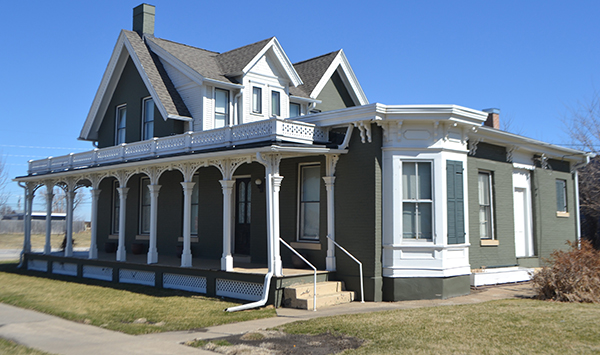
T-R PHOTOS BY MIKE DONAHEY — The Glick-Sower House at 201 E. State St. in Marshalltown is shown. It was built for local developer and entrepreneur Dr. George Glick in 1859. It is a strong representation of upper middle class residences with parquet floors and more. It is on the National Register of Historic Places.
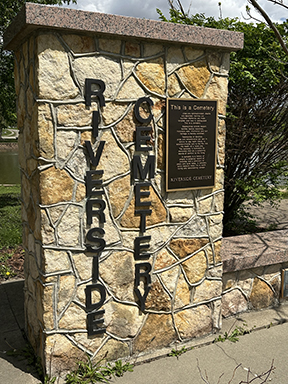
Shown is the Riverside Cemetery sign near its main entrance at 611 N. Center St. Dr. George Glick of Marshalltown was instrumental in co-founding the cemetery in 1863. Glick's name is also on a Marshall County rural road sign.
T-R PHOTOS BY MIKE DONAHEY — The Glick-Sower House at 201 E. State St. in Marshalltown is shown. It was built for local developer and entrepreneur Dr. George Glick in 1859. It is a strong representation of upper middle class residences with parquet floors and more. It is on the National Register of Historic Places.
Shown is the Riverside Cemetery sign near its main entrance at 611 N. Center St. Dr. George Glick of Marshalltown was instrumental in co-founding the cemetery in 1863. Glick's name is also on a Marshall County rural road sign.
Trending
Editor's Note: This is the second in a series of several articles reporting on the names of individuals whose names have been used on rural road signs in rural Marshall County. Names for avenue signs were mandated by the E-911 county system effective June 16, 1986.
Streets were designated numerically.
(Arney, Abbott, Binford, Brown, Canfield and Davidson were reported on in the first story).
Marshall County officials used the year 1847 as a benchmark for avenue names, since the first claim for land in Marshall County was made in that year according to county records.
A further review of county records showed an attempt was made to use names of attorneys, businessmen, farmers -- male and female settlers -- and those who made an impact on the county's initial development.
"The names were taken from the "History of Marshall County 1878," sponsored by the Central Iowa Genealogical Society in Albion," according to county documents. "In addition, a variety of professions were selected. Names used are no reflection on present county residents."
From Eastman to Glick avenues, rural road names for Marshall County roads are as unique as those of their city cousins in Marshalltown.
Some descriptions may be limited due to lack of resources needed at time of press.
Resources used were "The Continuing History of Marshall County 1997," History of Marshall County 1955 " by Gerard Schultz, and "Marshalltown Illustrated." The latter is not dated and was published as a supplement to the Times-Republican under the supervision of the Marshalltown Retail Merchants Association. Also used was the "History of Marshall County, Iowa, 1867" and social media references.
Arney Avenue begins on the western edge of Marshall County bordering Story County and subsequent avenues proceed east to Zeller which borders Tama County.
Listed below is the last name only on road signs followed by a brief description of the individual.
Eastman: Railroad Agent
No information. However, archives report the first train – the Cedar Rapids and Missouri River Railroad – arrived in Marshalltown March 11, 1863. Over the years, Marshalltown would become a major railroad hub with the Iowa Central Railroad, Chicago & Northwestern Railroad and Minneapolis & St. Louis having major operations locally.
Edwards: Farmer
No information.
Fairman: Farmer
No information.
Frederick: Foundry Owner
B.T. Frederick is listed as the operator of the Marshall Foundry & Machine Shop in Marshalltown before selling the property to A. E. Shorthill in 1865. Frederick is also listed with other community leaders as part of a dedication in "Schultz's History of Marshall County, 1955." It reads: "To the memory of these pioneers and their contemporaries who have contributed much to the development of Marshall County, Iowa."
Gerhart: County Treasurer
No record of a Gerhart serving as county treasurer was found in available archives. However, A H. Gerhart is listed as cashier at First National Bank, Marshalltown.
Glick: Bank President
Dr. George Glick was president of the First National Bank in Marshalltown. His name is synonymous with Marshalltown's and Marshall County's early and subsequent development, along with Abbott, Anson and Woodbury. In addition to his medical practice and bank duties, Glick was treasurer of the Marshalltown Independent School District. It was formed after the district separated from Marshall County schools in 1864. Glick School on South Third Avenue was named in his honor. It was one of several "neighborhood" schools built by the district. It closed in 1996. The building was razed and the site is now occupied by housing units. Glick was also instrumental in the creation and development of Marshalltown's iconic Riverside Cemetery with Rev. Louis DeLoss of the Presbyterian Church. The Marshalltown Cemetery Association was founded April 2, 1863 and reorganized in 1883 according to archives.