
Rural road names pt. 5 — Oxford Avenue: Named for a former village?
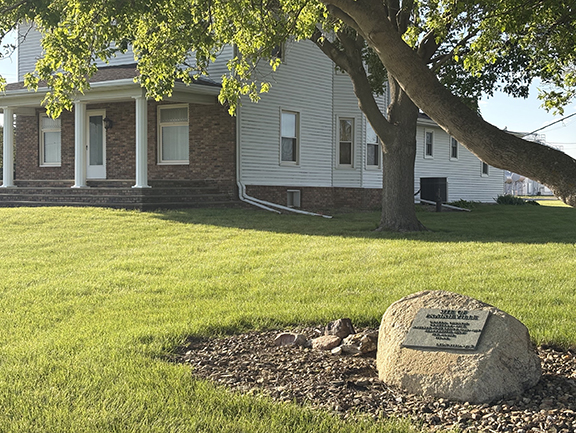
PHOTOS BY GARRY BRANDENBURG — Shown is a stone marker recently identifying the site of the former village of Prairieville in Marshall County. It is near the intersection of 145th Street and Reed Avenue. A cemetery not far away is the only remnant of the village.
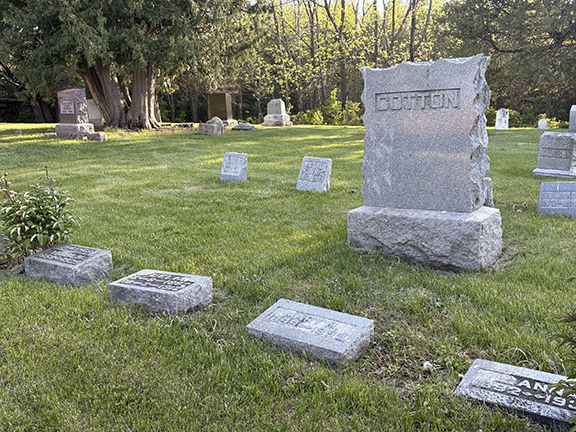
Prairieville Cemetery is shown earlier this week. It is near the intersection of 145th Street and Reed Avenue. The cemetery has many headstones identifying members of the Maulsby families. The former Prairieville village occupied a site nearby from 1898 to 1914.
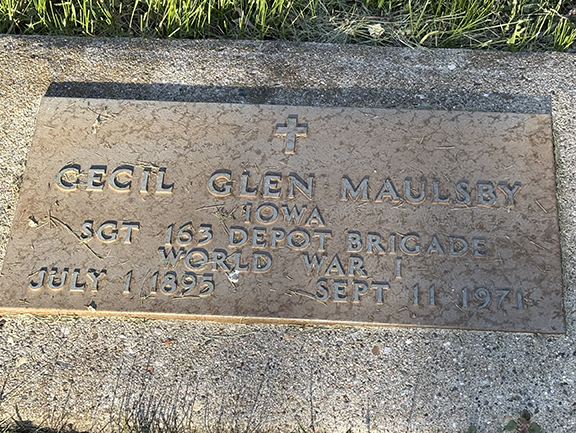
Shown recently is the headstone of Cecil Glen Maulsby in the Prairieville Cemetery. A WWI veteran, he was born in 1895 and died Sept. 11, 1971. The former village of Prairieville was nearby.
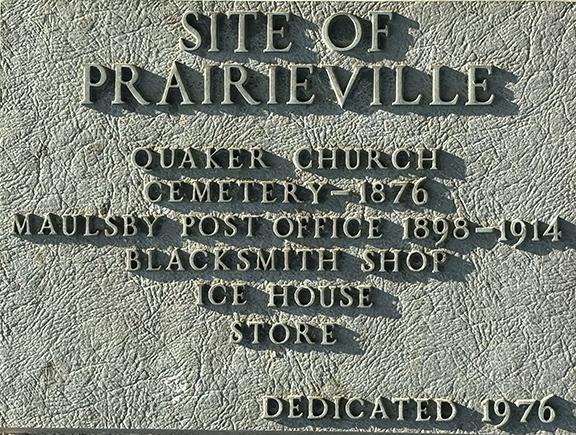
Pictured earlier this week is a stone marker identifying the site of the former village of Prairieville near the intersection of Reed Avenue and 145th Street. The Maulsby Post Office was located there from 1898 to 1914, according to the marker.
PHOTOS BY GARRY BRANDENBURG — Shown is a stone marker recently identifying the site of the former village of Prairieville in Marshall County. It is near the intersection of 145th Street and Reed Avenue. A cemetery not far away is the only remnant of the village.
Prairieville Cemetery is shown earlier this week. It is near the intersection of 145th Street and Reed Avenue. The cemetery has many headstones identifying members of the Maulsby families. The former Prairieville village occupied a site nearby from 1898 to 1914.
Shown recently is the headstone of Cecil Glen Maulsby in the Prairieville Cemetery. A WWI veteran, he was born in 1895 and died Sept. 11, 1971. The former village of Prairieville was nearby.
Pictured earlier this week is a stone marker identifying the site of the former village of Prairieville near the intersection of Reed Avenue and 145th Street. The Maulsby Post Office was located there from 1898 to 1914, according to the marker.
Trending
Editor's Note: This is the fifth in a series of articles reporting on Marshall County residents of the mid to late 1800s whose names are posted on rural avenue road signs.
Last names - and those of former towns or villages – were mandated by the E-911 county system. They were approved unanimously by the Marshall County Board of Supervisors in a June 16, 1986 resolution.
Joseph Armbrecht, chairman of the board, signed the resolution and it was attested to by Sherrill Snider, county auditor, according to county documents.
County officials used the year 1847 as a benchmark for avenue names, since the first claim for land in Marshall County was made then according to county records.
"The (avenue) names were taken from the "History of Marshall County 1878," sponsored by the Central Iowa Genealogical Society in Albion," according to documents. Names used are no reflection on present county residents."
A further review of records showed an attempt was made to use last names of attorneys, businessmen, farmers, female and male settlers, Civil War veterans and those who made an impact on Marshalltown and Marshall County's early development.
There were three exceptions.
The first was Lafayette Avenue - named for the town later renamed Albion.
A second exception was Oxford Avenue – reportedly named for the former town according to documents.
A third is Prairie Avenue - also reportedly named for the former village of Prairieville.
A special thanks to Marshall County Auditor/Recorder Nan Benson – her colleague Sara Badger – and to county GIS Specialist Melanie Ewalt for their assistance in searching for and authenticating E-911 documents.
Resources used for this series have been the "History of Marshall County, Iowa, 1867," "History of Marshall County, 1887," "History of Marshall County 1955 by Gerard Schultz," "The Continuing History of Marshall County 1997," and "Marshalltown Illustrated." The latter is not dated and was published as a supplement to the Times-Republican under the supervision of the Marshalltown Retail Merchants Association.
Reader Shelley Barron commented recently on the series:
"Just a clarification and correction to (the) article about county road names," she wrote in an email to the T-R recently. "Article stated east west roads are labeled streets and are numerical. It might have been helpful stating they begin at the north county line with 100th Street.
Oxford: Neighboring town
"Oxford, we hardly knew ye," is a play on words and with apologies to authors Joe McCarthy, Kenneth O'Donnell and David Powers for liberties taken from the title of their 1972 book "Johnny We Hardly Knew Ye."
The book details their memoirs about working with the late president John F. Kennedy in Boston and Washington, D.C. They in turn took the title from a centuries-old Irish ballad.
Regardless, skilled researcher, historian and Historical Society of Marshall County (HSMC) library assistant Dorie Tammen said she was unsuccessful in finding information about a town (or township) named Oxford in Marshall County. There is no listing for an individual named Oxford or a former town of that name in the index of the "History of Marshall County, Iowa, 1878" - the source for avenue names according to county documents. However, there is the town of Oxford in Johnson County.
Parker: Lawyer
J.M. Parker was born in 1838 in Pickaway, Co., Ohio. He later resided in Illinois. While a resident there, he enlisted in the Union Army during the Civil War and fought in a number of battles. He served three years and was wounded. Parker moved to State Center - (spelled Centre in some publications) in 1865 and then to Marshalltown that same year. He completed his law studies and was admitted to the bar in 1866. He served as Marshalltown's mayor for three terms and represented the county in the 17th general assembly. He held other town and school offices. He married Ms. M.J. Webster from La Porte Ind., and from that union were born four daughters.
Prairie: From Prairieville/Town
Google lists it as an early village platted in 1855 in the northwest corner of Section 16, Marion Township near present day Albion. Prairieville was abandoned and removed after the arrival of the Great Western Railroad in 1883. However, the Marshall County Atlas of 1871 has no listing of the village. Times-Republican columnist/photographer Garry Brandenburg - a longtime Albion resident - merits thanks for confirming the village did exist with a blacksmith shop, cemetery, a Quaker Church and post office. He took a photo of a stone documenting the village site near the intersection of Reed Avenue and 145th Street. The site was dedicated in 1976.
Reed: Minister
Rev. Isaiah Reed was pastor for 18 months at a Lutheran church possibly in Albion. The church had previously been of the Presbyterian denomination when organized in 1856. It transitioned to Lutheran in 1861.
Sanford: Military Officer
Col. James P. Sanford was born in 1832 in Seneca, N.Y. He traveled to South America, the West Indies in Mexico beginning in his mid-teens and through early adulthood. He returned to the United States and enrolled at the University of Iowa in 1858. Later, he enlisted in the military during the Civil War and served in several Iowa regiments. He rose to the rank of colonel. After resigning from the military, he continued his world travels and was renowned for crossing the Atlantic ocean 15 times and visiting many countries. He married Ms. Callie Wright of Fort Madison in 1860. From this union they bore a son, George. Sanford had a daughter Martha from a previous marriage.